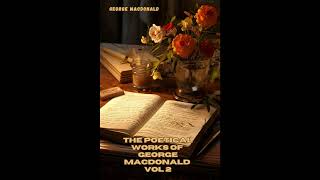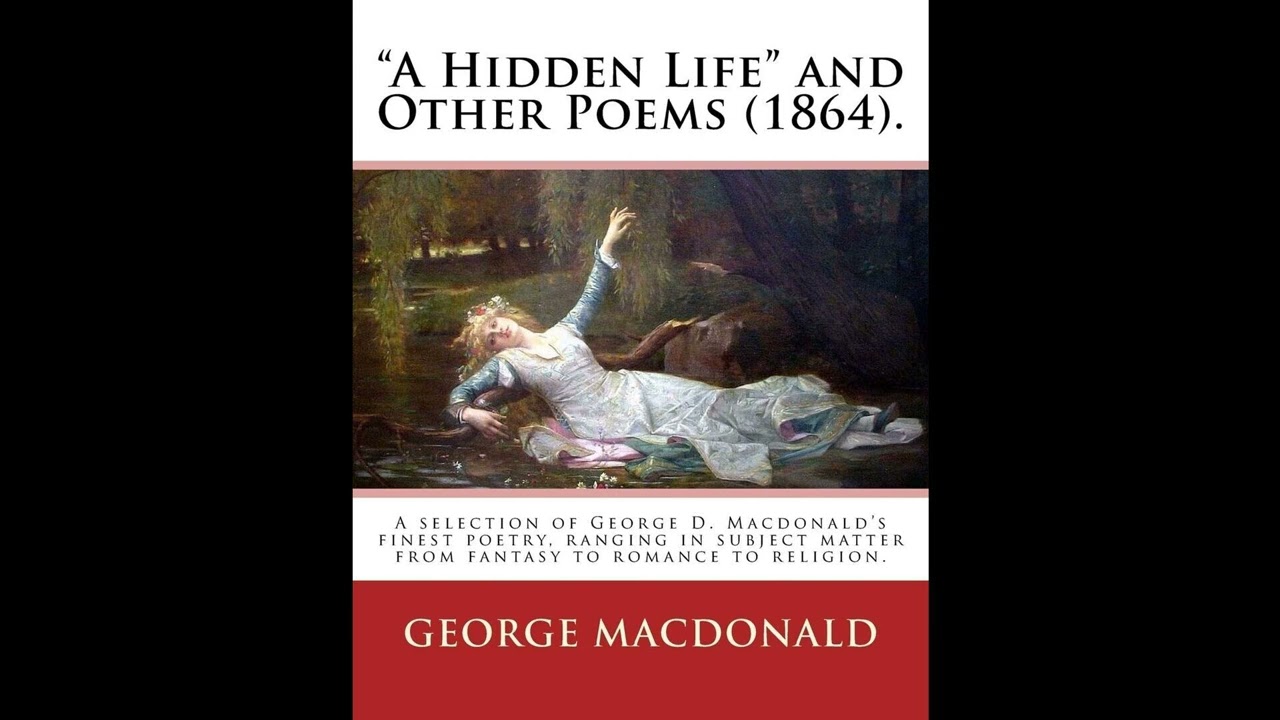
"A Hidden Life" and Other Poems (1864). By: George MacDonald: A selection of George
Step into a quiet corner of the Victorian soul with George MacDonald's "A Hidden Life" and Other Poems (1864), a collection that offers far more than mere verse; it presents an intimate communion with a mind wrestling with faith, doubt, and the profound beauty of existence. In an age increasingly defined by industry and scientific discovery, MacDonald's poetry served as a vital wellspring of spiritual and imaginative sustenance, beckoning readers to look beyond the material and discover the rich, unseen dimensions of life. These poems, lyrical and deeply reflective, resonate even today with anyone seeking meaning, solace, or a deeper connection to the divine amidst the clamor of the modern world. They invite a reflective pause, a chance to hear a voice that speaks with both the gentle wisdom of a sage and the tender questioning of a seeker. While a traditional plot with unfolding events and named characters might not define a poetry collection, "A Hidden Life" and Other Poems sketches an overarching narrative of the human spirit's journey through its inner landscape. The titular poem, "A Hidden Life," sets a contemplative tone, presenting a speaker who finds profound significance in an existence lived not for worldly acclaim, but in quiet devotion and communion with higher truths. We witness the unfolding of a spiritual narrative, often characterized by a retreat from the bustling world into the sanctuary of nature or the quiet chamber of the heart, where the divine presence is most keenly felt. Across the various poems, the "main character" is often a reflective soul, grappling with questions of purpose, suffering, and the nature of God's love. The central conflict frequently arises from the tension between external realities—the pressures of society, the inevitable pains of life, the intellectual challenges to faith—and the speaker's unwavering internal conviction, or at times, their struggle to maintain it. There is an arc that moves from moments of poignant questioning and melancholy to bursts of joyous affirmation and profound spiritual insight. Throughout the collection, recurring images of light and shadow, the grandeur of the Scottish landscape, and the simple beauty of everyday life serve as touchstones for this internal drama, guiding the listener through a deeply personal and universally resonant experience of seeking and finding spiritual solace. George MacDonald (1824-1905), the brilliant Scottish author, stands as one of the most significant, though sometimes underappreciated, literary figures of the Victorian era. Born in Huntly, Aberdeenshire, into a deeply Calvinist family, his early life was marked by both academic promise and a burgeoning spiritual curiosity that would eventually lead him to question the strict doctrines of his upbringing. After studying at King's College, Aberdeen, and Highbury College, London, he initially served as a Congregational minister, but his increasingly unorthodox views, particularly his belief in a universal divine love and rejection of predestination, led to his resignation. He then turned to writing and lecturing, establishing himself as a prolific author across various genres. MacDonald is perhaps best known today for his pioneering contributions to fantasy literature, influencing literary giants such as C.S. Lewis and J.R.R. Tolkien, who recognized his unique ability to imbue fantastical tales with profound spiritual allegory. His notable works include the whimsical fairy tales Phantastes (1858), The Princess and the Goblin (1872), and At the Back of the North Wind (1871), as well as the darker, more complex psychological fantasies Lilith (1895). However, his extensive output also encompassed numerous realistic novels, essays, and, significantly, poetry. Throughout his varied career, MacDonald remained committed to presenting a vision of God's benevolent and all-encompassing love, often through the lens of myth and imagination, carving out a unique and enduring place in the literary canon. The poems in "A Hidden Life" illuminate several core themes central to MacDonald's worldview. Foremost among these is the concept of a Quiet, Interior Faith. The titular poem itself perfectly enacts this, describing a life lived for spiritual connection rather than worldly recognition, finding strength and meaning in unseen communion with the divine. For instance, many verses speak of finding God in the stillness of nature or the solitude of the heart, echoing sentiments like "Better be than seem," emphasizing inner truth over outward show. Another prominent theme is the Redemptive Power of Divine Love, often presented as a paternal, all-encompassing force that gently guides and corrects rather than condemns. MacDonald’s own wrestling with rigid Calvinist doctrine frequently surfaces, resulting in poems that voice doubt and spiritual anguish only to find ultimate comfort in a God of boundless mercy, such as those lines that speak of a "love that will not let me go." Furthermore, the collection often underscores Nature as a Pathway to Revelation. MacDonald's deep connection to his Scottish homeland imbues his poetry with vivid natural imagery – windswept mountains, flowing streams, starry nights – which serve not merely as settings, but as living symbols of divine presence and instruction. A stanza might describe a particular vista as a "sacred scroll" revealing God’s handiwork, connecting the physical world directly to spiritual understanding. Finally, a pervasive thread of Childlike Innocence and Wonder weaves through the verses, suggesting that a simple, open heart, akin to a child's, is best equipped to perceive spiritual truths. There are often poignant reflections on the purity of youth or a yearning for a return to an unburdened spiritual state, highlighting the preciousness of an unadorned trust in God's goodness. The publication of "A Hidden Life" and Other Poems in 1864 places it squarely in the mid-Victorian period, a time of profound societal and intellectual upheaval. The industrial revolution had reshaped landscapes and social structures, while scientific advancements, particularly Charles Darwin's On the Origin of Species (1859), challenged traditional religious frameworks. This era witnessed a significant rise in spiritual questioning and doubt, leading many to seek new forms of assurance and meaning. MacDonald's poetry emerged as a crucial response to this cultural ferment. His work offered a humane, imaginative, and deeply compassionate alternative to the more rigid theological interpretations of the day, emphasizing a benevolent God and the power of individual spiritual experience. It provided a much-needed voice of comfort and profound reflection for those navigating a world rapidly changing both physically and philosophically, yearning for a spiritual anchor in turbulent times, drawing on Romantic sensibilities while looking towards a more modern, psychological understanding of faith. Listening to "A Hidden Life" and Other Poems as an audiobook offers a uniquely intimate and powerful experience. The lyrical quality of MacDonald's verse truly comes alive when spoken, allowing the listener to fully appreciate the rhythm, meter, and subtle emotional nuances woven into each line. A skilled narrator can bring out the quiet gravitas, the tender questioning, and the soaring moments of spiritual joy, guiding the listener through the text's layers of meaning with appropriate pacing and vocal sensitivity. The collection's several hours of runtime provide ample opportunity for sustained immersion, making it an ideal companion for moments of quiet reflection, contemplative walks, or simply unwinding after a busy day. The carefully modulated voice and the natural pauses can highlight the philosophical depth and spiritual reassurance, creating an atmosphere that encourages thoughtful engagement with these enduring works of devotion and imagination.
Enjoyed "A Hidden Life" and Other Poems (1864). By: George MacDonald: A selection of George? A few ways to support us
Audible & Amazon links are affiliate; we may earn a small commission at no extra cost.
About this production
Human narration by a volunteer reader from LibriVox.org, the public-domain audiobook project. LibriVox volunteers record literary works whose copyright has expired in the United States, releasing the resulting recordings into the public domain.
"A Hidden Life" and Other Poems (1864). By: George MacDonald: A selection of George by George MacDonald. The underlying text is in the U.S. public domain. We do not republish any modern copyrighted edition, translation, or commentary.
The 4K cinematic visuals accompanying this audiobook are generated by an AI image model from prompts derived from the source text. No copyrighted photos, paintings, or stock footage are used. AI generation is disclosed on every video on our YouTube channel as required by YouTube's altered/synthetic content policy.
English subtitles are transcribed from the LibriVox recording with OpenAI Whisper. Translations into the 11 other supported languages are produced by Meta's NLLB-200 neural translation model. No human translator's copyrighted translation is used.
Questions about sourcing or rights? See our DMCA & Sourcing policy or contact us.
Enjoyed this audiobook?
If you'd like to own a copy of "A Hidden Life" and Other Poems (1864). By: George MacDonald: A selection of George or hear a professionally produced edition, the links below help support free audiobook production at no extra cost to you.
As an Amazon Associate we earn from qualifying purchases. Audible / print links are affiliate.