Sketches and Studies
Step into the evocative world of Nathaniel Hawthorne with Sketches and Studies, a collection that offers an intimate look into the mind of one of America's most profound literary figures. Far from a single sprawling narrative, this assemblage presents a series of snapshots, reflections, and short fictions, each a polished gem offering a unique facet of Hawthorne's genius. Why should a listener engage with these varied pieces today? Because within these pages – or rather, within these hours of spoken performance – lies a direct connection to the enduring questions of human nature, history's persistent grip, and the subtle interplay of light and shadow that define the American spirit, all observed through the keen, often melancholic, gaze of a master stylist whose insights remain as piercing and relevant now as when they were first penned. This collection, rather than following a singular storyline, invites the listener to wander through a richly varied landscape of thought and imagination. You will encounter vignettes set in dusty New England villages, where the echoes of Puritan ancestors still resonate in the lives of their descendants. The "characters" are often ordinary folk, but Hawthorne's perception elevates them, revealing the hidden currents of their souls—a lonely scholar in his study, a traveler observing a quaint roadside inn, or a historical figure brought vividly to life through careful research and artistic license. The settings shift from the quiet, contemplative corners of his native Salem to the bustling streets of European cities he visited later in life, and even to the untamed wilderness where nature's vastness prompts philosophical musings. Across these varied canvases, a central thread emerges: Hawthorne's fascination with the moral and psychological underpinnings of human existence, often manifesting as a quiet conflict between societal expectations and individual conscience, between the seen and the unseen, the past and the present. Each piece, whether a character sketch or a more developed tale, presents a moment of introspection, a slice of life rendered with meticulous detail and a profound sense of the underlying currents of human experience. Listeners should expect to be transported from the intimate confines of a solitary room, where the author wrestles with the act of writing, to the bustling environment of a customs house, where he observes the daily rhythms of mundane life, each observation imbued with his signature depth. Some pieces are purely observational, akin to literary journalism, while others veer into the realm of the subtly supernatural, where the veil between the ordinary and the uncanny is momentarily lifted. The arc of this "story" is not linear but thematic, allowing for sudden shifts in mood and focus, moving from a gentle rumination on a forgotten historical event to a sharp, satirical commentary on contemporary society, or a poignant reflection on art and its power. Throughout, the overarching tension is the human struggle to reconcile one's inner self with the demands of the outer world, a conflict often played out in the quiet corners of the heart or the subtle expressions of a face, rather than in grand dramatic gestures. Nathaniel Hawthorne (1804-1864) stands as a towering figure in the landscape of American letters, a true pioneer of the psychological novel and the allegorical short story. Born in Salem, Massachusetts, his familial ties to the infamous Salem Witch Trials – his ancestor, Judge Hathorne, was a presiding magistrate – indelibly shaped his artistic sensibility and provided a recurring thematic wellspring for his fiction, particularly his preoccupation with ancestral guilt and the weight of history. After graduating from Bowdoin College alongside figures like Henry Wadsworth Longfellow and future President Franklin Pierce, Hawthorne spent a decade of self-imposed solitude, honing his craft by writing numerous short stories, many of which would later appear in collections such as Twice-Told Tales. His professional life saw him hold various government positions, including working at the Boston Custom House and later as the American Consul in Liverpool, appointments secured through political connections, notably with President Pierce. These experiences, though at times mundane, offered him a keen observational perch on human character and the machinery of society, which he skillfully wove into his narratives. He was briefly involved with the Transcendentalist utopian community of Brook Farm, an experience he later fictionalized in The Blithedale Romance. Hawthorne's most famous works, including The Scarlet Letter (1850), The House of the Seven Gables (1851), and The Marble Faun (1860), cemented his reputation as a key figure of American Romanticism, particularly its darker strain, often referred to as Dark Romanticism, which contrasted sharply with the more optimistic tenets of Transcendentalism. His enduring place in the canon is secured by his profound moral vision, his lyrical prose, and his masterful ability to probe the hidden motivations and secret sorrows of the human heart. The pieces within Sketches and Studies frequently return to several core concerns that illuminate Hawthorne's distinctive literary voice. One prominent theme is the enduring power of the past, particularly the Puritan legacy, to shape the present. He shows how ancestral deeds and the moral strictures of earlier generations can cast a long shadow over individuals and communities, often manifesting as a lingering sense of guilt or a burden of inherited sin, even for those who consciously try to escape it. For instance, in a description of an ancient, weather-beaten house, he might imbue its decaying timbers with the spectral presence of former inhabitants, suggesting that the very stones absorb the history they witness. Another recurring theme is the deceptive nature of appearance versus reality. Hawthorne consistently encourages the listener to look beyond superficial impressions, to question the outward composure of characters, and to discern the often-unsettling truths that lie beneath polished exteriors or conventional facades. He masterfully uses allegorical elements to hint at deeper meanings, turning an ordinary object or a fleeting encounter into a symbol of a larger spiritual or psychological truth. Furthermore, these sketches often meditate on the nature of art and imagination itself, with Hawthorne frequently reflecting on the creative process, the role of the artist in society, and the way the mind transforms observation into narrative. He uses seemingly simple descriptions – of a landscape, a building, or a person – as springboards for profound philosophical questions, blurring the lines between objective reporting and subjective interpretation. This collection also enacts the theme of isolation and the human yearning for connection, often portraying characters who are set apart by some secret, some eccentricity, or simply by their own introspective nature, highlighting the universal struggle for belonging and understanding within a sometimes indifferent world. This collection emerged during a fascinating period in American history, roughly spanning the 1830s through the 1860s. It was a time of intense national self-definition, where America was forging its own literary identity, distinct from its European predecessors. Culturally, the legacy of Puritanism still held sway in New England, even as the nation grappled with rapid industrialization, westward expansion, and the escalating tensions that would ultimately lead to the Civil War. Hawthorne, living in the crucible of this change, often observed the clash between old traditions and new ambitions. While his contemporaries like Ralph Waldo Emerson and Henry David Thoreau were championing Transcendentalism's optimistic view of human perfectibility and nature's divinity, Hawthorne offered a counterpoint. His writings often presented a more somber, realistic assessment of human fallibility, the corrupting influence of power, and the indelible stain of original sin, grounding his supernatural elements not in whimsy, but in a deep psychological truth. These sketches, therefore, can be seen as his ongoing engagement with the moral and social currents of his era, experiments in form and subject matter that allowed him to refine the themes and techniques that would define his most celebrated novels. Listening to Sketches and Studies as an audiobook offers a unique entry point into Hawthorne's intricate prose and contemplative spirit. The narrator's voice becomes crucial in conveying the subtle shifts in tone, moving seamlessly from the detached observation of an essayist to the hushed tension of a nascent gothic tale. With a run length of several hours, this collection is perfectly suited for focused listening over extended periods or for absorbing individual pieces during shorter commutes. Pay attention to the narrator's pacing, which can beautifully underscore Hawthorne's measured descriptions, allowing the listener to fully absorb the rich detail and the underlying philosophical implications of each passage. The delivery of dialogue, though less frequent than in a novel, helps to distinguish characters and imbue them with life, while the overall atmosphere created by the narration enhances the often melancholic, reflective, or subtly eerie moods Hawthorne so masterfully evokes. It is a chance to let Hawthorne's precise language and profound insights wash over you, bringing his world to vivid, auditory life.
Enjoyed Sketches and Studies? A few ways to support us
Audible & Amazon links are affiliate; we may earn a small commission at no extra cost.
About this production
Human narration by a volunteer reader from LibriVox.org, the public-domain audiobook project. LibriVox volunteers record literary works whose copyright has expired in the United States, releasing the resulting recordings into the public domain.
Sketches and Studies by Nathaniel Hawthorne. The underlying text is in the U.S. public domain. We do not republish any modern copyrighted edition, translation, or commentary.
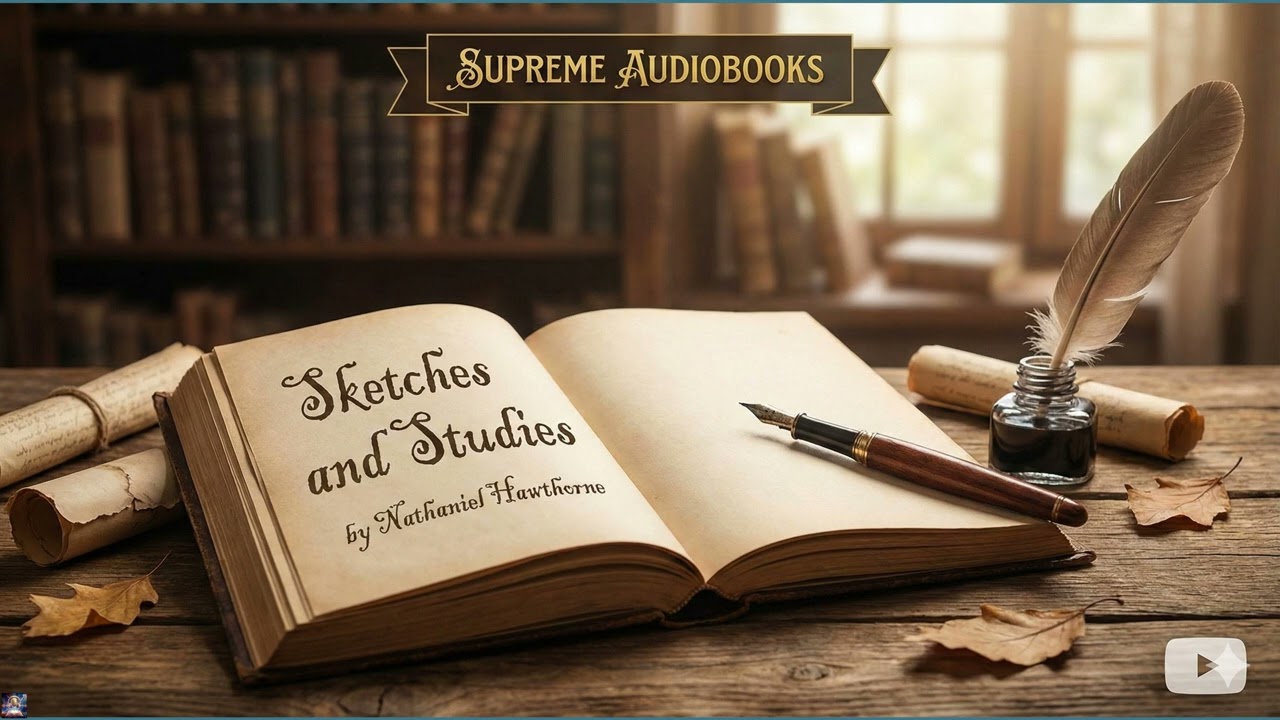
The 4K cinematic visuals accompanying this audiobook are generated by an AI image model from prompts derived from the source text. No copyrighted photos, paintings, or stock footage are used. AI generation is disclosed on every video on our YouTube channel as required by YouTube's altered/synthetic content policy.
English subtitles are transcribed from the LibriVox recording with OpenAI Whisper. Translations into the 11 other supported languages are produced by Meta's NLLB-200 neural translation model. No human translator's copyrighted translation is used.
Questions about sourcing or rights? See our DMCA & Sourcing policy or contact us.
View 10 famous quotes from this book →
Enjoyed this audiobook?
If you'd like to own a copy of Sketches and Studies or hear a professionally produced edition, the links below help support free audiobook production at no extra cost to you.
As an Amazon Associate we earn from qualifying purchases. Audible / print links are affiliate.