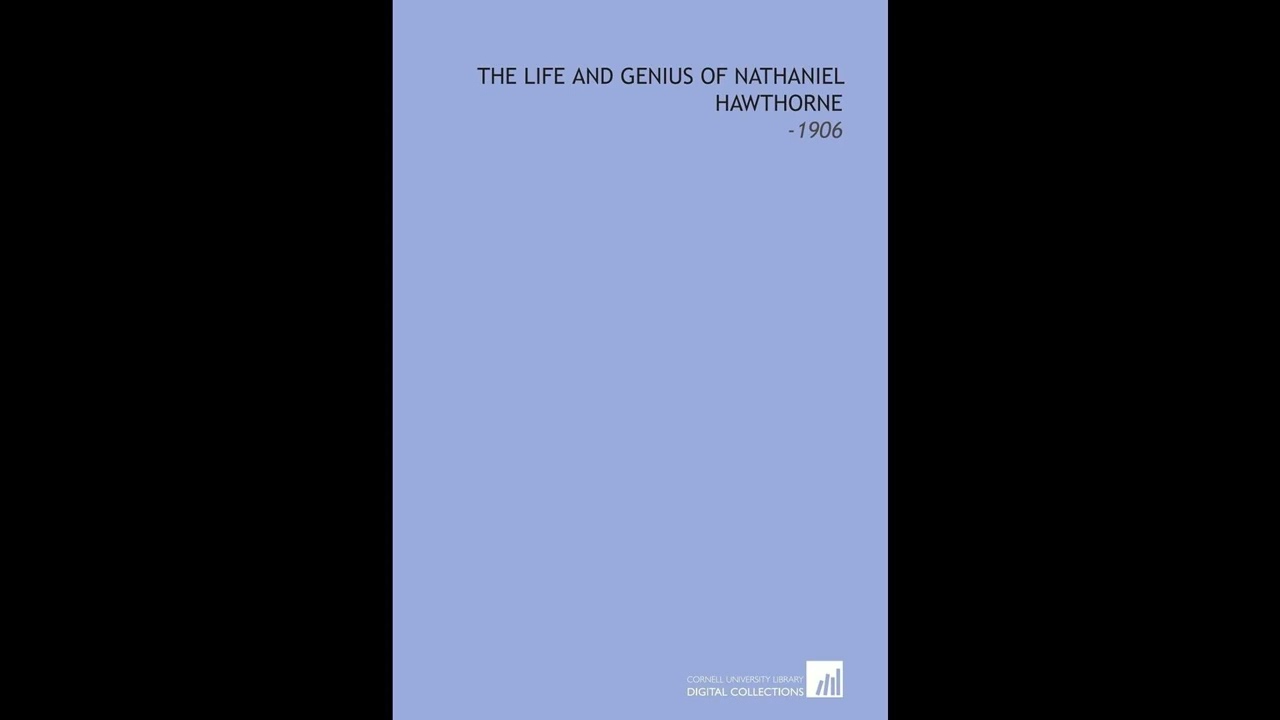
The Life and Genius of Nathaniel Hawthorne
Step into the intellectual landscape of nineteenth-century America with Frank Preston Stearns's "The Life and Genius of Nathaniel Hawthorne," a foundational biographical work that offers an intimate look at one of the nation's most profound literary figures. This audiobook is more than a simple recounting of facts; it is a thoughtful critical appreciation penned by a contemporary who witnessed the unfolding of American letters and culture. For anyone seeking to understand the enduring power of Hawthorne's fiction, the complex currents of New England thought, or simply the making of a literary mind, Stearns provides an essential lens, presenting Hawthorne not as a static historical artifact but as a dynamic force still shaping our understanding of human nature and the American experience. Stearns meticulously traces the often reclusive life of Nathaniel Hawthorne, beginning with his birth in the ancient seaport of Salem, Massachusetts, a town steeped in Puritan history and maritime lore that would forever cast a shadow over his imagination. The author details Hawthorne's solitary youth, spent in introspection and voracious reading after the early death of his father, an experience that instilled in him a deep well of observation and a quiet remove from the world. We follow him to Bowdoin College, where he forged lifelong friendships with future luminaries like Henry Wadsworth Longfellow and future President Franklin Pierce, connections that would prove vital to his personal and professional life. Stearns recounts Hawthorne's "twelve dark years" following graduation, a period spent largely in his mother's house, honing his craft in relative obscurity, producing tales and sketches that, while largely unacknowledged at the time, laid the groundwork for his eventual brilliance. The narrative shifts to Hawthorne's emergence into the public eye, first through his various government appointments at the Boston and Salem Custom Houses, positions that provided both financial stability and invaluable insight into the characters and customs of his era. His marriage to Sophia Peabody, a woman of profound artistic sensibility, is presented as a transformative event, pulling him from his solitude and anchoring him in a vibrant intellectual circle in Concord. Stearns chronicles the blossoming of Hawthorne's genius during this period, culminating in the publication of "The Scarlet Letter," a work that catapulted him to national fame and established his unique voice. This biography paints a vivid portrait of an artist grappling with his Puritan heritage, the moral complexities of his society, and the subtle workings of the human heart, all while striving to create a distinct American literature. Frank Preston Stearns, born in Massachusetts in 1846 and passing in 1917, was an astute observer and critic of American culture, belonging to a generation that inherited the legacy of the Transcendentalists and Romantics while also looking forward to a rapidly changing industrial age. The son of a prominent Unitarian minister, Stearns grew up immersed in the intellectual ferment of New England. He pursued studies in art and literature, becoming known as a thoughtful essayist and biographer. His body of work includes biographical studies of significant figures such as Ralph Waldo Emerson, Walt Whitman, and Abby May Alcott, solidifying his place as a meticulous chronicler of 19th-century American intellectual life. Stearns’s perspective is that of a scholar deeply conversant with the literary and philosophical currents of his time, offering a viewpoint both learned and deeply personal when interpreting the lives of those who came just before him. Through Stearns's keen analysis, several enduring aspects of Hawthorne's "genius" shine forth. One prominent idea is the profound influence of Puritan guilt and its legacy on the American psyche. Stearns shows how Hawthorne, deeply rooted in Salem’s history, wrestled with ancestral sin and the moral hypocrisy he perceived in society, a struggle most powerfully embodied in his creation of Hester Prynne and Arthur Dimmesdale in "The Scarlet Letter." Another key thread is the artist's isolation and the quest for recognition. Stearns sensitively details Hawthorne’s own periods of withdrawal and the difficulty he faced in gaining literary prominence, illustrating how these personal experiences often informed the solitary, contemplative nature of his characters and his persistent questioning of societal norms. Furthermore, Stearns highlights Hawthorne's ongoing engagement with American identity and history, particularly the tension between the inherited past and the striving present. He demonstrates how works such as "The House of the Seven Gables" serve as allegories for the decay of old New England aristocracy and the emergence of a new American character, forever tethered to its origins. Finally, the biographer illuminates the interplay of imagination and reality in Hawthorne's narratives. Stearns discusses how Hawthorne masterfully employed allegory, symbolism, and a subtle blend of the real and the fantastic to probe deeper truths, often blurring the lines of perception in stories that feel both historically grounded and wonderfully ethereal, prompting readers to look beyond the surface of everyday life. When Stearns wrote this biography, likely in the late nineteenth or early twentieth century, America was undergoing a period of intense self-reflection and literary canonization. The Civil War had passed, the nation was rapidly industrializing, and there was a growing desire to understand and preserve the cultural heritage that had emerged from the preceding Romantic era. Hawthorne, having passed away in 1864, was already cemented as a pillar of American literature, and Stearns's work contributed to the ongoing project of defining the nation's literary identity. This was a time when biographers and critics sought not just to recount lives but to interpret them, to place them within a larger national narrative, and to extract moral and artistic lessons for future generations. Stearns's biography reflects this era's reverence for its intellectual forebears and its earnest endeavor to understand the forces that shaped their minds and their epochal contributions. To experience "The Life and Genius of Nathaniel Hawthorne" as an audiobook is to immerse oneself in a detailed, contemplative examination of a literary giant. The narrator’s clear, measured voice allows Stearns’s thoughtful prose to unfold with a natural rhythm, bringing to life the historical period and the subtle nuances of Hawthorne’s character. With a run length of several hours, this work is ideal for extended listening sessions – perhaps during quiet reflection or a long commute – allowing the listener to fully absorb the depth of Stearns’s research and interpretation. Pay close attention to the way the narrator conveys Stearns’s particular insights into Hawthorne’s psychological makeup and the intricate connections he draws between Hawthorne's life events and his creative output, transforming what might be a simple historical account into a genuine intellectual companionship.
Enjoyed The Life and Genius of Nathaniel Hawthorne? A few ways to support us
Audible & Amazon links are affiliate; we may earn a small commission at no extra cost.
About this production
Human narration by a volunteer reader from LibriVox.org, the public-domain audiobook project. LibriVox volunteers record literary works whose copyright has expired in the United States, releasing the resulting recordings into the public domain.
The Life and Genius of Nathaniel Hawthorne by Frank Preston Stearns. The underlying text is in the U.S. public domain. We do not republish any modern copyrighted edition, translation, or commentary.
The 4K cinematic visuals accompanying this audiobook are generated by an AI image model from prompts derived from the source text. No copyrighted photos, paintings, or stock footage are used. AI generation is disclosed on every video on our YouTube channel as required by YouTube's altered/synthetic content policy.
English subtitles are transcribed from the LibriVox recording with OpenAI Whisper. Translations into the 11 other supported languages are produced by Meta's NLLB-200 neural translation model. No human translator's copyrighted translation is used.
Questions about sourcing or rights? See our DMCA & Sourcing policy or contact us.
Enjoyed this audiobook?
If you'd like to own a copy of The Life and Genius of Nathaniel Hawthorne or hear a professionally produced edition, the links below help support free audiobook production at no extra cost to you.
As an Amazon Associate we earn from qualifying purchases. Audible / print links are affiliate.