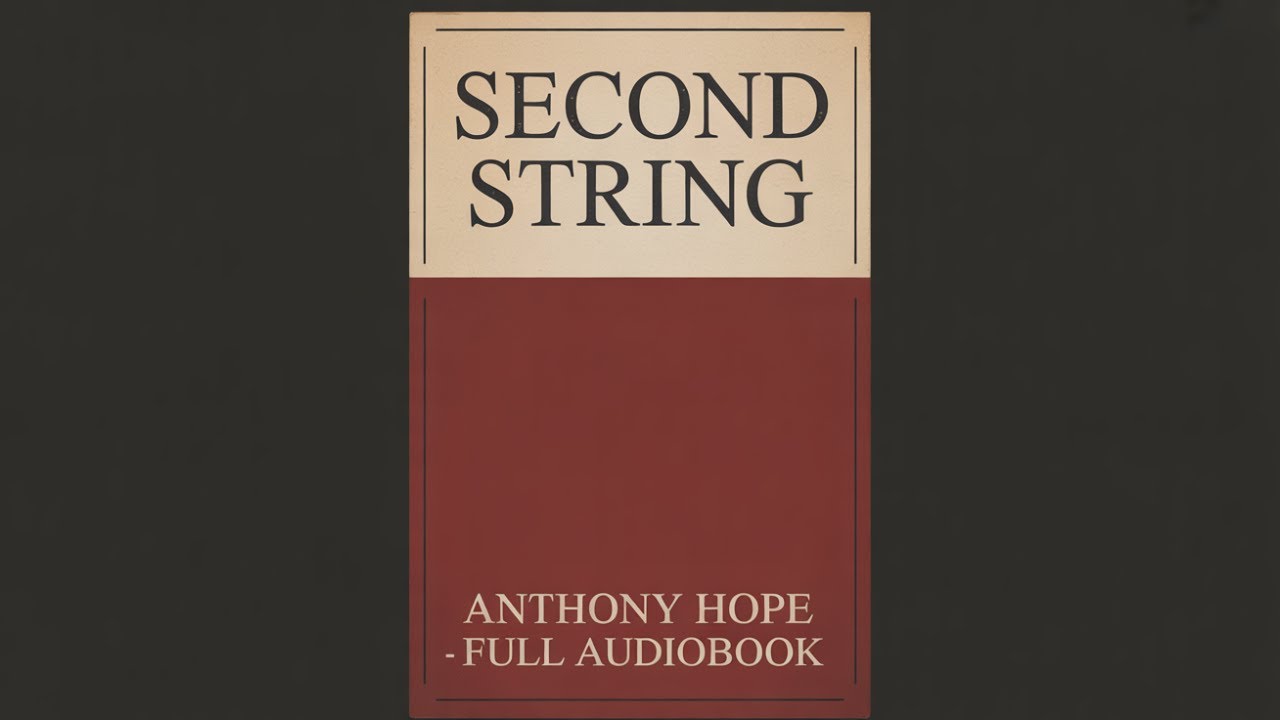
Second String
Anthony Hope’s Second String invites us into the high stakes world of Edwardian British politics and the private lives entwined with public ambition. Far from the swashbuckling adventures of his famous Ruritanian romances, this novel presents a poignant and incisive drama, asking us to consider the true cost of success and the quiet heroism found away from the limelight. It is a story that resonates powerfully today, as we still grapple with the ethical dilemmas faced by public figures, the pressures of maintaining appearances, and the often-unseen sacrifices made in the name of duty or love. This is a tale for anyone who understands that the real battles are often fought not on a grand stage, but within the human heart, testing loyalties, integrity, and the very definitions of winning and losing. The story introduces us to the formidable Gascoyne brothers: Richard, a brilliant and charismatic politician, whose star is rapidly ascending the Westminster firmament, and Herbert, his quieter, more reflective younger brother, a man of considerable talent himself, though perpetually overshadowed by Richard’s dazzling presence. Richard, engaged to the spirited and intelligent Lady Sarah Gayton, seems destined for the highest echelons of power. However, a brewing political scandal threatens to derail his promising career, casting a long shadow over his personal life and reputation. As Richard maneuvers through the treacherous currents of party politics, the narrative deftly exposes the cracks forming beneath his confident exterior. The pressure mounts, and the choices he faces are not merely political, but deeply personal, forcing him to confront the moral compromises inherent in his pursuit of greatness. It is Herbert, the "second string" of the title, who steps forward when his brother's world begins to unravel. Possessing an unwavering loyalty and a deep, unacknowledged affection for Sarah, Herbert finds himself in an impossible position. He works tirelessly, often thanklessly, to protect Richard, his actions driven by a complex mix of fraternal devotion and suppressed personal desire. The unfolding drama forces all three characters—Richard, Herbert, and Sarah—to navigate a delicate web of duty, love, and sacrifice. The novel beautifully portrays the quiet agony of unrequited affection, the burden of public expectation, and the profound impact of one's decisions on those closest to them, all while building towards a tense climax that questions the very nature of success and what it truly means to be a hero. The author, Anthony Hope Hawkins, born in London on February 9, 1863, was a fascinating figure whose literary output spanned both the popular and the profoundly insightful. Educated at Marlborough College and Balliol College, Oxford, where he excelled as a classical scholar, Hope initially pursued a career as a barrister, being called to the bar in 1887. His early legal experiences, though brief, undoubtedly provided him with a keen understanding of human nature, rhetoric, and the intricate workings of society, which would later inform his writing. However, the pull of literature proved stronger, and by the mid-1890s, he had fully committed himself to writing. Hope’s name is most famously associated with the Ruritanian romance, a genre he virtually originated with his wildly successful novel The Prisoner of Zenda (1894) and its sequel Rupert of Hentzau (1898). These tales of adventure, intrigue, and mistaken identity in a fictional European kingdom captivated readers worldwide and remain classics of the form. Yet, Hope was a versatile author whose talents extended far beyond fictional monarchies. He also penned numerous social comedies and dramas, like The Dolly Dialogues (1894), which offered witty and often biting commentary on contemporary manners and relationships. His ability to craft engaging plots, combine suspense with psychological depth, and write sparkling dialogue cemented his place as one of the most beloved and widely read authors of the late Victorian and Edwardian eras, even as his later, more introspective works like Second String revealed a deeper engagement with the complexities of human emotion and societal pressures. He died on July 8, 1933, in Surrey, leaving behind a body of work that continues to entertain and provoke thought. Second String skillfully enacts several enduring themes, providing rich ground for reflection. One prominent theme is the clash between ambition and personal integrity. Richard Gascoyne embodies the politician driven by an almost insatiable desire for power and recognition. We see him weighing the political advantage against the ethical cost, such as when he considers whether to sacrifice a colleague or compromise his own principles to salvage his career. His struggle highlights the constant tension between public aspirations and private morality, a dilemma that continues to plague public life. Another powerful theme is the nature of sibling loyalty and rivalry. Herbert's devotion to Richard, despite his own eclipsed talents and unacknowledged feelings for Sarah, forms the emotional core of the story. His actions, often self-effacing, demonstrate the profound strength and quiet sacrifice inherent in familial bonds, even when shadowed by the disparity in their public personas. The novel also examines the dichotomy of public perception versus private reality. Hope masterfully strips away the polished facade of political life, revealing the vulnerability and human frailty beneath. Richard, the seemingly indomitable statesman, is shown in moments of profound anxiety and indecision, struggling to maintain his composure as his world teeters on the brink. This provides a compelling look at the burden of living a life under constant scrutiny. Finally, the theme of unrequited love and sacrifice runs through the narrative, most poignantly through Herbert's silent adoration for Sarah. His quiet suffering and willingness to put her happiness and Richard's future before his own desires speak to a heroism that is often overlooked in the grander narratives of political triumph. Sarah herself navigates a difficult path, torn between her engagement and her growing awareness of the deeper emotional currents around her. When Anthony Hope published Second String in 1910, Britain was firmly in the Edwardian era, a period often characterized by its outward prosperity and social confidence, yet one also simmering with underlying anxieties. The early years of the 20th century were a time of significant social and political change. The British Empire, though vast, was facing challenges, and internal political debates were growing more intense, particularly around issues of social reform, the increasing power of organized labor, and the fervent campaign for women's suffrage. The public was keenly interested in the machinations of Parliament and the personal lives of its leaders, making a novel centered on political intrigue and social drama particularly resonant. Literary tastes were also evolving, moving away from the more overt moralizing of the Victorians towards a greater interest in psychological realism and nuanced character studies, even as popular adventure stories remained highly sought after. Hope’s ability to combine a gripping plot with insightful observations about human nature and society allowed him to bridge these evolving sensibilities, offering readers both entertainment and genuine intellectual stimulation, reflecting the period's fascination with public duty and private compromise. Listening to Second String as an audiobook offers a unique opportunity to immerse oneself in the refined yet often fraught atmosphere of Edwardian society. A skilled narrator can truly bring Hope's articulate prose and nuanced dialogue to life, capturing the subtle inflections and social cues that define the era. The pacing of the story, with its gradual unveiling of character motivations and the slow burn of its central conflict, is perfectly suited to the audiobook format, allowing the listener to savor each development. You can appreciate the careful construction of Hope's sentences, the wit embedded in seemingly casual conversations, and the emotional weight carried by a character's tone of voice. The several hours of listening provide ample time to delve into the minds of Richard, Herbert, and Sarah, feeling the pressure of political ambition, the quiet pain of unspoken love, and the tension of a looming scandal, all vividly rendered through the power of performance.
Enjoyed Second String? A few ways to support us
Audible & Amazon links are affiliate; we may earn a small commission at no extra cost.
About this production
Human narration by a volunteer reader from LibriVox.org, the public-domain audiobook project. LibriVox volunteers record literary works whose copyright has expired in the United States, releasing the resulting recordings into the public domain.
Second String by Anthony Hope. The underlying text is in the U.S. public domain. We do not republish any modern copyrighted edition, translation, or commentary.
The 4K cinematic visuals accompanying this audiobook are generated by an AI image model from prompts derived from the source text. No copyrighted photos, paintings, or stock footage are used. AI generation is disclosed on every video on our YouTube channel as required by YouTube's altered/synthetic content policy.
English subtitles are transcribed from the LibriVox recording with OpenAI Whisper. Translations into the 11 other supported languages are produced by Meta's NLLB-200 neural translation model. No human translator's copyrighted translation is used.
Questions about sourcing or rights? See our DMCA & Sourcing policy or contact us.
Enjoyed this audiobook?
If you'd like to own a copy of Second String or hear a professionally produced edition, the links below help support free audiobook production at no extra cost to you.
As an Amazon Associate we earn from qualifying purchases. Audible / print links are affiliate.