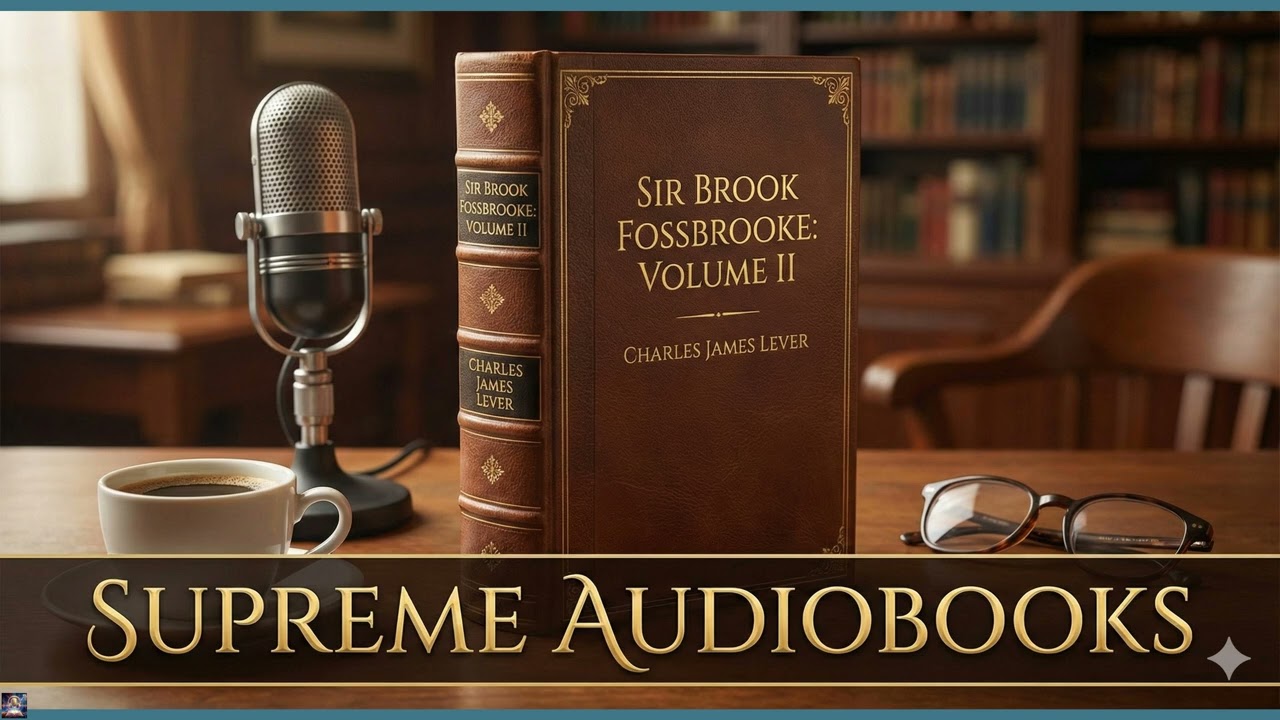
Sir Brook Fossbrooke: Volume II
Step into the layered world of Victorian society with Charles James Lever's Sir Brook Fossbrooke: Volume II, a continuation that deepens the currents of social ambition, personal integrity, and the elusive nature of happiness. This isn't merely a historical novel; it's a keen observation of human nature under the constraints of a rigid era, offering a window into the dilemmas of status, love, and identity that resonate even now. As a character study and a narrative rich with dramatic turns, this second volume invites listeners to witness the consequences of choices made, the weight of reputation, and the enduring charm of a man who sees through the polite deceptions of his world. For anyone seeking to understand the intricate social machinery of the past or simply desiring a story told with wit and discernment, Lever's continuing saga presents a compelling experience. Volume Two plunges us further into the lives entangled around the enigmatic Sir Brook Fossbrooke. The setting drifts between the drawing-rooms of English gentry, the quiet estates of the Irish countryside, and glimpses of continental life—each location a backdrop for the unfolding drama of aspiration and disappointment. Sir Brook himself remains a central figure, a man of unconventional wisdom and quiet influence, whose past hints at both brilliance and hardship. We follow the fortunes of young Tom Lendrick, a decent but somewhat naive gentleman, whose romantic prospects and financial stability are constantly under threat from various machinations and misunderstandings. Lucy, the object of his affection, navigates her own path through societal expectations, her innocence and good heart tested by the pressures around her. The narrative also brings into sharper focus the figures who stand to gain or lose from the outcomes, including shrewd lawyers, ambitious parents, and those who trade on gossip and hidden agendas. The central conflict continues to revolve around identity, inheritance, and the struggle to establish a reputable place within a society obsessed with appearances. Questions of parentage, legitimate succession, and the true value of character versus wealth drive much of the plot. Characters find themselves caught in legal battles, social snubs, and personal betrayals, forcing them to confront their own principles. Sir Brook often acts as a quiet catalyst or an unexpected ally, his unconventional methods frequently cutting through the hypocrisy of others, though not without consequences for himself and those he tries to help. The story progresses through a series of interlocking events—a legal dispute over a will, a challenged engagement, a duel averted—each incident building upon the last to create a complex web of relationships and moral quandaries, always hinting at revelations that promise to alter the course of several lives. Charles James Lever, born in Dublin in 1806, lived a life as varied and international as many of his characters. Initially trained as a physician, a profession that offered him a keen insight into human nature and suffering, he eventually turned his talents to literature. His early career saw him working as a doctor in Ireland and Canada before he settled into a successful writing career, frequently serializing his novels in magazines. Lever served as editor of the Dublin University Magazine from 1842 to 1845, a period that allowed him to shape the literary landscape of his time. He spent much of his later life living abroad, holding diplomatic posts in various European cities like Brussels, Florence, and Trieste, which enriched his understanding of different cultures and human folly. Lever was a prolific author, known for his distinctive "Leverian" novels that often blended adventure, humor, and social commentary. Works such as Charles O'Malley, The Irish Dragoon and Harry Lorrequer cemented his reputation for lively narratives featuring spirited Irish characters, often involved in military life or genteel society. His later novels, including Davenport Dunn and Sir Brook Fossbrooke, demonstrate a move towards more serious social critique and character depth, positioning him alongside contemporaries like Thackeray and Trollope as a chronicler of Victorian mores, albeit with a unique Irish sensibility that tempered his observations with both wit and empathy. Lever passed away in 1872, leaving behind a body of work that continues to provide both entertainment and historical insight. Lever's Sir Brook Fossbrooke enacts several themes relevant to its era and beyond. One prominent theme is the contrast between gentility and genuine integrity. Characters often strive for social acceptance and the appearance of wealth, yet the novel consistently demonstrates that true worth lies in moral character and honesty, rather than inherited status or material possessions. We see this through Sir Brook himself, a man whose seemingly diminished circumstances belie his profound wisdom and unwavering ethical compass, standing in stark contrast to those who possess titles and fortunes but lack honor. Another key theme is the power of reputation and social perception. The fate of several characters hangs precariously on how they are perceived by their peers, highlighting the suffocating pressure of Victorian propriety. For example, a single rumor or a misplaced accusation can threaten to unravel years of careful social climbing or destroy a potential marriage, illustrating how the court of public opinion often overshadowed objective truth. Additionally, the novel examines mentorship and intergenerational influence. Sir Brook acts as a guide, albeit an unconventional one, to younger characters like Tom Lendrick, offering advice that often goes against the grain of societal expectations. These interactions show how wisdom can be imparted, and how younger individuals must ultimately choose their own path, weighing the counsel of elders against their own experiences and desires. Finally, there's a nuanced exploration of Irish identity within the broader British society. While much of the action occurs in England, Lever, as an Irish writer, subtly weaves in perceptions and cultural differences. The resilience and sometimes the impulsiveness of Irish characters, often misunderstood by their English counterparts, provide a quiet counterpoint to the more rigid social codes prevalent elsewhere, adding a layer of cultural commentary that is central to Lever’s distinctive voice. When Sir Brook Fossbrooke first appeared in the mid-19th century, published serially between 1864 and 1866, the Victorian era was in full swing, a time of immense social change and consolidation of empire. The novel emerged during a period marked by a growing middle class, an expanding literary market, and an intense focus on morality, domesticity, and social hierarchy. The novel form itself was thriving, with authors like Charles Dickens, William Thackeray, and Anthony Trollope dominating the literary scene by producing lengthy, often serialized works that reflected and shaped public consciousness. Lever's detailed descriptions of estates, social gatherings, and legal battles resonate with the public's fascination with the intricacies of property, inheritance, and the social mobility—or lack thereof—within their structured society. Culturally, this was a period of both progress and rigidity. Scientific advancements challenged traditional beliefs, while strict social conventions governed public behavior and private lives. Novels like Lever's served not only as entertainment but also as a mirror, allowing readers to observe the machinations of their own world, critique its flaws, and perhaps, find solace in stories of virtue rewarded. The emphasis on character, the careful unfolding of plot, and the nuanced social observation found in Sir Brook Fossbrooke directly responded to the literary tastes of its time, providing a narrative that was both engaging and reflective of the complex moral landscape of Victorian Britain and Ireland. It was a work that contributed to the ongoing conversation about what it meant to be a gentleman or lady, and how to navigate a world where appearance often held sway over reality. Listening to Sir Brook Fossbrooke: Volume II as an audiobook offers a singular opportunity to immerse oneself in Lever's narrative style. The spoken word brings forth the author's considerable skill with dialogue, allowing listeners to hear the distinct cadences and social nuances in the conversations between characters—the wit of Sir Brook, the earnestness of Tom, the subtle condescension of an antagonist. A skilled narrator can make these voices come alive, distinguishing characters not just by their words but by their very tone and inflection, enhancing the dramatic tension and comedic timing Lever intended. With several hours of content, this audiobook provides an ideal companion for long drives, peaceful afternoons, or while engaging in daily tasks, allowing the listener to truly settle into the story's rhythm. The atmosphere of Victorian drawing-rooms, Irish landscapes, and continental cities is evoked through the narrator's pacing and interpretation, painting a vivid picture with sound that complements the author's descriptive prose, making the historical setting feel immediate and engaging.
Enjoyed Sir Brook Fossbrooke: Volume II? A few ways to support us
Audible & Amazon links are affiliate; we may earn a small commission at no extra cost.
About this production
Human narration by a volunteer reader from LibriVox.org, the public-domain audiobook project. LibriVox volunteers record literary works whose copyright has expired in the United States, releasing the resulting recordings into the public domain.
Sir Brook Fossbrooke: Volume II by Charles James Lever. The underlying text is in the U.S. public domain. We do not republish any modern copyrighted edition, translation, or commentary.
The 4K cinematic visuals accompanying this audiobook are generated by an AI image model from prompts derived from the source text. No copyrighted photos, paintings, or stock footage are used. AI generation is disclosed on every video on our YouTube channel as required by YouTube's altered/synthetic content policy.
English subtitles are transcribed from the LibriVox recording with OpenAI Whisper. Translations into the 11 other supported languages are produced by Meta's NLLB-200 neural translation model. No human translator's copyrighted translation is used.
Questions about sourcing or rights? See our DMCA & Sourcing policy or contact us.
View 10 famous quotes from this book →
Enjoyed this audiobook?
If you'd like to own a copy of Sir Brook Fossbrooke: Volume II or hear a professionally produced edition, the links below help support free audiobook production at no extra cost to you.
As an Amazon Associate we earn from qualifying purchases. Audible / print links are affiliate.