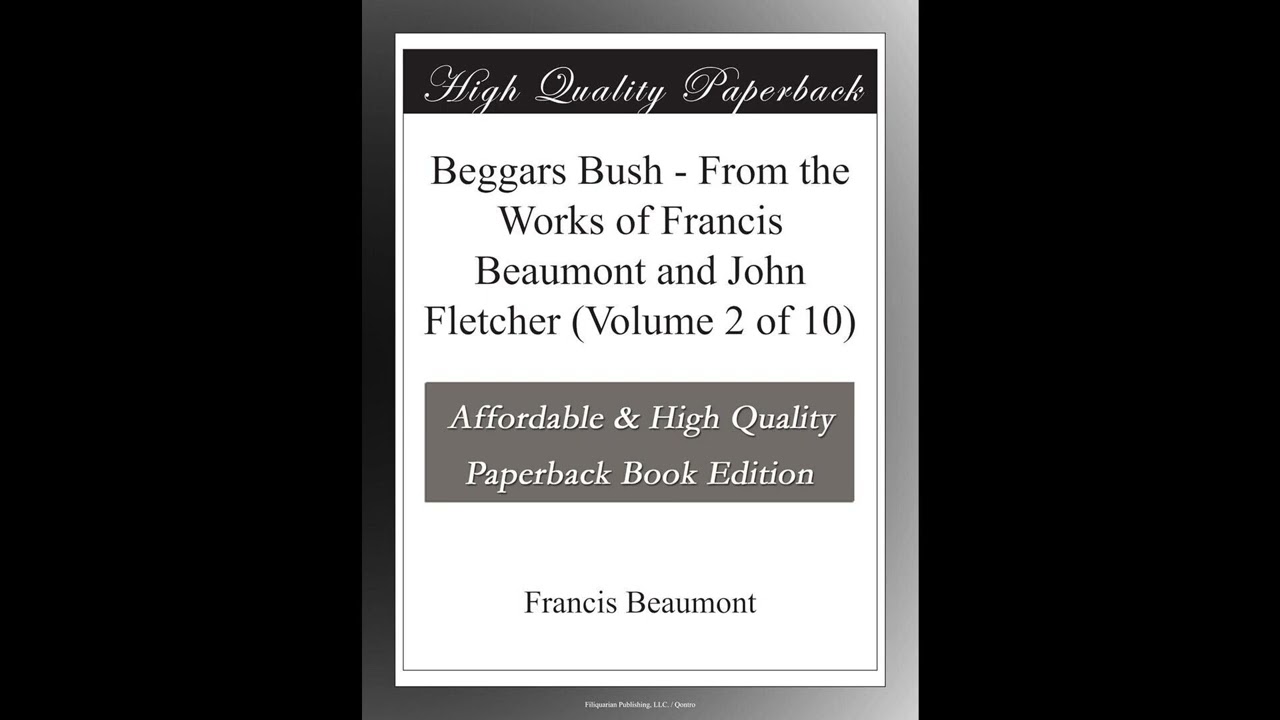
Beggars Bush - From the Works of Francis Beaumont and John Fletcher (Volume 2 of 10)- Full Audiobook
Step into the bustling, sometimes dangerous, often hilarious world of Jacobean England, where wit and intrigue hold sway. Beggars Bush, drawn from the enduring collaborative works of Francis Beaumont and John Fletcher, offers more than just a historical curiosity; it is a vivid dramatic experience that speaks to the enduring power of love, the resilience of the human spirit, and the surprising turns of fortune. This play, a prime example of the tragicomedy genre they so expertly pioneered, invites listeners to consider how identity is forged under pressure, how justice can prevail even in disguise, and how the simplest communities sometimes harbor the noblest hearts. Its clever plotting, vibrant characters, and keen observations on social order make it a compelling listen, reminding us that the fundamental human struggles for recognition and belonging transcend the centuries. The scene opens in the fertile, often war-torn land of Flanders, specifically near the bustling market town of Bruges. A young man, Florez, lives a life of assumed obscurity, having been displaced from his rightful inheritance as the Prince of Flanders by the usurper, Wolfort. Driven into hiding, Florez has adopted the humble garb and challenging existence of a beggar, living among a unique community in a nearby forest. It is here he encounters Jacomine, a young woman of equally mysterious origins, also disguised and living among the beggars. Their shared circumstances and hidden nobility quickly spark a deep and genuine affection, though neither is fully aware of the other’s true heritage. This community of beggars, far from a disorganized rabble, operates under its own strict hierarchy and curious customs, led by the enigmatic figure of Clause, their 'King' or chieftain, who enforces a code of honor among his ragged subjects. The unfolding narrative sees Florez navigate the treacherous waters of his secret identity, grappling with his desire to reclaim his birthright while also cherishing his burgeoning love for Jacomine. Subplots weave through the main narrative, involving other members of the court, the loyal merchant Giles, and the various colorful characters within the beggar’s bush, each with their own motives and secrets. The central conflict intensifies as outside forces threaten the stability of both the disguised royal couple and the unusual society that has sheltered them, pushing them towards a confrontation with their past and a possible revelation of their true selves, without yet revealing the eventual outcome. The play is attributed to Francis Beaumont and John Fletcher, a celebrated pair of playwrights whose collaboration was one of the most fruitful and influential in English dramatic history during the early 17th century. Francis Beaumont (born around 1584) came from an established Leicestershire family and studied at Oxford, though he left without a degree. He gravitated towards literary circles in London, where his talent for poetry and drama quickly became evident. John Fletcher (born in 1579), the son of a dean of St. Paul's Cathedral, also received a university education at Corpus Christi College, Cambridge. His early life exposed him to the sophisticated world of court and church, which undoubtedly shaped his understanding of power and social dynamics. Their unique partnership, which flourished between approximately 1606 and Beaumont’s premature death in 1616, produced a body of work that dramatically shifted the direction of English theater. They are particularly credited with popularizing the tragicomedy, a genre that blends serious, sometimes near-tragic elements with comedic resolutions, keeping audiences in suspense until the final act. Their plays, including notable successes like Philaster and A King and No King, were characterized by complex plots, eloquent verse, and a focus on spectacle and dramatic effect. After Beaumont’s death, Fletcher continued to write prolifically, often collaborating with other dramatists like Philip Massinger, cementing his place as a leading playwright for the King's Men, the most prominent acting company of the era, which had previously been Shakespeare’s company. Their collective influence on subsequent generations of playwrights, particularly in their development of intricate plotting and sophisticated dialogue, solidified their reputation as key figures in the Jacobean literary canon. At its core, Beggars Bush scrutinizes the nature of identity and the pervasive power of disguise. Florez and Jacomine both adopt the roles of common beggars, not just to hide from enemies, but also, inadvertently, to discover aspects of their character that might have remained dormant in courtly life. The play questions whether true nobility resides in birthright or in one’s actions and moral compass, suggesting that genuine virtue can shine through any outward appearance. For instance, Florez, despite his royal lineage, embraces the beggar’s life with a surprising dignity and learns lessons in humility and community that a prince in power might never encounter. Jacomine, too, demonstrates a fortitude and self-reliance that belies her hidden aristocratic status, reinforcing the idea that character often reveals itself most clearly under adversity. Another significant theme running through the play is the exploration of social order and justice. The contrasting societies of the court and the beggar community provide a fascinating juxtaposition. While the court is plagued by usurpation and deceit, the beggar’s bush, despite its humble origins, maintains its own code of ethics and a clear leadership structure under Clause. This parallel allows the play to comment on what constitutes legitimate authority and moral governance, suggesting that honor and loyalty can flourish even outside conventional societal boundaries. The beggars, often perceived as the lowest rung of society, exhibit a surprising degree of integrity and mutual support, often acting with more genuine honor than some of the supposedly noble characters in the play’s more elevated spheres. The early 17th century, known as the Jacobean era after the reign of King James I, witnessed a distinct shift in the English literary landscape following the exuberant creativity of the Elizabethan age. The theater of this period often reflected a growing cynicism and disillusionment, with plays frequently exploring themes of political intrigue, corruption, and psychological complexity. The patronage system was vital, with dramatists relying on noble sponsors and the favor of the monarch to fund their work and companies. Playhouses, like the Globe and the Blackfriars, were thriving cultural centers, drawing diverse audiences from all social strata. Beggars Bush emerged from this environment, embodying the Jacobean taste for sophisticated, often convoluted plots, witty repartee, and the specific theatrical innovation of tragicomedy, which Beaumont and Fletcher popularized. This genre offered audiences the emotional intensity of tragedy combined with the reassurance of a happy or at least non-catastrophic resolution. Such plays resonated with a society grappling with anxieties about succession, religious tensions, and the delicate balance of power between king and parliament. The exploration of disguise and hidden royalty in Beggars Bush would have held particular resonance in a time when legitimate authority was often a subject of intense debate, making the play not merely entertainment, but a reflection of contemporary concerns about kingship and social stability. Listening to Beggars Bush as an audiobook transforms the experience of this classic drama. The spoken word brings out the lively dialogue, the intricate plotting, and the distinct personalities of the characters with an immediacy that reading alone might not fully convey. Imagine the crisp delivery of Florez’s disguised pronouncements, the warmth in Jacomine’s voice, and the boisterous, varied accents of the beggar community, all rendered by skilled narrators. The several hours of run time allow the complex narrative to unfold at a natural pace, giving listeners ample opportunity to immerse themselves in the unfolding drama without the visual cues of a stage production. The precise pacing of the performance, from moments of comedic banter to scenes of genuine dramatic tension, enhances the atmosphere and deepens the understanding of the playwrights' intentions. It is an opportunity to truly hear the play as it was meant to be experienced—through the power of performance.
Enjoyed Beggars Bush - From the Works of Francis Beaumont and John Fletcher (Volume 2 of 10)- Full Audiobook? A few ways to support us
Audible & Amazon links are affiliate; we may earn a small commission at no extra cost.
About this production
Human narration by a volunteer reader from LibriVox.org, the public-domain audiobook project. LibriVox volunteers record literary works whose copyright has expired in the United States, releasing the resulting recordings into the public domain.
Beggars Bush - From the Works of Francis Beaumont and John Fletcher (Volume 2 of 10)- Full Audiobook. The underlying text is in the U.S. public domain. We do not republish any modern copyrighted edition, translation, or commentary.
The 4K cinematic visuals accompanying this audiobook are generated by an AI image model from prompts derived from the source text. No copyrighted photos, paintings, or stock footage are used. AI generation is disclosed on every video on our YouTube channel as required by YouTube's altered/synthetic content policy.
English subtitles are transcribed from the LibriVox recording with OpenAI Whisper. Translations into the 11 other supported languages are produced by Meta's NLLB-200 neural translation model. No human translator's copyrighted translation is used.
Questions about sourcing or rights? See our DMCA & Sourcing policy or contact us.
Enjoyed this audiobook?
If you'd like to own a copy of Beggars Bush - From the Works of Francis Beaumont and John Fletcher (Volume 2 of 10)- Full Audiobook or hear a professionally produced edition, the links below help support free audiobook production at no extra cost to you.
As an Amazon Associate we earn from qualifying purchases. Audible / print links are affiliate.