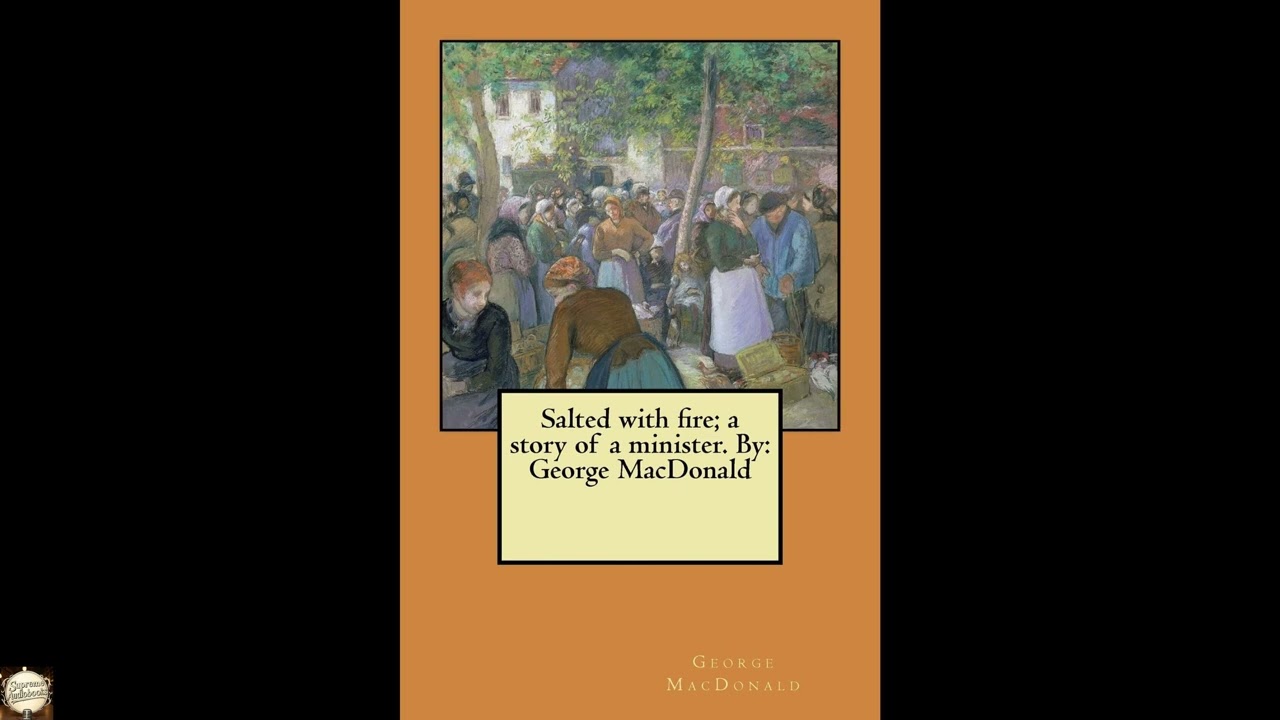
Salted with fire; a story of a minister. By: George MacDonald
"Salted with Fire" invites a profound examination of faith, doubt, and the demanding path of spiritual authenticity. George MacDonald’s story of a minister grappling with his calling remains relevant where genuine conviction often clashes with outward performance. It asks what truly constitutes a life lived in service and truth, urging us to look beyond rituals and doctrines to the core of our being. This narrative is not just about a man of the cloth, but about the universal human struggle to reconcile intellect with spirit, ambition with humility, and societal expectations with the quiet stirrings of one's soul. The book promises not easy answers, but a deeply felt confrontation with the refining fires of self-discovery. MacDonald transports us to a secluded Scottish parish, painting a vivid portrait of a community rooted in tradition and expectations of moral leadership. Here we meet Robert Falconer, a young minister endowed with sharp intellect and fervent oratorical skill, initially commanding respect. However, beneath this polished exterior lies a simmering internal conflict. Robert’s faith, while outwardly strong, is intellectualized, built more on rigid dogma than on a compassionate understanding of human frailty. His sermons, though eloquent, begin to ring hollow, lacking the genuine spiritual authority that comes from a humble heart, leading to isolation from his parishioners. The central conflict emerges as Robert's pride and intellectual arrogance lead him down a perilous path. His character is tested by internal crises that chip away at his identity, fueled by an inability to see beyond his own interpretation of truth. As his life unravels, he experiences a profound fall from grace, losing his ministerial position and much he held dear. Stripped of outward markers of success, he is cast into a wilderness of doubt and hardship. This period of intense suffering forces him to confront the superficiality of his earlier faith, beginning an arduous path towards a more authentic spiritual understanding and a hard-won humility. George MacDonald, the visionary Scottish author behind "Salted with Fire," was a figure of immense spiritual and literary influence in the Victorian era. Born in Aberdeenshire in 1824, MacDonald was initially drawn to the ministry, serving briefly as a Congregational pastor. His unconventional theological views—particularly his belief in a loving, merciful God whose "consuming fire" was ultimately redemptive—led to his dismissal. This pivotal experience deeply shaped his literary career, imbuing his work with a passionate quest for spiritual authenticity and a profound understanding of divine grace. MacDonald dedicated his life to writing, producing a prolific body of work that spanned novels, poetry, essays, and beloved children's stories. His adult novels, including "Robert Falconer," "Lilith," and "Phantastes," often blend realism with allegory, probing the nature of good and evil, the complexities of faith, and the transformative power of suffering. His children's books, such as "The Princess and the Goblin," remain classics. MacDonald's impact extended far beyond his immediate readership; C.S. Lewis famously referred to MacDonald as his "master," and figures like G.K. Chesterton and J.R.R. Tolkien also acknowledged his profound influence, securing his place in modern fantasy literature and Victorian spiritual discourse. "Salted with Fire" resonates with several powerful themes, each explored with MacDonald's characteristic blend of psychological insight and spiritual depth. A central concern is the authenticity of faith versus mere intellectual assent. Robert Falconer's downfall stems from his reliance on theological correctness and public appearance rather than a genuine, heartfelt connection to God, a truth vividly enacted when his sermons, despite their intellectual rigor, fail to move his parishioners. The narrative carefully distinguishes between superficial doctrine and a living, transforming belief. Additionally, the interplay of humility and pride is critical; Robert's intellectual superiority and inability to admit flaws drive his isolation, while humility, painfully achieved, opens the door to genuine connection. The title itself points to MacDonald's often-repeated theological concept of Divine Love as a refining force, a judgment that burns away impurities not to condemn, but to purify and restore. Robert's arduous experience of loss and hardship serves as this metaphorical fire, stripping away his false self and leading him toward a profound, albeit agonizing, spiritual rebirth. This process ultimately opens him to redemption and forgiveness, demonstrating MacDonald's unwavering belief in the possibility of spiritual transformation even after profound failure, offering a potent vision of spiritual renewal grounded in suffering. Published posthumously in 1897, "Salted with Fire" emerges from a distinct period of flux and questioning in late Victorian Britain. The latter half of the nineteenth century saw scientific advancements like Darwin's theories challenging traditional religious narratives, alongside rising biblical criticism and the social pressures of industrialization. Within this landscape, MacDonald’s work offered a counter-narrative to rigid Calvinism, emphasizing a loving, merciful God and the redemptive nature of suffering. "Salted with Fire," with its central character’s struggle against intellectual pride and his eventual journey to a more compassionate faith, directly embodies MacDonald's own theological arguments, speaking to the spiritual anxieties and evolving understanding of faith prevalent at the close of the Victorian era. Listening to "Salted with Fire" as an audiobook offers a uniquely intimate and profound experience. The "several hours" run length allows ample time to become fully immersed in Robert Falconer's complex internal world, following his doubts, misguided certainties, and slow revelations. A skilled narrator brings a crucial layer of nuance to MacDonald’s rich prose, lending distinct voices to characters and carefully modulating pacing to reflect moments of spiritual intensity and quiet introspection. The spoken word allows listeners to absorb the subtleties of Victorian dialogue and evocative descriptions, conjuring a strong sense of atmosphere that pulls one deeply into the narrative. This story unfolds with deliberate gravity, and the aural presentation encourages contemplative engagement with its weighty themes.
Enjoyed Salted with fire; a story of a minister. By: George MacDonald? A few ways to support us
Audible & Amazon links are affiliate; we may earn a small commission at no extra cost.
About this production
Human narration by a volunteer reader from LibriVox.org, the public-domain audiobook project. LibriVox volunteers record literary works whose copyright has expired in the United States, releasing the resulting recordings into the public domain.
Salted with fire; a story of a minister. By: George MacDonald by George MacDonald. The underlying text is in the U.S. public domain. We do not republish any modern copyrighted edition, translation, or commentary.
The 4K cinematic visuals accompanying this audiobook are generated by an AI image model from prompts derived from the source text. No copyrighted photos, paintings, or stock footage are used. AI generation is disclosed on every video on our YouTube channel as required by YouTube's altered/synthetic content policy.
English subtitles are transcribed from the LibriVox recording with OpenAI Whisper. Translations into the 11 other supported languages are produced by Meta's NLLB-200 neural translation model. No human translator's copyrighted translation is used.
Questions about sourcing or rights? See our DMCA & Sourcing policy or contact us.
Enjoyed this audiobook?
If you'd like to own a copy of Salted with fire; a story of a minister. By: George MacDonald or hear a professionally produced edition, the links below help support free audiobook production at no extra cost to you.
As an Amazon Associate we earn from qualifying purchases. Audible / print links are affiliate.