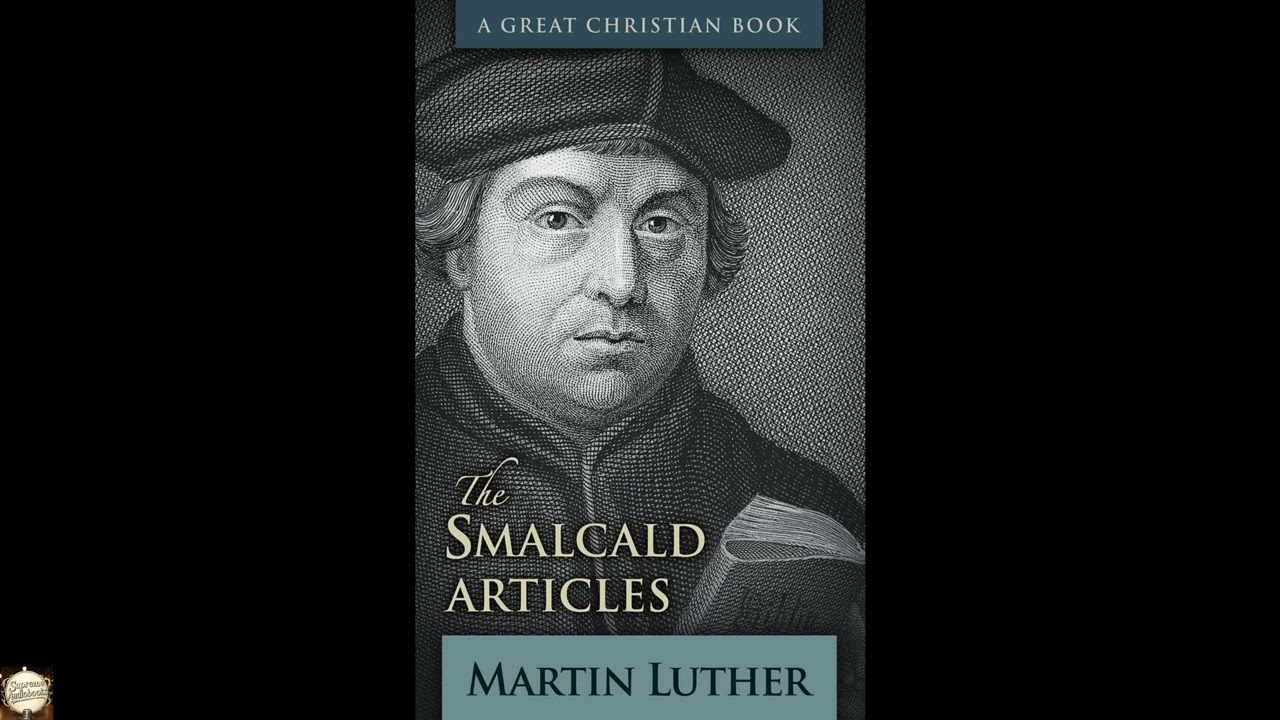
The Smalcald Articles
Imagine a moment when the destiny of an entire continent hung by the thread of theological conviction, where spiritual doctrine became the battleground for political power, and a single voice defied centuries of established authority. That moment, and that voice, resonates profoundly within The Smalcald Articles, Martin Luther's potent declaration of faith. Far from being a mere historical curiosity, this foundational document of the Protestant Reformation offers a riveting insight into the courage of dissent, the enduring power of ideas, and the profound questions of conscience that continue to shape our world. It is an unvarnished testament to the unwavering commitment of an individual who irrevocably altered the course of Western civilization, challenging us even today to consider the bedrock of our own beliefs and the cost of standing firm in the face of overwhelming opposition. The scene is set in the volatile Holy Roman Empire of the mid-16th century, a time fractured by burgeoning religious divides and the looming threat of war. Luther, a figure whose name had already become synonymous with audacious defiance, penned these articles in 1537, intending them as a definitive statement of Protestant beliefs to be presented at an anticipated General Council of the Church. The central conflict lies in the chasm between the Reformers' understanding of Christian doctrine and the entrenched teachings of the Roman Catholic Church, particularly concerning salvation, the role of sacraments, and the ultimate authority within Christianity. Luther, writing at the behest of John Frederick I, Elector of Saxony, and the Schmalkaldic League—an alliance of Lutheran princes and cities—understood the gravity of this moment. These articles were designed not for compromise or negotiation, but as an unyielding statement of faith, a line in the sand beyond which the Reformers would not retreat. The arc of this profound work unfolds not as a traditional narrative with characters in dialogue, but as a meticulously structured argument, a theological manifesto. Luther begins by outlining the "chief articles" of Christian faith, those shared with the Roman Church, albeit interpreted through a distinctly Reformational lens. He then moves to the heart of the disagreement, articulating the articles that are fundamentally incompatible with Rome, notably his fierce rejection of the Mass as a sacrifice, purgatory, and the invocation of saints. This section is particularly charged, as Luther declares these points to be non-negotiable, essential to the purity of the Gospel. Finally, he addresses areas where concessions might be possible, though always stressing that such concessions must not compromise core biblical truths. The "story" here is one of escalating conviction, a relentless hammering home of theological distinctions that were, in Luther's view, essential for true faith and the salvation of souls. The reader witnesses the hardening of positions, the clear articulation of an alternative path for Christianity that would forever divide the Western Church. Martin Luther, born in 1483 in Eisleben, Germany, and passing away in the same town in 1546, was a pivotal figure whose life and work ignited the Protestant Reformation. His early path led him to the monastery, where as an Augustinian friar, he grappled deeply with questions of sin and salvation. It was his theological studies, particularly his lectures on the book of Romans at the University of Wittenberg, that led him to his transformative understanding of justification by faith alone. This revelation blossomed into his challenge against the sale of indulgences, famously articulated in his Ninety-five Theses in 1517—an act widely considered the spark of the Reformation. His subsequent refusal to recant his writings at the Diet of Worms in 1521, declaring, "Here I stand; I can do no other," solidified his status as an unyielding reformer. Luther's prodigious output shaped not only theology but also the German language itself through his translation of the Bible, making the scriptures accessible to the common people. Beyond The Smalcald Articles, his significant works include On the Freedom of a Christian, a powerful treatise on Christian liberty; Babylonian Captivity of the Church, a critique of the sacramental system; and his Small and Large Catechisms, essential instructional tools for the nascent Lutheran church. He was not merely a theologian but a cultural force, a writer whose direct, often fiery prose carved out a new literary and religious landscape. His marriage to Katharina von Bora, a former nun, further broke with centuries of clerical celibacy, establishing a new model for the Protestant ministry. One of the central themes that runs through The Smalcald Articles is the radical concept of sola fide, or "faith alone." Luther repeatedly argues that salvation is a gift from God, received solely through faith in Jesus Christ, entirely apart from human works, merits, or the rituals mediated by the Church. For instance, in his treatment of penance, he dismantles the Roman Catholic system of confession, absolution, and satisfaction, insisting that true repentance is a lifelong turning to God, and forgiveness is freely given by divine grace, not earned through human effort or sacerdotal mediation. This foundational belief fundamentally alters the relationship between the individual believer and God, stripping away the layers of institutional control and personal striving that Luther felt obscured the true Gospel. Another powerful theme is the unwavering assertion of sola scriptura, the belief that the Bible is the sole infallible source of Christian doctrine, superior to papal pronouncements, church councils, or tradition. Luther vehemently critiques the authority of the Pope, classifying it among the "articles where we cannot yield or make any compromise." He systematically refutes the Roman Catholic understanding of the Mass as a repeated sacrifice of Christ, instead affirming the Eucharist as a testament of God's grace, received by faith. He further challenges the veneration of saints and the concept of purgatory, all based on his conviction that these practices lack scriptural foundation and detract from the sufficiency of Christ's work. His writings here are a masterclass in theological argumentation, revealing how carefully he grounded his radical positions in biblical interpretation. The historical backdrop to The Smalcald Articles is one of escalating tension and ideological warfare. Written in 1537, these articles emerged at a critical juncture for the burgeoning Protestant movement. Emperor Charles V, a staunch Catholic, along with the Papacy, was determined to crush the Reformation. An ecumenical council had been repeatedly called, often with the intention of condemning the Reformers rather than engaging in genuine dialogue. The Schmalkaldic League, a military alliance of Lutheran princes and imperial cities, had formed to defend their religious liberty against Imperial aggression. Luther’s articles were drafted specifically for this council, intended as an uncompromising declaration of Protestant doctrine. They served as a benchmark, a clear statement of what the Lutherans considered essential truths, indicating the points upon which they would rather face war and death than compromise. The political and religious stakes could not have been higher, and Luther's text reflects this profound sense of urgency and finality. Listening to The Smalcald Articles as an audiobook offers a unique and intimate way to encounter this potent work. The several hours of narration allow for a sustained engagement with Luther’s arguments, letting his forceful logic and passionate convictions unfold at a pace that encourages reflection. A skilled narrator can bring out the inherent drama of Luther’s prose, conveying the gravity of his pronouncements and the unyielding certainty behind his words. Pay attention to the shifts in his tone, from theological exposition to outright polemic, as he moves between clarifying shared beliefs and condemning what he perceives as grave errors. The directness of his arguments and the clarity with which he articulates complex theological points become particularly apparent when voiced, allowing the listener to absorb the historical and spiritual weight of a text that, nearly five centuries later, continues to resonate with profound significance.
Enjoyed The Smalcald Articles? A few ways to support us
Audible & Amazon links are affiliate; we may earn a small commission at no extra cost.
About this production
Human narration by a volunteer reader from LibriVox.org, the public-domain audiobook project. LibriVox volunteers record literary works whose copyright has expired in the United States, releasing the resulting recordings into the public domain.
The Smalcald Articles by Martin Luther. The underlying text is in the U.S. public domain. We do not republish any modern copyrighted edition, translation, or commentary.
The 4K cinematic visuals accompanying this audiobook are generated by an AI image model from prompts derived from the source text. No copyrighted photos, paintings, or stock footage are used. AI generation is disclosed on every video on our YouTube channel as required by YouTube's altered/synthetic content policy.
English subtitles are transcribed from the LibriVox recording with OpenAI Whisper. Translations into the 11 other supported languages are produced by Meta's NLLB-200 neural translation model. No human translator's copyrighted translation is used.
Questions about sourcing or rights? See our DMCA & Sourcing policy or contact us.
Enjoyed this audiobook?
If you'd like to own a copy of The Smalcald Articles or hear a professionally produced edition, the links below help support free audiobook production at no extra cost to you.
As an Amazon Associate we earn from qualifying purchases. Audible / print links are affiliate.