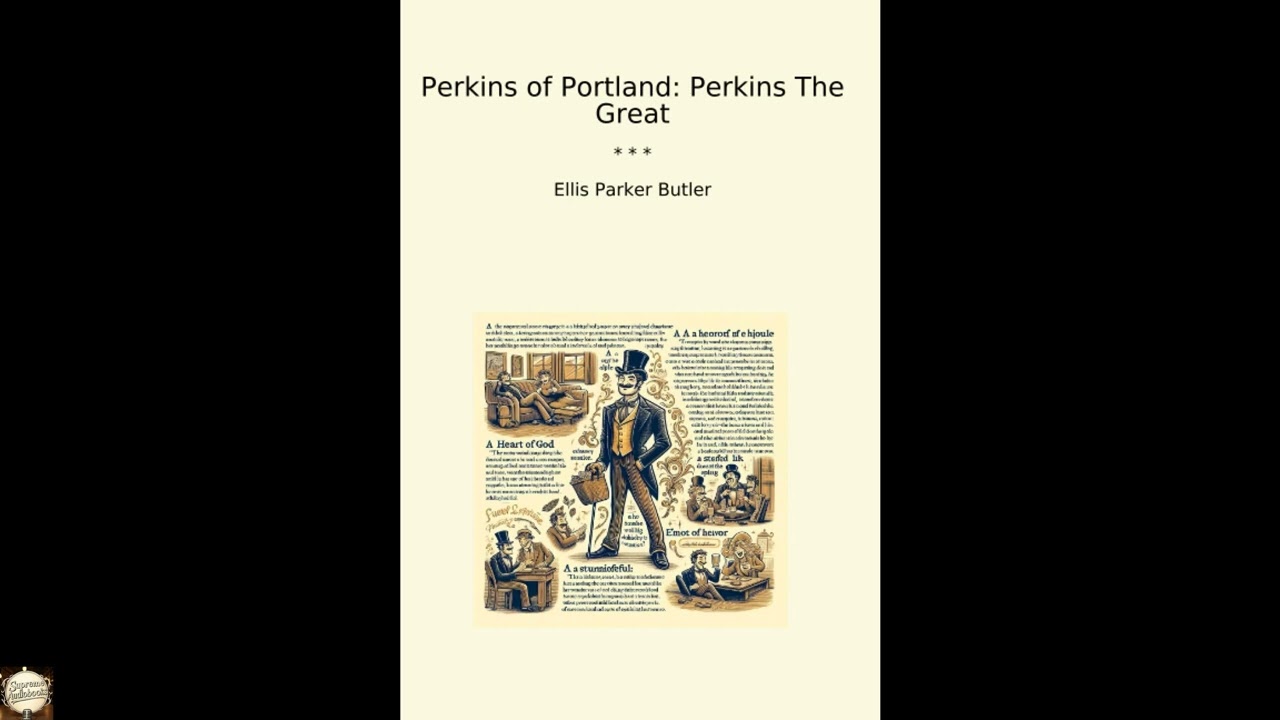
Perkins of Portland: Perkins The Great
Step into the bustling, optimistic, and often absurd world of early 20th-century America with Ellis Parker Butler's "Perkins of Portland: Perkins The Great." This delightful novel introduces listeners to a character whose grand ambitions and unshakeable self-belief turn the mundane into the magnificent – at least in his own mind. More than a century after its initial publication, Perkins's relentless pursuit of greatness, his schemes, and his endearing eccentricities continue to charm and amuse, offering a gentle satire on human nature, the spirit of enterprise, and the universal comedy of a man convinced of his own brilliance against all odds. It's a humorous and surprisingly relevant look at the power of conviction, even when that conviction is utterly misplaced, making it a perfect listen for anyone who appreciates witty observation and a good-natured laugh at our shared human foibles. Our story centers on Perkins, a man of modest means but immodest dreams, living in the eponymous city of Portland. From the outset, Perkins is characterized by an almost pathological optimism and an uncanny ability to elevate the most ordinary concepts to monumental significance. He is not merely an inventor or a businessman; he is "Perkins The Great," a title he bestows upon himself with complete conviction, even if the rest of the world has yet to catch up. His latest and most ambitious venture involves the seemingly unremarkable field of "Pure-Air Advertising." Perkins is convinced that he has stumbled upon a revolutionary method for disseminating advertisements through the very atmosphere, ensuring that every inhabitant of Portland – and eventually the world – will subconsciously absorb his clients' messages, whether they want to or not. The narrative follows Perkins as he attempts to launch his improbable business, navigating a world of skeptical bankers, bewildered potential clients, and his own long-suffering family. His unwavering enthusiasm clashes spectacularly with the practical realities of setting up an enterprise, leading to a series of increasingly comical situations. We meet an array of supporting characters who variously doubt, humor, or are exasperated by Perkins's relentless drive. From the well-meaning but utterly confused associates he tries to bring into his fold, to the local newspaper editors he attempts to impress, each encounter highlights the wide gulf between Perkins's idealized vision and the often-gritty details of daily life. The central conflict lies in whether Perkins can actually bring his audacious vision to fruition, or if his "Pure-Air Advertising" will simply dissipate into the very atmosphere it seeks to conquer, leaving behind only the lingering scent of dashed but gloriously conceived hopes. Ellis Parker Butler, the author behind this comedic gem, was born on December 5, 1869, in Muscatine, Iowa, and passed away on September 13, 1937, in Williamsville, Massachusetts. He was an incredibly prolific American humorist, known for his vast output of short stories and novels that appeared in popular magazines of the day, such as The Saturday Evening Post and American Magazine. Before devoting himself entirely to writing, Butler worked in banking, an experience that likely sharpened his observational skills regarding human nature and the quirks of commerce, which he so effectively parodied in his fiction. His most famous work, "Pigs Is Pigs" (1906), a hilariously absurd tale of a railway agent, a pair of guinea pigs, and an argument over freight charges, cemented his reputation as a master of gentle satire. Butler’s literary career spanned several decades, during which he published more than thirty books and thousands of stories and essays. He wasn't part of a formal literary movement in the academic sense, but he was a prominent voice in American humor during the early 20th century. His writing often focused on the everyday absurdities of middle-class life, bureaucratic follies, and the sometimes-foolish aspirations of ordinary people. He had a gift for creating memorable characters whose earnestness in the face of illogical situations produced genuine comedy. His place in the canon is as a beloved and widely read humorist who captured the spirit of his time with wit and a keen understanding of human nature, paving the way for many subsequent writers who found humor in the mundane. "Perkins of Portland" enacts several enduring themes, most notably the often-humorous disconnect between ambition and reality. Perkins’s unwavering belief in his "Pure-Air Advertising" scheme, despite its evident impracticality, perfectly illustrates this. For instance, when he attempts to demonstrate his technology by simply waving a stick and declaring that advertisements are now subtly permeating the air, his profound earnestness in the face of utter nonsense creates a comedic tension that drives the story. Another significant theme is the power of self-delusion, or perhaps more generously, the strength of an unshakeable belief system. Perkins's ability to rationalize every setback, every skeptical glance, and every failure as merely a temporary hurdle on his path to "greatness" provides a constant source of amusement. He might, for example, attribute a lack of sales not to the absurdity of his product, but to the public's temporary inability to grasp true genius, thus reinforcing his own skewed self-perception. The novel also functions as a satire of early 20th-century American entrepreneurial spirit. It lampoons the era’s fascination with grand schemes, innovative (if sometimes ill-conceived) business ideas, and the relentless pursuit of wealth and status. Through Perkins, Butler humorously questions the very foundations of what constitutes "progress" and "success" in a rapidly industrializing society. Furthermore, the story subtly touches on the theme of community and social interaction, as Perkins's idiosyncratic nature brings him into contact with various strata of Portland society. His interactions with his neighbors, local officials, and potential investors highlight the diverse ways people react to eccentricity and the delicate balance between supporting innovation and recognizing outright folly within a community. "Perkins of Portland" was published in 1906, a period known as the Progressive Era in American history. This was a time of immense social, economic, and technological change, marked by rapid industrialization, increasing urbanization, and a burgeoning consumer culture. It was an age ripe for both genuine innovation and outlandish speculative ventures. New inventions, advertising techniques, and business models were constantly emerging, and with them, opportunities for satire. The cultural landscape was also shifting, with a growing middle class and a widespread appetite for popular fiction, particularly the kind found in magazines. Ellis Parker Butler's career thrived within this environment, as his witty, character-driven humor provided a lighthearted reflection on the anxieties and absurdities of a nation grappling with modernity. The novel emerged precisely when American society was questioning the nature of progress and the true meaning of success, making Perkins's quixotic quest for "greatness" a perfectly timed and highly resonant piece of social commentary. Listening to "Perkins of Portland: Perkins The Great" as an audiobook offers a unique opportunity to truly appreciate Ellis Parker Butler's comedic timing and the nuances of his characters. The narrator's performance is crucial in bringing Perkins’s earnest yet utterly misguided voice to life, capturing his grand pronouncements and the underlying sweetness of his delusion. Listeners can savor the pacing of the humor, allowing the absurd situations to unfold with just the right rhythm. The distinct voices given to Perkins and the other residents of Portland create an immersive atmosphere, painting a vivid soundscape of an early 20th-century American city grappling with an extraordinary individual. With a run length of several hours, this audiobook is perfectly suited for a relaxed afternoon, a series of commutes, or as a charming companion for household tasks, offering a dose of wit and a memorable character whose pursuit of "greatness" is as entertaining as it is ultimately heartwarming.
Enjoyed Perkins of Portland: Perkins The Great? A few ways to support us
Audible & Amazon links are affiliate; we may earn a small commission at no extra cost.
About this production
Human narration by a volunteer reader from LibriVox.org, the public-domain audiobook project. LibriVox volunteers record literary works whose copyright has expired in the United States, releasing the resulting recordings into the public domain.
Perkins of Portland: Perkins The Great by Ellis Parker Butler. The underlying text is in the U.S. public domain. We do not republish any modern copyrighted edition, translation, or commentary.
The 4K cinematic visuals accompanying this audiobook are generated by an AI image model from prompts derived from the source text. No copyrighted photos, paintings, or stock footage are used. AI generation is disclosed on every video on our YouTube channel as required by YouTube's altered/synthetic content policy.
English subtitles are transcribed from the LibriVox recording with OpenAI Whisper. Translations into the 11 other supported languages are produced by Meta's NLLB-200 neural translation model. No human translator's copyrighted translation is used.
Questions about sourcing or rights? See our DMCA & Sourcing policy or contact us.
Enjoyed this audiobook?
If you'd like to own a copy of Perkins of Portland: Perkins The Great or hear a professionally produced edition, the links below help support free audiobook production at no extra cost to you.
As an Amazon Associate we earn from qualifying purchases. Audible / print links are affiliate.