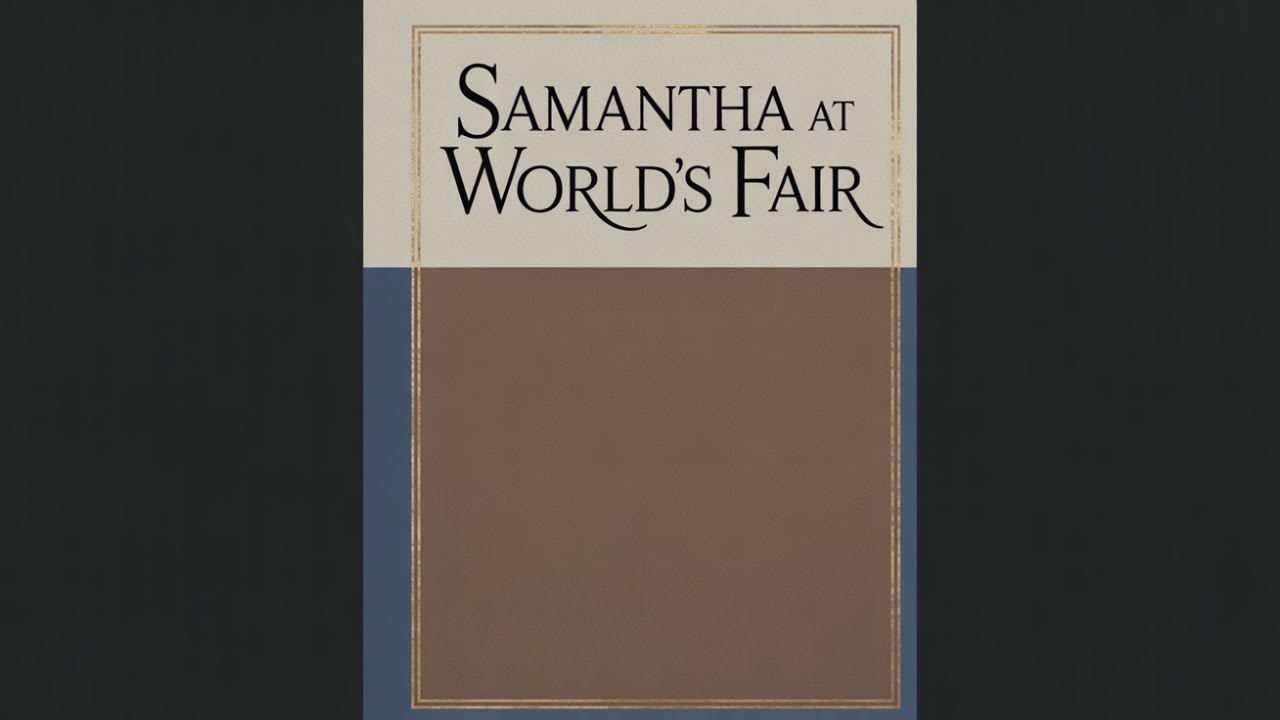
Samantha at the World's Fair
Step into a bustling, dazzling past with Marietta Holley’s Samantha at the World’s Fair, a delightful and insightful literary expedition that transports listeners directly to the marvels and absurdities of the 1893 World’s Columbian Exposition in Chicago. This isn’t merely a historical account; it’s a living, breathing commentary from the perspective of Samantha Allen, a sharp-witted, plain-spoken New York farm woman whose observations on technology, culture, and human nature remain surprisingly resonant today. Her gentle humor, keen eye for hypocrisy, and unwavering commitment to common sense offer both a charming escape and a mirror to our own era’s rapid changes and ongoing debates about progress, gender, and what truly makes a nation great. The story opens as Samantha and her well-meaning but often bewildered husband, Josiah Allen, prepare to visit the grand World’s Fair. Samantha, ever the practical philosopher, views the Exposition not just as a spectacle but as a colossal classroom—a place to learn, to question, and to form her own opinions on the advancements and social currents of the late nineteenth century. From the moment they arrive in Chicago, the scale of the "White City" overwhelms and amazes them. They wander through the vast halls dedicated to industry, agriculture, and the arts, witnessing electric lights, massive machinery, and exotic displays from around the globe. Samantha’s narrative voice serves as our guide, her down-to-earth perspective cutting through the grandeur to reveal the human element beneath the technological marvels. The central dynamic of the story is the contrast between Samantha’s open-minded curiosity and Josiah’s more conventional, often comically narrow views. Their debates and discussions, often occurring amidst the clamor of the Fair, become the vehicle for Holley’s social commentary. Samantha is particularly drawn to the Woman’s Building, a groundbreaking feature of the Fair that showcased female achievements and intellect, a stark counterpoint to Josiah’s insistence on women’s proper "sphere." Through their encounters with various personalities—from earnest reformers to cynical opportunists—Samantha articulates her thoughts on everything from women’s rights and education to the perils of urban life and the true meaning of Christian charity. The story unfolds as a series of vignettes and reflections, allowing the listener to experience the Fair alongside Samantha, seeing both its triumphs and its underlying social tensions through her uniquely engaging lens, all building to a comprehensive, yet never fully revealed, understanding of this pivotal moment in American history. Marietta Holley, born in Ellisburg, New York, in 1836, was an extraordinarily popular American humorist during the late nineteenth and early twentieth centuries. Living most of her life quietly in her rural hometown, she began her literary career writing poetry and articles for local newspapers, quickly gaining recognition for her distinctive voice. Her first major success came with My Opinions and Betsey Bobbet’s, published in 1873, which introduced the world to Samantha Allen and established her as a formidable presence in American letters. Holley’s writing often blended sharp social critique with accessible, folksy humor, a combination that resonated deeply with a wide readership. She crafted a long-running series of "Samantha" books, including Samantha Among the Brethren and Samantha on Picket Duty, which addressed contemporary issues ranging from temperance and women’s suffrage to political corruption and religious hypocrisy. Despite her immense popularity—at one point rivaling even Mark Twain’s in terms of sales and recognition—Marietta Holley, often writing under the pseudonym "Josiah Allen’s Wife," remains a somewhat overlooked figure in the modern literary canon. Her work stands as a significant bridge between the traditions of local color writing and the emerging voices of social reform, particularly for women. She perfected a narrative style that used the ostensibly naive observations of a rural woman to deliver pointed, often progressive, commentary on American society. Holley's commitment to using her platform for social good, combined with her unparalleled ability to make her readers laugh, secured her a unique and important place in the literary landscape of her time, representing a powerful, yet understated, proto-feminist voice. At its heart, Samantha at the World’s Fair enacts several significant themes. One prominent thread is the advocacy for women's rights and intellectual equality. Samantha consistently challenges the patriarchal assumptions of her husband and society at large. When visiting the Woman’s Building, for example, she doesn’t just admire the exhibits; she uses them as evidence in her arguments with Josiah, asserting women’s capacity for leadership, innovation, and intellectual pursuits beyond the domestic sphere. Another theme is the critique of social pretense and hypocrisy. Samantha, with her plain-spoken honesty, often punctures the inflated egos and superficial displays she encounters. She might observe a pompous lecturer and then comment on the lack of genuine charity she sees in the speaker's actions, highlighting the disparity between outward show and inner conviction. The book also grapples with the tension between progress and tradition. The World's Fair itself is a monument to technological advancement and global connection, representing a future hurtling forward. Josiah often views these changes with skepticism, preferring the familiar ways of home. Samantha, however, is more open to new ideas, questioning what truly constitutes "progress" and whether it always serves humanity’s best interests. She weighs the marvels of electricity against the simple virtues of rural life, reflecting on whether the dazzling inventions truly lead to moral or spiritual improvement. This thoughtful examination of change, innovation, and their impact on traditional values makes for a surprisingly nuanced look at a period of profound societal transformation. Samantha at the World’s Fair emerged during a period of immense change and self-reflection in America, a time often referred to as the Gilded Age. The 1893 World’s Columbian Exposition itself was a monumental event, commemorating 400 years since Columbus’s arrival in the Americas, but more importantly, it served as a grand showcase of American industrial might, technological innovation, and burgeoning global influence. It was a time of rapid urbanization, mass immigration, and stark contrasts between immense wealth and grinding poverty. Culturally, there was a growing women’s suffrage movement, intense debates about labor rights, and a fascination with both scientific progress and exotic foreign cultures. Holley’s book captures this moment perfectly, offering a popular and accessible commentary on the social and political currents of the day, allowing readers to process the dizzying pace of change through the relatable eyes of Samantha. The work became a crucial outlet for conveying serious social critiques wrapped in humor, making weighty topics palatable to a broad audience eager to understand their rapidly evolving world. Listening to Samantha at the World’s Fair as an audiobook offers a truly special way to connect with Marietta Holley’s unique literary voice. The opportunity to hear Samantha's distinct blend of wry humor, keen observation, and unwavering common sense brings an entirely new dimension to her character. A skilled narrator can beautifully differentiate between Samantha’s thoughtful reflections and Josiah’s often comically stubborn pronouncements, making their dialogues come alive. With a run length of several hours, this audiobook provides the perfect companion for leisurely afternoons or for bringing a touch of turn-of-the-century charm to daily commutes. Listen for the subtle shifts in pacing that reflect Samantha’s observational rhythms, the warmth and wit in the vocal interpretations of her internal monologues, and the way the narration builds an atmosphere that evokes the bustling, awe-inspiring, and sometimes perplexing world of the World’s Fair. It is an experience that allows the listener to savor every carefully crafted word, turning a historical text into an intimate, engaging conversation.
Enjoyed Samantha at the World's Fair? A few ways to support us
Audible & Amazon links are affiliate; we may earn a small commission at no extra cost.
About this production
Human narration by a volunteer reader from LibriVox.org, the public-domain audiobook project. LibriVox volunteers record literary works whose copyright has expired in the United States, releasing the resulting recordings into the public domain.
Samantha at the World's Fair by Marietta Holley. The underlying text is in the U.S. public domain. We do not republish any modern copyrighted edition, translation, or commentary.
The 4K cinematic visuals accompanying this audiobook are generated by an AI image model from prompts derived from the source text. No copyrighted photos, paintings, or stock footage are used. AI generation is disclosed on every video on our YouTube channel as required by YouTube's altered/synthetic content policy.
English subtitles are transcribed from the LibriVox recording with OpenAI Whisper. Translations into the 11 other supported languages are produced by Meta's NLLB-200 neural translation model. No human translator's copyrighted translation is used.
Questions about sourcing or rights? See our DMCA & Sourcing policy or contact us.
Enjoyed this audiobook?
If you'd like to own a copy of Samantha at the World's Fair or hear a professionally produced edition, the links below help support free audiobook production at no extra cost to you.
As an Amazon Associate we earn from qualifying purchases. Audible / print links are affiliate.