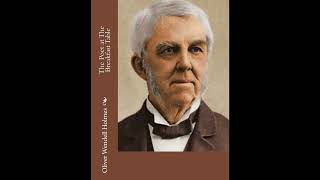
by Oliver Wendell Holmes
Step into the intellectual parlor of mid-nineteenth century Boston, where wit, wisdom, and the gentle art of conversation flourish over plates of eggs and coffee. The book known simply by its author, Oliver Wendell Holmes, is an invitation to sit at the breakfast table of a cultivated mind, listening in on discussions that ripple with humor, insight, and profound observation on the human condition. More than a century and a half after its first appearance, this classic of American letters remains an engaging and surprisingly relevant companion, offering a window into the inner workings of a brilliant mind and a thoughtful reflection on society, science, and the art of living. Its enduring appeal lies in its conversational charm, its philosophical musings, and the delightful company of its characters, who feel as real and engaging today as they did to its original readers. The heart of this literary experience unfolds within the quiet confines of a Boston boarding house, where a diverse group gathers daily for breakfast. Presiding over these morning meals is the central figure, the Autocrat himself—a genial, opinionated, and endlessly articulate observer of life. Through his eyes and his eloquent pronouncements, we are introduced to a recurring cast: the sensible and somewhat reserved Schoolmistress, whose quiet intelligence slowly wins the Autocrat's admiration; a earnest but sometimes naive Divinity Student; a cheerful, practical Young Man called John; and various other passing figures who contribute to the daily discourse. The book doesn't follow a traditional linear plot with dramatic events; instead, it progresses through a series of connected essays and dialogues, each "chapter" representing a new breakfast gathering. The central conflict, if one can call it that, is the gentle clash of ideas, the testing of theories, and the unfolding of personal philosophies among the table's inhabitants. The Autocrat discusses everything from the nature of genius and the mechanics of poetry to the proper way to manage a friendship, often interweaving anecdotes and verses of his own composition. As the weeks and months pass, a subtle arc develops, not through external action, but through the deepening relationships and the gradual revelation of each character's inner world. The Autocrat, despite his tendency to dominate the conversation, displays a tender heart and a keen understanding of human frailties and aspirations. We witness his growing affection for the Schoolmistress, a quiet subplot that adds warmth and emotional depth to the intellectual proceedings. Minor characters drift in and out, contributing their own perspectives and sparking new lines of inquiry, creating a miniature society within the dining room. The book concludes with a satisfying sense of closure, as certain relationships reach their natural fruition and the Autocrat prepares to leave the familiar table, leaving readers with a lingering impression of warmth, wit, and intellectual stimulation, without revealing the specific outcome of the Autocrat's personal revelations or the Schoolmistress's fate. The author, Oliver Wendell Holmes, Senior (1809-1894), was a truly remarkable figure of the American nineteenth century, a polymath whose accomplishments spanned medicine, poetry, and prose. Born into a prominent Boston family, Holmes was educated at Harvard and later studied medicine in Paris. He returned to America to become a distinguished physician and professor of anatomy and physiology at Dartmouth and then Harvard Medical School, where he made significant contributions to medical science, including his pioneering work on puerperal fever. Beyond his medical career, Holmes was a celebrated literary voice. He was a co-founder of The Atlantic Monthly magazine in 1857, a pivotal institution for American letters, and it was in its pages that the "Autocrat" series first appeared, establishing his literary reputation. His poetry, often characterized by its wit and patriotic fervor, includes "Old Ironsides," which helped save the USS Constitution from demolition, and the widely loved "The Last Leaf." Holmes’s unique blend of scientific rigor and poetic sensibility shaped his writing, allowing him to approach human experience with both analytical clarity and imaginative grace, cementing his place among the revered "Fireside Poets" and contributing significantly to the cultural landscape of his era. The work enacts several profound themes that resonate with listeners then and now. One prominent theme is the power of conversation and community to shape understanding and build connection. The breakfast table serves as a microcosm of society, where diverse viewpoints are aired, challenged, and often reconciled through polite discourse. For instance, the debates between the Autocrat and the Divinity Student over faith and science illustrate how respectful dialogue can bridge intellectual divides. Another central theme is observation and the intricacies of human nature. Holmes, with a physician's keen eye, dissects the quirks, habits, and underlying motivations of his characters and, by extension, all people. His musings on the "three selves" of every individual—the actual self, the ideal self, and the self one's friends see—showcases his psychological acumen and his humorous yet empathetic understanding of self-perception and social identity. Additionally, the book gently reflects on the passage of time and the role of memory, with the Autocrat often reminiscing about his youth, the changing face of Boston, and the cyclical nature of life. His occasional verses, like "The Chambered Nautilus," offer allegories about growth and self-improvement, tying individual experience to broader philosophical concepts, illustrating the enduring human quest for wisdom and meaning in the face of life's relentless progression. This particular work emerged during a fascinating period in American history, the years just prior to the Civil War, when intellectual and cultural life in New England was reaching a peak. Boston, often called the "Athens of America," was a hub of literary activity, home to figures like Ralph Waldo Emerson, Henry Wadsworth Longfellow, and James Russell Lowell. Holmes himself was deeply embedded in this intellectual milieu, though he often adopted a more pragmatic and scientific perspective than the prevailing Transcendentalism of some of his contemporaries. The debates at the Autocrat's table often mirrored the cultural conversations of the day, touching on scientific discovery, religious belief, social reform, and the burgeoning sense of an American literary identity. The book's serialized format in The Atlantic Monthly was also indicative of the era's expanding periodical culture, which brought sophisticated literary content to a broader reading public. It offered a comforting, stable intellectual space during a time of increasing national tension and uncertainty, a place where ideas could be freely exchanged and pondered. Listening to this classic work as an audiobook offers a particularly rewarding experience. The very nature of the prose, structured as a series of conversations and personal reflections, lends itself beautifully to the spoken word. The run length, several hours in total, provides ample opportunity to truly settle into the rhythm of the Autocrat's thoughts and the repartee of the boarding house guests. Listeners can savor the careful pacing of Holmes’s arguments, allowing his witty turns of phrase and insightful observations to sink in without the pressure of deciphering complex sentence structures on the page. A skilled narrator can bring each of the distinct personalities at the breakfast table to life, giving voice to the Autocrat’s sagacity, the Schoolmistress’s quiet dignity, and the various interjections of other characters. The subtle shifts in tone, the pauses for reflection, and the playful delivery of the dialogue create a rich atmospheric listening experience, making the listener feel as if they are truly present at the table, a silent participant in these enduring and delightful discussions.
Enjoyed by Oliver Wendell Holmes? A few ways to support us
Audible & Amazon links are affiliate; we may earn a small commission at no extra cost.
About this production
Human narration by a volunteer reader from LibriVox.org, the public-domain audiobook project. LibriVox volunteers record literary works whose copyright has expired in the United States, releasing the resulting recordings into the public domain.
by Oliver Wendell Holmes. The underlying text is in the U.S. public domain. We do not republish any modern copyrighted edition, translation, or commentary.
The 4K cinematic visuals accompanying this audiobook are generated by an AI image model from prompts derived from the source text. No copyrighted photos, paintings, or stock footage are used. AI generation is disclosed on every video on our YouTube channel as required by YouTube's altered/synthetic content policy.
English subtitles are transcribed from the LibriVox recording with OpenAI Whisper. Translations into the 11 other supported languages are produced by Meta's NLLB-200 neural translation model. No human translator's copyrighted translation is used.
Questions about sourcing or rights? See our DMCA & Sourcing policy or contact us.
Enjoyed this audiobook?
If you'd like to own a copy of by Oliver Wendell Holmes or hear a professionally produced edition, the links below help support free audiobook production at no extra cost to you.
As an Amazon Associate we earn from qualifying purchases. Audible / print links are affiliate.