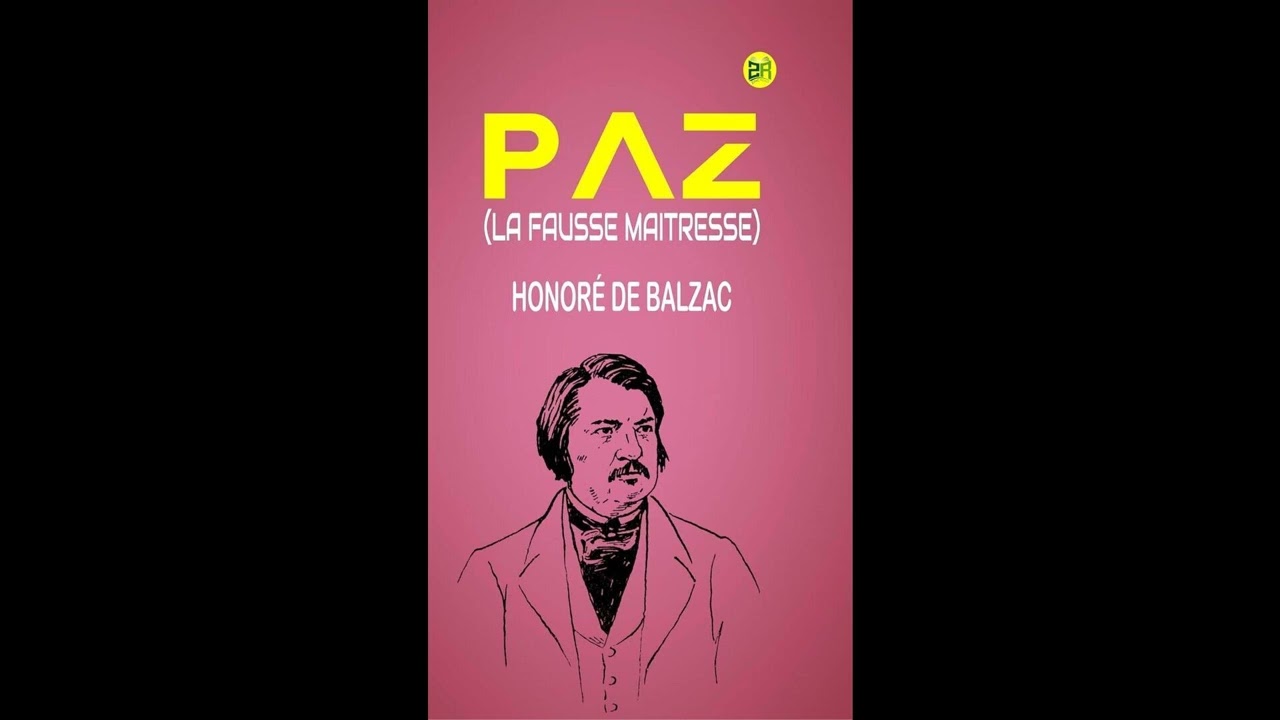
Paz (La Fausse Maitresse)
Honoré de Balzac’s Paz (La Fausse Maitresse) stands as a poignant reminder that love, devotion, and sacrifice often wear unexpected guises, shaping human lives with profound, often unacknowledged power. This novella, part of his monumental La Comédie humaine, offers a penetrating look at the complex emotional landscapes hidden beneath society's polished surface. It is a story about the lengths people will go to protect those they care for, a testament to silent suffering and extraordinary selflessness that resonates deeply even today, challenging us to consider the true nature of loyalty and the cost of unwavering affection. At its heart lies a deceptively simple premise that unfurls into a tale of layered deception and the quiet heroism found in everyday acts of love. Set against the glittering backdrop of Parisian high society and the lingering shadows of post-Napoleonic Europe, Paz (La Fausse Maitresse) introduces us to Count Adam Laginski, a Polish émigré living a life of apparent ease and social grace in the French capital. Laginski, a man of noble birth and generous spirit, harbors a profound secret: he is secretly married to a young woman named Clementine, whom he cherishes above all else, but whose modest means prevent him from openly acknowledging their union without jeopardizing his standing and his ability to provide for her. His fortune, while comfortable, is not limitless, and his love for Clementine drives him to maintain a delicate balance between public facade and private devotion. The central conflict arises from Laginski’s deep affection for his compatriot and childhood friend, General Paz, a man of immense physical strength and quiet, unyielding loyalty. Paz, an exiled Polish officer scarred by war and devoted to Laginski, lives in the Count’s household, serving as his indispensable confidant and protector. When Laginski realizes that his wife Clementine’s lonely existence and his own financial limitations are causing her distress, a desperate plan begins to form. To protect Clementine and ensure her comfort without revealing their marriage, Laginski orchestrates a grand deception: Paz will pretend to be Clementine’s lover, her "false mistress," thereby explaining her presence in their social circle and allowing Laginski to support her financially without suspicion. This elaborate charade requires immense dedication from Paz, whose inner turmoil and silent suffering form the emotional core of the narrative as he embodies a role that forces him to deny his deepest feelings while appearing to live a life of casual romance. Honoré de Balzac, born in Tours in 1799, spent a life steeped in the observation and chronicling of French society, which he meticulously documented in his sprawling fictional universe, La Comédie humaine. His early years were marked by financial struggles and a relentless drive to succeed as a writer, often working through the night fueled by coffee. He experimented with various literary forms before finding his true voice in the novel, producing a prodigious output of nearly one hundred novels and novellas before his death in Paris in 1850. Balzac became the quintessential author of the French Realist movement, meticulously detailing the manners, customs, and social hierarchies of his time, often with a critical eye. He created recurring characters who appeared across multiple novels, lending an unprecedented sense of continuity and reality to his fictional world. Beyond Paz, his most celebrated works include Le Père Goriot, a searing portrayal of filial ingratitude and Parisian ambition; Eugénie Grandet, which dissects the destructive power of avarice; and Lost Illusions, a sweeping narrative of an aspiring poet’s disillusionment in the literary world. Balzac's unique approach positioned him as a towering figure in European literature, influencing generations of writers with his psychological depth, social commentary, and unparalleled ability to bring an entire society to life on the page. Paz exemplifies several key Balzacian themes, notably the profound nature of self-sacrifice. General Paz’s willingness to assume the role of Clementine’s lover, enduring public scorn and private heartache, serves as a poignant illustration of selfless devotion. He gives up his emotional peace, his reputation, and the potential for his own romantic happiness to secure the well-being of his friend and his friend's beloved. This act is not born of weakness but of a deep, almost ancient sense of loyalty and honor. Another prominent theme is the corrosive power of social deception and the illusions of happiness. Laginski constructs an elaborate lie to navigate societal expectations and protect his cherished Clementine, but this deception comes with its own set of emotional costs for everyone involved. The constant maintenance of the facade, the unspoken truths, and the emotional distance it creates between the characters highlight how appearances, while sometimes necessary for survival within a rigid social structure, can distort reality and inflict unseen wounds. The novel meticulously demonstrates how characters wrestle with their public roles versus their private feelings, a conflict central to many of Balzac's observations on society. The novella emerged in 1841 during a period known as the July Monarchy in France, under the reign of Louis-Philippe I. This era was characterized by a bourgeois ascendancy, a focus on material wealth, and a certain degree of social conservatism, though underlying political tensions simmered. Balzac, ever the keen observer, was writing against a backdrop where financial stability and social standing were paramount, and where appearances often dictated one's place in the world. The lingering effects of the Napoleonic wars and subsequent political upheavals also meant a population of émigrés and ex-soldiers, like Paz, who navigated a changed landscape, often with their pasts defining their present struggles. Balzac's realism provided a lens through which to examine these societal pressures. His works were a commentary on how individuals grappled with the demands of class, money, and reputation in a rapidly evolving Paris. Paz fits perfectly into this context by portraying how personal desires and ethical dilemmas are shaped by external social structures. The need for Laginski’s deception, for instance, stems directly from the societal expectations regarding marriage, wealth, and status, making the novella a microcosm of the larger social forces Balzac was so intent on documenting. Listening to Paz (La Fausse Maitresse) as an audiobook offers an intimate connection to Balzac’s prose and the emotional landscape he creates. The narrator’s voice becomes crucial in conveying the subtle nuances of Paz’s stoicism and Laginski’s conflicted affections. Listeners can fully appreciate the delicate pacing as the deception unfolds, feeling the tension build in the dialogue and the unspoken words between characters. The distinct voice given to each figure—Paz’s quiet resolve, Laginski’s bursts of passion, Clementine’s gentle vulnerability—enhances the dramatic impact of their interactions. The several hours of listening time allow for a complete immersion into the Parisian atmosphere, the intricate social dynamics, and the deep psychological currents that run through this compelling story of love and sacrifice.
Enjoyed Paz (La Fausse Maitresse)? A few ways to support us
Audible & Amazon links are affiliate; we may earn a small commission at no extra cost.
About this production
Human narration by a volunteer reader from LibriVox.org, the public-domain audiobook project. LibriVox volunteers record literary works whose copyright has expired in the United States, releasing the resulting recordings into the public domain.
Paz (La Fausse Maitresse) by Honoré de Balzac. The underlying text is in the U.S. public domain. We do not republish any modern copyrighted edition, translation, or commentary.
The 4K cinematic visuals accompanying this audiobook are generated by an AI image model from prompts derived from the source text. No copyrighted photos, paintings, or stock footage are used. AI generation is disclosed on every video on our YouTube channel as required by YouTube's altered/synthetic content policy.
English subtitles are transcribed from the LibriVox recording with OpenAI Whisper. Translations into the 11 other supported languages are produced by Meta's NLLB-200 neural translation model. No human translator's copyrighted translation is used.
Questions about sourcing or rights? See our DMCA & Sourcing policy or contact us.
Enjoyed this audiobook?
If you'd like to own a copy of Paz (La Fausse Maitresse) or hear a professionally produced edition, the links below help support free audiobook production at no extra cost to you.
As an Amazon Associate we earn from qualifying purchases. Audible / print links are affiliate.