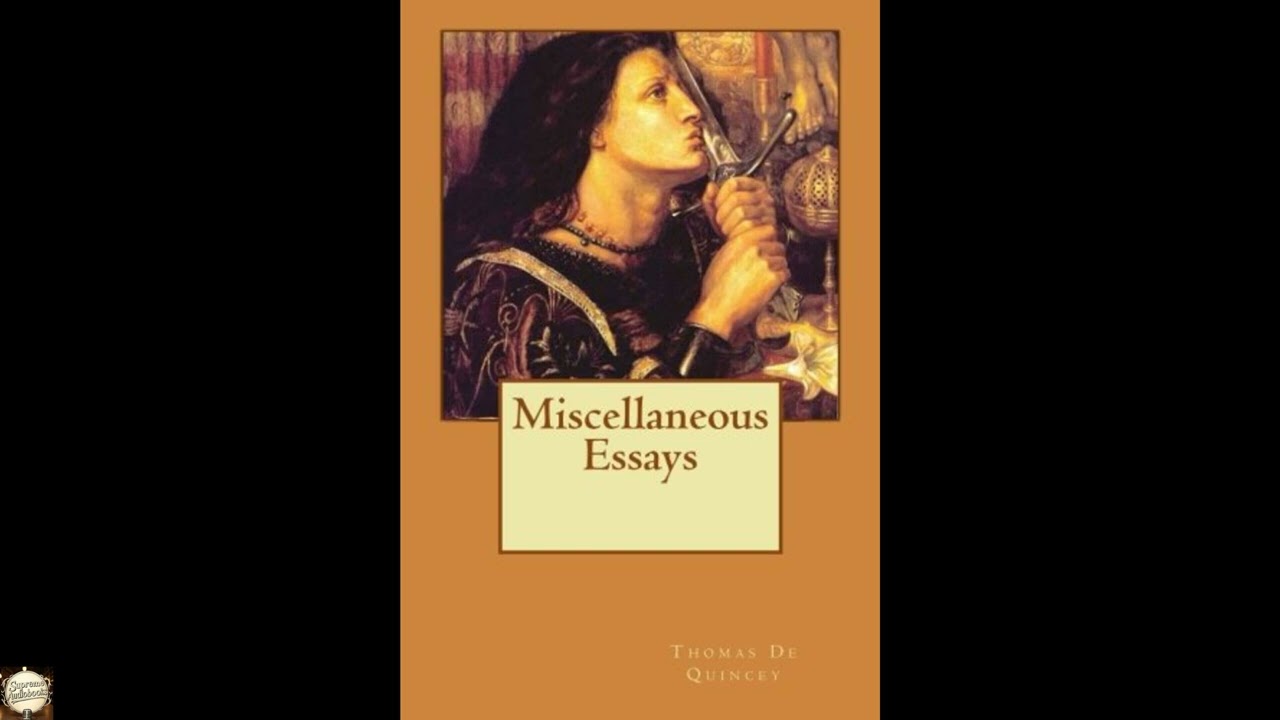
Miscellaneous Essays
Step into the singular, often dreamlike, mind of Thomas De Quincey with "Miscellaneous Essays," a collection that gathers the astonishing breadth of his intellectual and stylistic prowess. This isn't a book with a single story, but rather a literary salon hosted by one of the 19th century’s most idiosyncratic and brilliant figures, inviting the listener to wander through a landscape of criticism, autobiography, philosophy, and history. Why should this resonate today? Because De Quincey, a master of elaborate prose and psychological observation, grapples with themes that remain profoundly human: the nature of memory, the anguish of addiction, the intricacies of consciousness, and the enduring power of literature to shape and reflect our inner lives. His essays offer not just information, but an immersive experience in thought, a journey into the very act of thinking itself, presented with an eloquence that feels both grandly formal and intensely intimate. The "plot" of "Miscellaneous Essays" unfolds not through a linear narrative of characters and events, but through the shifting perspectives and intellectual wanderings of De Quincey himself, the ever-present guide. The setting is diverse, ranging from the literary salons of Regency England, where he might dissect the genius of a Shakespeare play, to the philosophical realms of German idealism, which he approaches with both reverence and critical insight. Listeners will find themselves transported to the bustling streets of London and Edinburgh as De Quincey offers acute social commentary, or drawn into the hushed chambers of his own memory, where past experiences – both joyful and harrowing – are meticulously revisited and reinterpreted. The central conflict animating these diverse pieces often lies in De Quincey’s internal struggles and his vigorous intellectual engagements. He wrestles with philosophical problems, debates literary interpretations, and confronts the pervasive influence of his own opium addiction, which lent a hallucinatory vividness to many of his perceptions and prose constructions. There is no simple arc to this collection beyond the overarching development of De Quincey’s distinctive style and the cumulative revelation of his unique worldview. Each essay stands as a self-contained intellectual adventure, sometimes a deeply personal reflection, sometimes a sharp piece of literary analysis like "On the Knocking at the Gate in Macbeth," which delves into the psychological impact of a specific scene, or a vivid biographical sketch offering intimate glimpses of his contemporaries. The overall effect is that of a grand mosaic, each piece contributing to a comprehensive portrait of a mind wrestling with the complexities of existence, art, and the human condition. Thomas De Quincey, born in Manchester in 1785, led a life as unconventional as his writing. A child prodigy, he displayed an extraordinary intellect from an early age, excelling in classical languages before famously running away from grammar school. This act of youthful rebellion set the tone for a life often marked by both brilliant achievement and profound personal difficulty. After a period of wandering and poverty, he eventually attended Oxford, though he never took a degree. It was during these years, and later, that he began his long and complex relationship with opium, initially taken for a neuralgic pain, which would profoundly influence his literary output and personal experiences. He moved to the Lake District, becoming an associate of prominent Romantic poets like William Wordsworth and Samuel Taylor Coleridge, absorbing their intellectual currents and literary ambitions. De Quincey rose to prominence with the anonymous publication of "Confessions of an English Opium-Eater" in 1821, a groundbreaking work that fused autobiography with philosophical reflection and vivid imaginative prose. Throughout his career, he became a prolific contributor to influential literary journals such as Blackwood's Magazine and Tait's Edinburgh Magazine, producing a vast body of essays on an astonishing array of subjects. He died in Edinburgh in 1859, leaving behind a legacy as one of the most distinctive prose stylists of his era and a pioneering figure in the genre of confessional literature, bridging the Romantic and early Victorian periods with his unique voice. Within "Miscellaneous Essays," De Quincey continually enacts several powerful themes. One significant theme is the nature of memory and its subjective reconstruction. He often revisits past events, not as simple reportage, but as intricately layered recollections, demonstrating how memory is not a static record but an active process of shaping and understanding. For instance, in essays that touch upon his childhood or his encounters with literary giants, he meticulously reconstructs scenes, not always for factual accuracy, but for psychological truth, showing how the past continues to resonate and reformulate itself in the present mind. Another prominent theme is the power and complexity of language itself. De Quincey's celebrated prose style, often characterized by its elaborate sentences, intricate syntax, and wide-ranging vocabulary, is not merely a vehicle for ideas but a testament to language's capacity for profound expression. He constructs lengthy periods that build suspense, amplify meaning, and guide the reader through complex logical and emotional landscapes. His critical essays, for example, often foreground his precise word choices and rhetorical strategies, revealing how a writer’s linguistic decisions can alter perception and interpretation. A third recurrent theme is the exploration of the human mind and its altered states. Drawing heavily from his experiences with opium, De Quincey often delves into the labyrinthine workings of consciousness, dreams, and the subconscious. His descriptions of inner turmoil, heightened perception, and the interplay between imagination and reality offer a remarkably early psychological realism, often presented with a poetic intensity. The era in which De Quincey wrote was a period of immense intellectual and societal transformation in Britain. The early to mid-19th century witnessed the full force of the Industrial Revolution, leading to rapid urbanization, social upheaval, and new class structures. Politically, Europe was navigating the aftermath of the Napoleonic Wars, fostering a sense of national identity while also fueling philosophical inquiries into human nature and governance. Culturally, the Romantic movement, with its emphasis on emotion, individualism, and the sublime, was giving way to the more pragmatic and often moralistic concerns of the Victorian age. In the literary world, the essay was experiencing a renaissance, becoming a highly popular form disseminated through burgeoning magazines and periodicals. These journals provided a platform for a wide range of voices and subjects, from literary criticism to social commentary, perfectly suited to De Quincey’s versatile intellect and his capacity for producing engaging, standalone pieces. His work emerged from this fertile ground, reflecting the Romantic fascination with the self and introspection, while also engaging with the philosophical and critical debates that characterized the intellectual life of the period. He capitalized on the demand for informed and eloquently presented opinions, contributing significantly to the expansion of public discourse. Listening to "Miscellaneous Essays" as an audiobook offers a uniquely fitting experience for De Quincey's prose. His sentences, often long and winding, with numerous clauses and intricate rhetorical devices, possess a distinct rhythm and musicality that comes alive when spoken by a skilled narrator. The narrator's voice becomes a crucial guide, leading the listener through the complex syntactical structures, ensuring that the intellectual thread remains clear even amidst digressions. The run length of several hours makes this an ideal companion for reflective moments – commutes, quiet evenings, or long walks – where De Quincey’s profound thoughts and evocative language can truly sink in. Listen for the narrator’s subtle pacing, which can emphasize the weight of a philosophical argument or lighten the tone for a whimsical anecdote. The human voice elevates De Quincey’s carefully constructed atmosphere, transforming the dense text into an accessible and immersive auditory event, allowing the listener to fully appreciate the distinctive voice and intellectual grandeur of this extraordinary writer.
Enjoyed Miscellaneous Essays? A few ways to support us
Audible & Amazon links are affiliate; we may earn a small commission at no extra cost.
About this production
Human narration by a volunteer reader from LibriVox.org, the public-domain audiobook project. LibriVox volunteers record literary works whose copyright has expired in the United States, releasing the resulting recordings into the public domain.
Miscellaneous Essays by Thomas De Quincey. The underlying text is in the U.S. public domain. We do not republish any modern copyrighted edition, translation, or commentary.
The 4K cinematic visuals accompanying this audiobook are generated by an AI image model from prompts derived from the source text. No copyrighted photos, paintings, or stock footage are used. AI generation is disclosed on every video on our YouTube channel as required by YouTube's altered/synthetic content policy.
English subtitles are transcribed from the LibriVox recording with OpenAI Whisper. Translations into the 11 other supported languages are produced by Meta's NLLB-200 neural translation model. No human translator's copyrighted translation is used.
Questions about sourcing or rights? See our DMCA & Sourcing policy or contact us.
Enjoyed this audiobook?
If you'd like to own a copy of Miscellaneous Essays or hear a professionally produced edition, the links below help support free audiobook production at no extra cost to you.
As an Amazon Associate we earn from qualifying purchases. Audible / print links are affiliate.