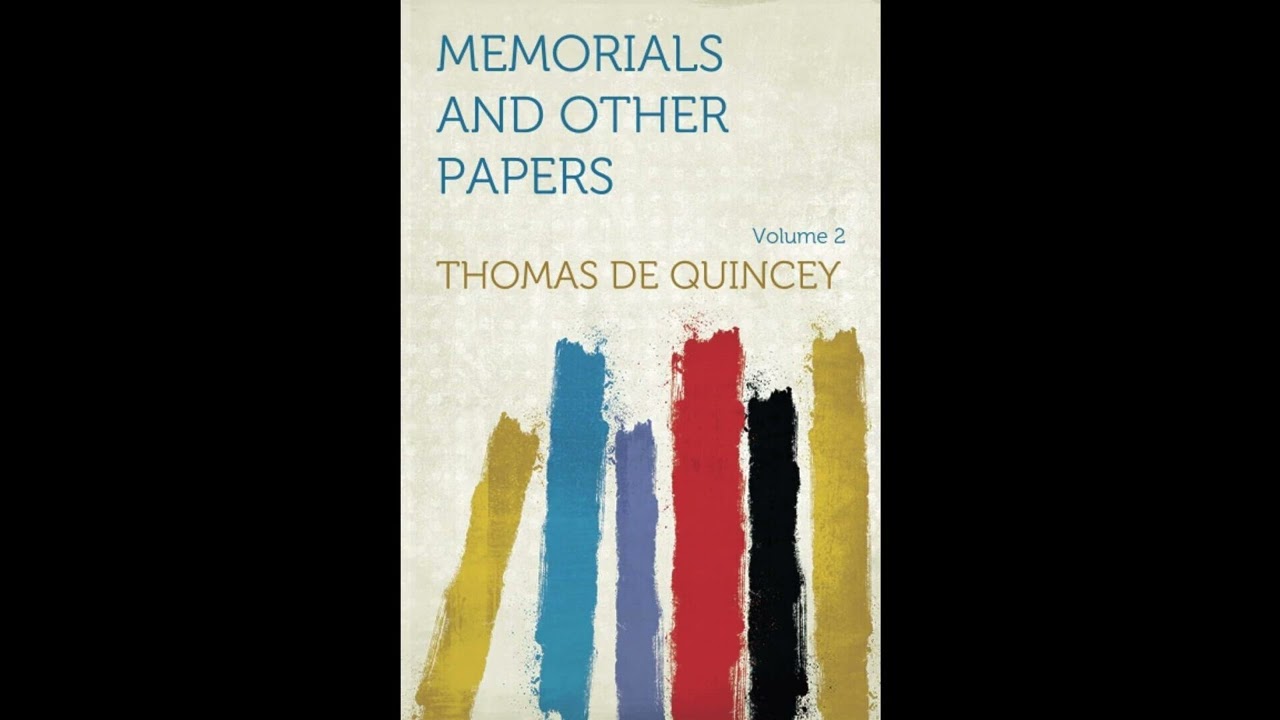
Memorials and Other Papers
Thomas De Quincey's Memorials and Other Papers invites the listener into the unique, often labyrinthine mind of one of the 19th century’s most idiosyncratic prose stylists. This collection is not a single narrative, but rather a series of intensely personal reminiscences, literary critiques, and speculative essays that together form a compelling portrait of an intellectual life lived on the fringes of genius and despair. It is a work that challenges conventional understandings of autobiography and literary criticism, offering a rare glimpse into the complex interplay of memory, imagination, and analytical thought. For a contemporary listener, De Quincey's writing remains remarkably resonant, speaking to enduring questions about identity, the weight of the past, and the power of language to reconstruct — and perhaps even invent — reality. The pieces within Memorials and Other Papers operate less like traditional stories and more like profound intellectual and emotional excursions. The "setting" is often the landscape of De Quincey’s own consciousness, shifting from the precise recollection of a childhood incident to a wide-ranging disquisition on classical literature or contemporary politics. The "main character," if one can be said to exist, is De Quincey himself—a highly sensitive, intellectually agile observer whose life experiences, particularly his early struggles and later opium use, profoundly shaped his perceptions. Listeners will encounter vivid recollections of his early life, his encounters with the leading literary figures of his day, and his meticulous, sometimes obsessive, analyses of literary texts and historical events. Central to many of these papers is a subtle conflict: the ongoing struggle to reconcile personal experience with universal truth, to capture the fleeting nature of memory while constructing enduring meaning. De Quincey does not present a linear plot, but rather a spiraling exploration, where a seemingly simple anecdote can lead to a profound philosophical rumination, and a detailed literary analysis can reveal deeper psychological insights. The collection’s arc is therefore one of intellectual and emotional discovery, a journey through the author’s inner world where logic and dream often intertwine, leaving the listener with a deep sense of the richness and sometimes the anguish of human thought. Born in Manchester in 1785, Thomas De Quincey experienced a childhood marked by both intellectual precocity and profound sorrow, particularly after the early death of his father. A brilliant but rebellious student, he famously ran away from grammar school at seventeen, leading to a period of destitution and hardship in London. It was during these formative years that he first encountered opium, which would become both a source of relief from physical pain and the genesis of some of his most striking literary visions. He later attended Oxford, though without taking a degree, and settled in the Lake District, forming associations with literary giants like William Wordsworth and Samuel Taylor Coleridge. De Quincey’s most celebrated work, Confessions of an English Opium-Eater (1821), revolutionized the genre of autobiography, blending personal confession with vivid, dream-like prose to create a powerful account of addiction and its psychological effects. Beyond the Confessions, he was a prolific essayist, contributing to leading periodicals of his day and producing a vast body of literary criticism, historical reflections, and philosophical speculations. His distinctive prose style—often elaborate, parenthetical, and highly rhetorical—cemented his place as a significant figure within the Romantic movement, though his individualistic approach and psychological depth often set him apart from his contemporaries. He spent much of his later life in Scotland, continuing to write until his death in Edinburgh in 1859. The papers collected here often manifest several enduring themes. One prominent theme is the unreliability and transformative power of memory. De Quincey frequently returns to episodes from his childhood and youth, not merely as factual recall but as subjects for intense contemplation, showing how the past is continually reshaped by the present mind. For instance, his detailed yet sometimes elusive recollections of figures like Wordsworth illustrate how personal admiration and intellectual engagement color the act of remembrance, making the past a living, mutable entity rather than a fixed historical record. Another central theme is the profound influence of imagination and the subconscious on human perception. De Quincey’s prose often blurs the lines between waking reality and dream logic, reflecting his own experiences and his belief in the mind’s capacity for rich, internal landscapes. His descriptions of seemingly mundane events can suddenly swell with symbolic resonance and emotional intensity, akin to the unsettling clarity of a dream, suggesting that even in his critical essays, an imaginative undercurrent constantly operates beneath the surface of his analytical thought. A third theme that often emerges is the tension between the solitary individual and societal expectations. De Quincey often presents himself as an outsider, an observer of humanity, and his unique perspective allows him to dissect social norms and intellectual trends with both humor and critical insight, even as he recounts his own struggles with isolation. De Quincey's productive years spanned a fascinating period in European history, the first half of the 19th century, following the Napoleonic Wars and coinciding with the flourishing of British Romanticism. It was an era characterized by immense social and political upheaval, rapid industrialization, and a fervent interest in individual emotion, nature, and the sublime. The burgeoning periodical press provided an ideal platform for essayists like De Quincey, allowing him to disseminate his unconventional ideas and elaborate prose to a wider, increasingly literate public. His work emerged from a cultural landscape that valued profound introspection and the personal narrative, making the individual's inner world a legitimate subject for serious literary consideration. His essays captured the intellectual ferment of the time, engaging with current debates in philosophy, literature, and even economics, while always infusing them with his distinct psychological lens. Listening to Memorials and Other Papers as an audiobook provides an ideal conduit for De Quincey's singular voice. His elaborate sentence structures, long parenthetical clauses, and nuanced shifts in tone—from reflective and melancholic to sharply witty and analytical—gain immense clarity and dramatic weight when expertly narrated. The run length of several hours allows the listener to become fully immersed in his discursive style, to appreciate the rhythm and musicality of his prose, rather than being daunted by its complexity on the page. A good narrator can highlight the sometimes subtle shifts in De Quincey's mood, from the grandiloquent to the intimately confiding, making his erudition accessible and his personal confessions deeply affecting. The atmospheric quality of his writing, whether describing the grimy streets of London or the serene landscapes of the Lakes, comes alive through the spoken word, creating a profound auditory experience that captures the essence of this extraordinary writer.
Enjoyed Memorials and Other Papers? A few ways to support us
Audible & Amazon links are affiliate; we may earn a small commission at no extra cost.
About this production
Human narration by a volunteer reader from LibriVox.org, the public-domain audiobook project. LibriVox volunteers record literary works whose copyright has expired in the United States, releasing the resulting recordings into the public domain.
Memorials and Other Papers by Thomas De Quincey. The underlying text is in the U.S. public domain. We do not republish any modern copyrighted edition, translation, or commentary.
The 4K cinematic visuals accompanying this audiobook are generated by an AI image model from prompts derived from the source text. No copyrighted photos, paintings, or stock footage are used. AI generation is disclosed on every video on our YouTube channel as required by YouTube's altered/synthetic content policy.
English subtitles are transcribed from the LibriVox recording with OpenAI Whisper. Translations into the 11 other supported languages are produced by Meta's NLLB-200 neural translation model. No human translator's copyrighted translation is used.
Questions about sourcing or rights? See our DMCA & Sourcing policy or contact us.
Enjoyed this audiobook?
If you'd like to own a copy of Memorials and Other Papers or hear a professionally produced edition, the links below help support free audiobook production at no extra cost to you.
As an Amazon Associate we earn from qualifying purchases. Audible / print links are affiliate.