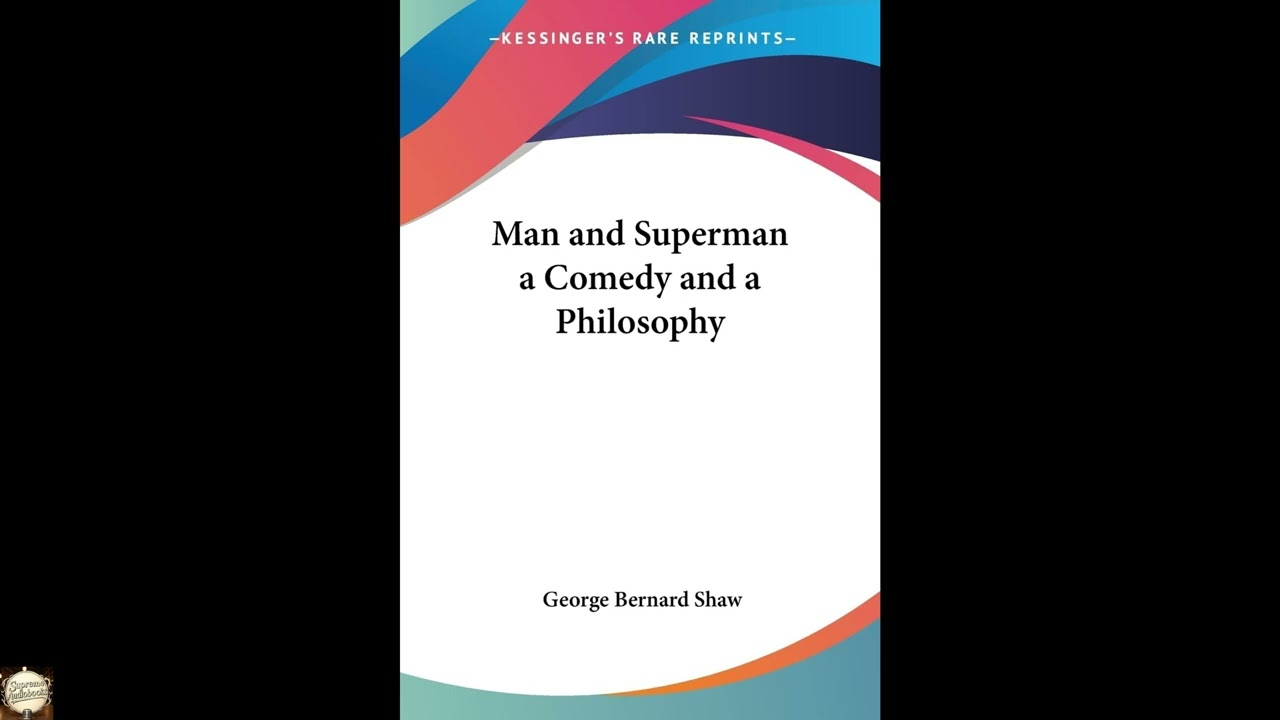
Man and Superman a Comedy and a Philosophyv
George Bernard Shaw's Man and Superman is no mere drawing-room comedy. Published at the dawn of the 20th century, this audacious work is a vibrant intellectual skirmish disguised as a play about love and marriage, and it remains as relevant and provocative today as it was over a hundred years ago. It forces us to confront fundamental questions about human nature, the battle between the sexes, and the relentless drive for progress, all wrapped in Shaw's signature wit and bracing philosophical debate. Why should a listener care now? Because its central premise—that life itself is driven by an evolutionary "Life Force" using individuals as its instruments—challenges our notions of free will, societal expectations, and the true motivations behind our most personal choices. This is a work that entertains even as it reshapes your understanding of the world, urging you to look past superficialities to the deeper currents of human existence. The play introduces us to a world of Edwardian society where appearances often mask deeper, more primal urges. Our chief protagonist is Jack Tanner, a young, wealthy, and fiercely independent intellectual, a self-proclaimed revolutionary who has authored a incendiary philosophical text entitled The Revolutionist's Handbook and Pocket Companion. He sees himself as a free spirit, railing against the conventions of property, morality, and most vehemently, marriage, which he views as a trap designed by women to subjugate men. Arrayed against his ideals is Ann Whitefield, a beautiful, intelligent, and outwardly demure young woman who has recently become Tanner’s ward. She is, to all outward appearances, a proper lady, but beneath her polite facade lies an indomitable will and a clear objective: she intends to marry Jack Tanner. The central conflict hinges on Ann's relentless pursuit of Jack, who, despite his grand pronouncements and attempts to escape, finds himself increasingly cornered. Ann is aided and abetted by her social set, including Ricky, a respectable but less intellectually formidable suitor, and Octavius Robinson, a romantic poet hopelessly in love with Ann, who remains oblivious to her deeper machinations. The narrative unfolds through a series of witty verbal duels, farcical chases, and unexpected encounters, including a celebrated dream sequence where Tanner finds himself in Hell debating the nature of humanity with Don Juan, the Devil, and other figures. This philosophical interlude, often considered the intellectual core of the play, allows Shaw to put his most radical ideas directly into the mouths of his characters, further illuminating the profound conflict between intellect and instinct that drives the main plot. Throughout, the audience watches as Jack tries desperately to outrun his fate, only to discover that the forces aligned against him are far more ancient and powerful than any philosophical argument. George Bernard Shaw (1856-1950) was a towering figure of Irish literature, a playwright, critic, and polemicist whose influence on 20th-century theatre is impossible to overstate. Born in Dublin, he moved to London in his early twenties and soon made a name for himself as a fiercely intelligent music and theatre critic, known for his sharp tongue and radical views. Shaw became a prominent member of the Fabian Society, a socialist intellectual movement advocating for gradual rather than revolutionary social reform, and many of his plays served as platforms for his social and political ideas. He was a prolific writer, penning more than sixty plays, along with novels, essays, and critical pieces. Shaw’s contribution to the literary canon is immense. He received the Nobel Prize in Literature in 1925, though he famously tried to decline the prize money. His output includes universally acclaimed works such as Pygmalion (the basis for My Fair Lady), a satirical look at class and language; Major Barbara, which questions the ethics of philanthropy and the source of moral goodness; Mrs. Warren's Profession, which boldly tackles prostitution and societal hypocrisy; and Saint Joan, a profound historical drama. Shaw is remembered for his brilliant wit, his capacity for intellectual argument, and his unwavering commitment to using theatre as a means of challenging complacent Victorian and Edwardian morality, making him a pivotal figure in the development of modern drama. At its heart, Man and Superman presents a stark and fascinating reversal of traditional gender roles, a theme enacted through the relentless pursuit of Jack Tanner by Ann Whitefield. Shaw introduces his concept of the "Life Force," an evolutionary drive that compels individuals, particularly women, to seek out the most intelligent and capable partners for the advancement of the species. Ann, far from being a passive damsel, is the active hunter, embodying this instinctual power with calculated charm and unwavering resolve, demonstrating that the woman is, in Shaw's view, often the aggressor in the "battle of the sexes," despite societal appearances. Her quiet determination utterly overwhelms Jack's verbose, intellectual resistance, turning the conventional romantic chase on its head. Beyond this gender role reversal, the play offers a searing critique of Edwardian society and its inherent hypocrisies. Shaw exposes the superficiality of upper-class manners and the performative nature of morality, particularly concerning marriage and social standing. The characters often say one thing while their actions, driven by deeper, often unconscious forces, suggest another. This social commentary is intertwined with the profound philosophical debate between intellect and instinct. Jack Tanner represents pure reason, idealism, and the belief in human agency, while Ann represents the primal, irresistible pull of the Life Force. The play repeatedly questions whether human intellect can truly withstand or redirect the powerful, biological imperatives that shape our lives and the direction of human evolution, ultimately suggesting that instinct often holds the upper hand. When Man and Superman was published in 1903, Britain stood at a fascinating cultural crossroads. The long, rigid Victorian era had just concluded, giving way to the Edwardian period, a time of increasing social change and questioning of established norms. The women's suffrage movement was gaining momentum, challenging patriarchal structures and demanding greater agency for women, a sentiment Shaw clearly echoes and even exaggerates in his depiction of Ann Whitefield. Intellectually, Charles Darwin's theories of evolution were still hotly debated and being assimilated into broader cultural thought, providing a fertile ground for Shaw’s concept of the "Life Force" as an evolutionary imperative. Politically, socialist ideas, championed by groups like the Fabian Society, were challenging the entrenched class system and capitalist structures. In the literary world, there was a growing appetite for "problem plays" and dramas of ideas, pioneered by Henrik Ibsen, which confronted social issues head-on rather than offering escapist entertainment. Shaw took this trend and supercharged it, using his stage not just to reflect society, but to actively argue for its transformation, making Man and Superman a direct product of, and a powerful commentary on, its specific historical moment. Listening to Man and Superman as an audiobook offers a singular opportunity to engage with Shaw's electric prose and challenging ideas. The play's considerable run length—several hours—provides ample time to become fully immersed in its world and its dense philosophical arguments, allowing listeners to absorb the nuances without the pressure of a live performance or the visual distractions of reading. A skilled narrator, or indeed a full cast, can brilliantly illuminate the rapid-fire wit and intellectual sparring that defines the play. Pay close attention to the pacing of the dialogue, the distinct voices that emerge for each character—from Jack Tanner’s earnest, often frantic intellectualizing to Ann Whitefield’s deceptively gentle but ultimately unyielding tone—and the shifts in atmosphere from drawing-room comedy to intense philosophical debate. The spoken word brings Shaw’s vibrant dialogue to life, making the complex ideas more accessible and the comedy even more potent, ensuring the listener hears the very pulse of his revolutionary thought.
Enjoyed Man and Superman a Comedy and a Philosophyv? A few ways to support us
Audible & Amazon links are affiliate; we may earn a small commission at no extra cost.
About this production
Human narration by a volunteer reader from LibriVox.org, the public-domain audiobook project. LibriVox volunteers record literary works whose copyright has expired in the United States, releasing the resulting recordings into the public domain.
Man and Superman a Comedy and a Philosophyv by George Bernard Shaw. The underlying text is in the U.S. public domain. We do not republish any modern copyrighted edition, translation, or commentary.
The 4K cinematic visuals accompanying this audiobook are generated by an AI image model from prompts derived from the source text. No copyrighted photos, paintings, or stock footage are used. AI generation is disclosed on every video on our YouTube channel as required by YouTube's altered/synthetic content policy.
English subtitles are transcribed from the LibriVox recording with OpenAI Whisper. Translations into the 11 other supported languages are produced by Meta's NLLB-200 neural translation model. No human translator's copyrighted translation is used.
Questions about sourcing or rights? See our DMCA & Sourcing policy or contact us.
Enjoyed this audiobook?
If you'd like to own a copy of Man and Superman a Comedy and a Philosophyv or hear a professionally produced edition, the links below help support free audiobook production at no extra cost to you.
As an Amazon Associate we earn from qualifying purchases. Audible / print links are affiliate.