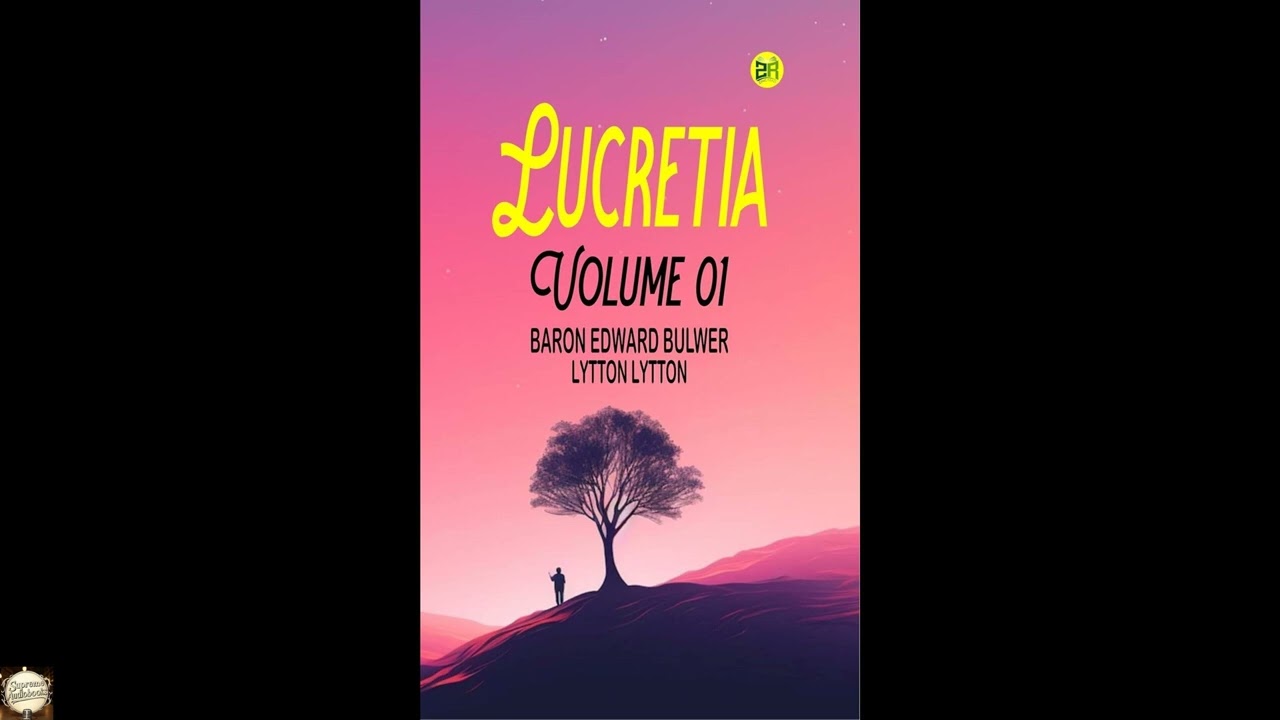
Lucretia Volume 01
Baron Edward Bulwer Lytton’s Lucretia Volume 01 emerges from the Victorian literary landscape as a searing psychological drama, a chilling examination of ambition, morality, and the devastating consequences of unchecked will. Forget the dusty perception of classic literature; this is a novel that plunges headfirst into the darker corners of the human psyche, presenting a protagonist whose complex motivations and calculated actions resonate with an unnerving modernity. For listeners seeking a challenging narrative that probes the very nature of good and evil, and for those fascinated by the intricate workings of a mind driven to its limits, Lucretia offers an absorbing experience that questions the boundaries of societal expectation and individual desire, proving that the Victorian age harbored stories as profoundly disturbing and thought-provoking as any penned today. Volume 01 introduces us to Lucretia Clavering, a woman of striking beauty and formidable intellect, whose early life is shadowed by complex familial relationships and a nascent, yet powerful, desire for control and social standing. Her background is not one of straightforward villainy, but rather a nuanced interplay of circumstance, perceived slights, and a chillingly rational view of the world that gradually divorces itself from conventional morality. We see her navigate the polite yet ruthless society of early nineteenth-century England, moving from aristocratic country estates where appearances are paramount to the grittier, more dangerous undercurrents of London. Among those drawn into Lucretia’s orbit is Clarence Glyndon, a young artist of passionate temperament and naive idealism, whose artistic sensibilities make him particularly susceptible to her allure. Perceval Athelstone, a man of unwavering integrity and a strong moral compass, stands as a stark contrast to Lucretia’s emerging worldview, representing the virtues that she increasingly discards. The central conflict of this initial volume centers on Lucretia’s calculated ascent, her subtle manipulations, and the slow unraveling of her moral restraints as she pursues wealth and power, often at the expense of those closest to her. The stage is meticulously set for a grand moral confrontation, as Bulwer Lytton masterfully foreshadows the tragic implications of Lucretia’s relentless drive, sketching out the early stages of a life that promises to be both dazzling and devastating. The author behind this compelling narrative was Edward Bulwer Lytton, born Edward George Earle Lytton Bulwer in 1803. A prodigious and celebrated figure of the Victorian age, he was a novelist, poet, playwright, and politician whose influence stretched across multiple spheres. His early life was marked by a somewhat unconventional upbringing, characterized by an overprotective mother and an inherited intellectual inclination. After a turbulent marriage to Rosina Doyle Wheeler, which became a scandalous public affair, Bulwer Lytton inherited his mother’s Knebworth estate and assumed the additional surname "Lytton," becoming Baron Lytton. He served as a Whig Member of Parliament for many years, later switching to the Conservative party and holding positions such as Secretary of State for the Colonies, demonstrating a public career as varied and dramatic as his literary output. Bulwer Lytton was an immensely popular writer during his lifetime, and his work profoundly shaped popular fiction. He is perhaps best remembered for novels like The Last Days of Pompeii, a vivid historical reconstruction, and Rienzi, the Last of the Roman Tribunes, another tale of historical grandeur and political ambition. His earlier "Newgate novels," such as Paul Clifford and Eugene Aram, which focused on criminals and their psychology, sparked considerable debate for their perceived glamorization of crime, a controversy that Lucretia would later reignite. He was a master of the sensational and the psychological, known for his elegant prose and his ability to construct intricate plots. Bulwer Lytton’s place in the literary canon is that of a pivotal transitional figure, bridging the Romantic and Gothic traditions with the burgeoning realism and psychological depth of the Victorian novel, even coining phrases that endure in our language today, such as "the pen is mightier than the sword." He died in 1873, leaving behind an oeuvre that continues to be re-evaluated for its insights into society and human nature. Lucretia powerfully enacts several key themes, making it a text rich with meaning for contemporary audiences. Central to the novel is the theme of ambition and its corrupting force. Lucretia herself is the embodiment of this, as her early desire for status and security transforms into a relentless, almost pathological drive for control, leading her to consider and perform acts that defy conventional morality. For instance, the novel meticulously details her calculated decisions regarding strategic marriages or the manipulation of inheritances, showing how each step, seemingly rational in isolation, draws her deeper into a web of deceit. Another prominent theme is the nature of psychological villainy, exploring how a mind can become detached from empathy and moral constraint without resorting to caricature. The novel probes the origins of Lucretia’s cold reasoning, illustrating how her formidable intellect can operate with ruthless efficiency, justifying increasingly dark deeds through a twisted internal logic, rather than relying on external forces of evil. The novel also examines social hypocrisy and the illusion of respectability within Victorian society. Bulwer Lytton consistently exposes the moral failings and hidden machinations that lie beneath the polished surfaces of aristocratic and genteel life. The contrast between outward appearances and the secret, often sinister, dealings within supposedly respectable homes highlights the era's deep-seated anxieties about class, status, and the fragility of public perception. Finally, the question of fate versus free will looms large throughout Lucretia. While some characters might feel trapped by circumstance or inherited disposition, the narrative consistently emphasizes Lucretia’s active choices, presenting her not as a victim, but as an agent who deliberately charts her destructive course, forcing the reader to confront the profound responsibility inherent in individual decisions. Published in 1846, Lucretia arrived at a moment when Victorian society grappled intensely with questions of morality, crime, and the boundaries of literary taste. The mid-19th century was a period of rapid social change, marked by the ongoing effects of industrialization, growing urban centers, and increasing awareness of social inequalities. There was a public fascination with crime, often sensationalized in newspapers and pamphlets, leading to intense debates about the moral responsibility of authors depicting such subjects. Bulwer Lytton himself, a prominent politician and intellectual, found his work scrutinized not just for its literary merit, but for its potential social impact. The novel’s portrayal of a female criminal, intelligent and calculating rather than merely passionate or insane, sparked considerable outrage and controversy. Critics accused Bulwer Lytton of glorifying vice and challenging established moral norms, placing Lucretia squarely within the ongoing "Newgate novel" debate. This outcry, while perhaps hindering its immediate critical reception, solidified its place as a daring and provocative text that pushed the envelope of psychological realism and social commentary, reflecting Victorian anxieties about the darker aspects of human nature and the unsettling potential for evil within seemingly respectable individuals. The layered prose of Bulwer Lytton, with its careful character studies and dramatic build-up, truly comes alive when delivered by an expressive narrator. Listeners will find the several hours of performance a deeply absorbing experience, one that allows the intricate language and psychological tension to unfold at a measured pace. A skilled voice actor can convey the subtle nuances of Lucretia’s chilling rationality, the artistic angst of Glyndon, and the unwavering integrity of Athelstone, distinguishing characters and bringing their internal struggles into sharp relief. The pacing of the narration can build suspense during Lucretia's machinations and allow moments of moral reflection to truly resonate, pulling listeners into the gaslit drawing rooms and shadowed alleyways of the 19th century. This vocal rendition transforms a dense classic into an immediate, almost theatrical presentation, allowing the dark atmosphere and profound moral questions of Lucretia Volume 01 to permeate the listener's consciousness with undeniable force.
Enjoyed Lucretia Volume 01? A few ways to support us
Audible & Amazon links are affiliate; we may earn a small commission at no extra cost.
About this production
Human narration by a volunteer reader from LibriVox.org, the public-domain audiobook project. LibriVox volunteers record literary works whose copyright has expired in the United States, releasing the resulting recordings into the public domain.
Lucretia Volume 01 by Baron Edward Bulwer Lytton Lytton. The underlying text is in the U.S. public domain. We do not republish any modern copyrighted edition, translation, or commentary.
The 4K cinematic visuals accompanying this audiobook are generated by an AI image model from prompts derived from the source text. No copyrighted photos, paintings, or stock footage are used. AI generation is disclosed on every video on our YouTube channel as required by YouTube's altered/synthetic content policy.
English subtitles are transcribed from the LibriVox recording with OpenAI Whisper. Translations into the 11 other supported languages are produced by Meta's NLLB-200 neural translation model. No human translator's copyrighted translation is used.
Questions about sourcing or rights? See our DMCA & Sourcing policy or contact us.
Enjoyed this audiobook?
If you'd like to own a copy of Lucretia Volume 01 or hear a professionally produced edition, the links below help support free audiobook production at no extra cost to you.
As an Amazon Associate we earn from qualifying purchases. Audible / print links are affiliate.