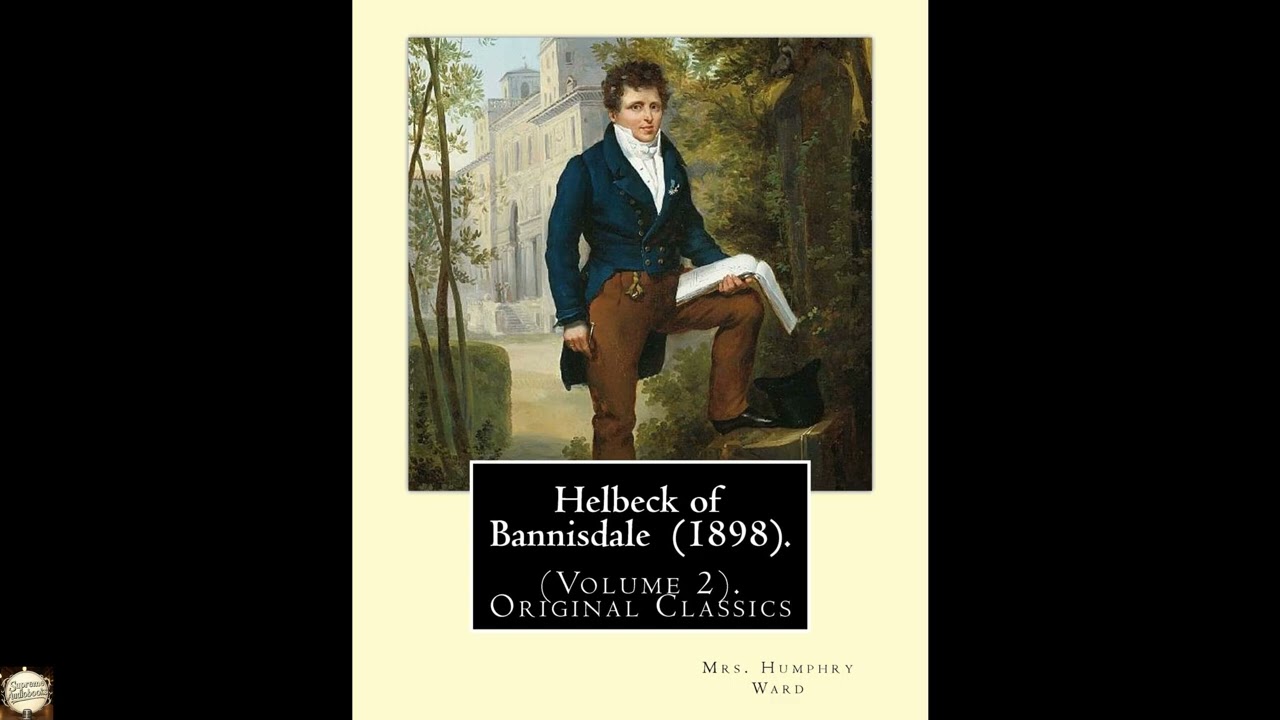
Helbeck of Bannisdale — Volume I
In the quiet corners of the Victorian psyche, where duty wrestled with desire and fervent belief clashed with emerging doubt, stood a novelist unafraid to expose the very sinews of human spiritual struggle. Mrs. Humphry Ward's Helbeck of Bannisdale — Volume I invites listeners into a world where the heart’s affections are inextricably bound to the soul’s convictions. This is a story for anyone who has ever grappled with the profound question of what it means to love someone whose fundamental worldview stands in direct opposition to their own, a drama as resonant today in our ideologically divided world as it was over a century ago. It challenges us to consider whether bridges of affection can truly span the chasms of faith and philosophy. The story unfurls amidst the stark, beautiful landscape of Bannisdale in the English Lake District, a place steeped in tradition and isolated from metropolitan life. Here resides Alan Helbeck, the austere and deeply pious owner of Bannisdale Hall, a man whose entire existence is devoted to his Roman Catholic faith. His ancestral home, once a monastic property, is a testament to generations of devotion, filled with relics and religious observance. Helbeck, a figure of moral rectitude and quiet intensity, carries the weight of his family’s history and the obligations of his inherited faith. Into this carefully ordered world arrives Laura Fountain, a young woman whose background could not be more different. Orphaned and recently returned from a progressive upbringing on the Continent, Laura represents the burgeoning modernity of the late nineteenth century. Her late father, a Cambridge scholar, instilled in her a spirit of independent inquiry and agnosticism. She comes to Bannisdale to live with her aunt, Helbeck’s sister, who has married outside the Catholic Church and lives in uneasy truce with her brother’s piety. The central conflict ignites with the undeniable, yet profoundly complicated, attraction that blossoms between Alan and Laura. He finds himself drawn to her intelligence, her honesty, and her freshness of spirit, despite her lack of faith. She, in turn, is moved by his sincerity, his quiet strength, and the goodness she perceives in him, even as she recoils from the strictures of his Catholicism. Volume I meticulously traces the development of this impossible love, detailing their intense conversations, unspoken desires, and the growing awareness of the gulf separating their spiritual worlds. Can love conquer such fundamental differences, or is their connection doomed by the very bedrock of their beings? The author behind this compelling drama was Mary Augusta Ward, known to her readers as Mrs. Humphry Ward. Born in 1851 in Hobart, Tasmania, she hailed from a strong intellectual lineage: she was the granddaughter of educator Thomas Arnold of Rugby, and niece of poet Matthew Arnold. Her family relocated to England when she was a child, and she grew up surrounded by the academic life of Oxford, where her father was a professor. This environment fostered her intellect and early engagement with philosophical and religious questions. Mrs. Ward became a significant literary figure in her own right, achieving widespread fame and recognition during the late Victorian and Edwardian eras. Her work often grappled with the intellectual and social anxieties of her time—the erosion of traditional religious belief in the face of scientific criticism, and the changing roles of women. Her novel Robert Elsmere, published in 1888, became an international sensation, selling hundreds of thousands of copies and sparking debate about faith and doubt. Other notable works include Marcella (1894), which addressed social reform, and The History of David Grieve (1892). While later literary tastes sometimes relegated her to a lesser status, recent scholarship shows renewed interest in her nuanced contributions to Victorian literature. She was not only a novelist but also an active social reformer, involved in educational initiatives and settlement work, even as she controversially opposed women’s suffrage. Her life, like her novels, observed a society in flux, where progress and tradition continually sparred. At its core, Helbeck of Bannisdale directly confronts the theme of religious faith versus intellectual doubt. The novel portrays Alan Helbeck’s unwavering devotion to Roman Catholicism—a faith providing structure, purpose, and belonging to an ancient spiritual heritage, a world of ritual and personal sacrifice. Laura Fountain embodies modern skepticism, valuing rational inquiry and personal freedom. Her discomfort during a Catholic service and her arguments with Helbeck show the incompatibility of their worldviews. The story forces characters to confront the personal implications of these divergent paths. Another crucial theme woven throughout the narrative is the conflict between love and ideology. Can affection survive when two people are separated by such profound differences? Mrs. Ward renders Laura's agonizing struggle: drawn to Helbeck’s character, yet unable to embrace his beliefs, which she perceives as restrictive. Helbeck is tested by his love for a woman whose being challenges his faith. The novel also addresses the role of women in a changing society. Laura seeks intellectual fulfillment and agency in a world still defined by conventional expectations. Her unconventional upbringing and resistance to conforming offer commentary on the evolving female experience. The novel emerged at a pivotal moment in English history: the twilight of the Victorian era (1898). This period was characterized by societal upheaval and intellectual ferment. Charles Darwin's theories had long since shaken the bedrock of religious orthodoxy, and biblical scholarship questioned traditional scripture. Agnosticism and non-belief became common among educated classes, creating a crisis of faith across literature and culture. Simultaneously, a resurgence of Roman Catholicism drew converts from the Anglican Church, influenced by the Oxford Movement. Helbeck of Bannisdale perfectly captures this tension. Mrs. Ward, witnessing these intellectual debates, used her fiction to scrutinize the schisms these developments created. The novel functions as a literary snapshot of a society grappling with tradition versus modernity, asking questions about belief, doubt, and conviction. It offers a window into the intellectual anxieties of a generation on the cusp of a new century, wrestling with the meaning of faith in a secularizing world. To experience Helbeck of Bannisdale — Volume I as an audiobook offers an intimate understanding of its nuanced arguments and characters' emotional lives. The narrative, spanning several hours, unfolds with a deliberate pace, allowing full absorption of its moral and philosophical dilemmas. A skilled narrator illuminates subtle shifts in dialogue, emphasizing tensions and the inner turmoil defining Alan and Laura’s interactions. The spoken word brings directness to intellectual debates, placing the listener in their discussions about faith, reason, and duty. Bannisdale's atmosphere, with its ancient presence, comes alive through vocal interpretation, painting mental pictures of the landscape and Helbeck's solemn world. This format deepens engagement with Mrs. Ward's prose, making the struggles of love and belief feel immediate and moving, transforming a Victorian classic into a resonant dramatic experience.
Enjoyed Helbeck of Bannisdale — Volume I? A few ways to support us
Audible & Amazon links are affiliate; we may earn a small commission at no extra cost.
About this production
Human narration by a volunteer reader from LibriVox.org, the public-domain audiobook project. LibriVox volunteers record literary works whose copyright has expired in the United States, releasing the resulting recordings into the public domain.
Helbeck of Bannisdale — Volume I by Mrs. Humphry Ward. The underlying text is in the U.S. public domain. We do not republish any modern copyrighted edition, translation, or commentary.
The 4K cinematic visuals accompanying this audiobook are generated by an AI image model from prompts derived from the source text. No copyrighted photos, paintings, or stock footage are used. AI generation is disclosed on every video on our YouTube channel as required by YouTube's altered/synthetic content policy.
English subtitles are transcribed from the LibriVox recording with OpenAI Whisper. Translations into the 11 other supported languages are produced by Meta's NLLB-200 neural translation model. No human translator's copyrighted translation is used.
Questions about sourcing or rights? See our DMCA & Sourcing policy or contact us.
Enjoyed this audiobook?
If you'd like to own a copy of Helbeck of Bannisdale — Volume I or hear a professionally produced edition, the links below help support free audiobook production at no extra cost to you.
As an Amazon Associate we earn from qualifying purchases. Audible / print links are affiliate.