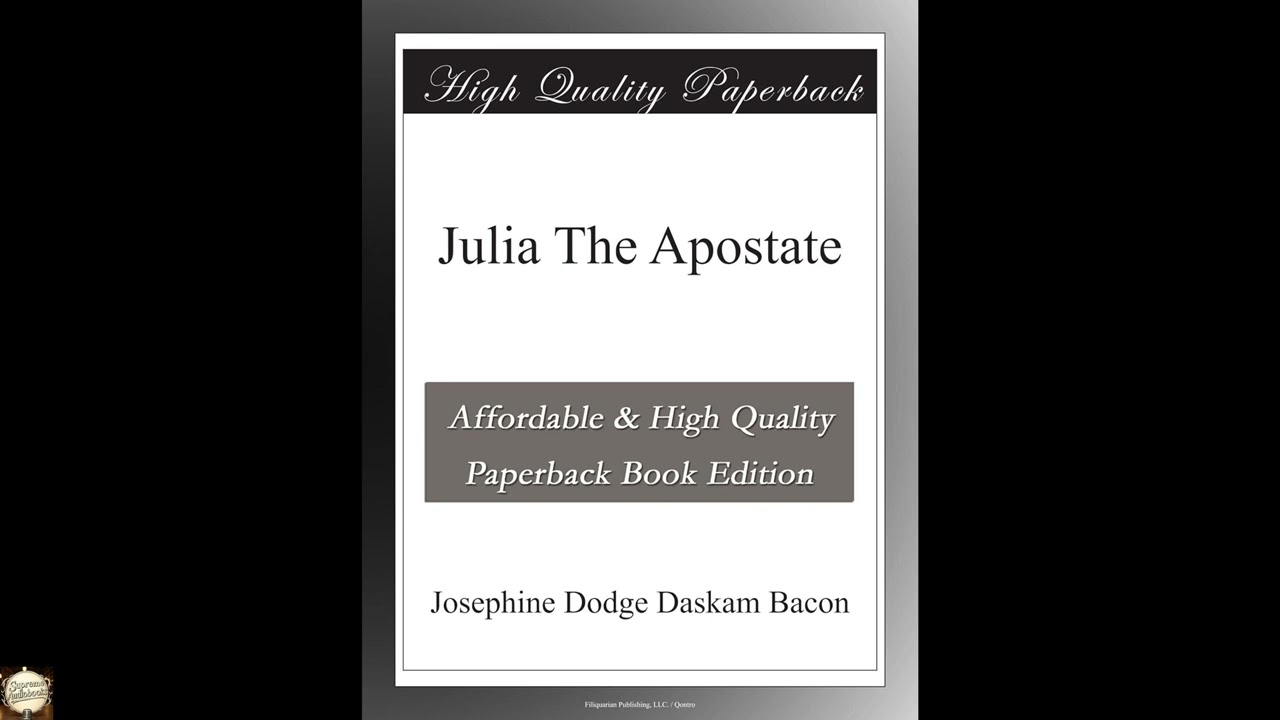
Julia The Apostate
In an era often fixated on external success and conformity, Josephine Dodge Daskam Bacon's "Julia The Apostate" emerges as a compelling declaration for the individual spirit. This keenly observed novel, a classic of American literature, invites listeners to consider the often-unseen battles fought within drawing-rooms and social circles, battles whose echoes resonate with surprising clarity in our own time. It is a story not just about a woman's refusal to conform, but about the profound search for authenticity amidst a sea of expectations, offering a nuanced look at the true cost and ultimate reward of charting one's own course, even if it means being labeled an "apostate" by society. The narrative introduces us to Julia, a young woman living within the well-defined, somewhat suffocating parameters of turn-of-the-century American high society. She possesses all the advantages of her class—beauty, intelligence, and social standing—which, by all accounts, should pave her way to an enviable marriage and a life of domestic fulfillment. Yet, Julia finds herself increasingly alienated by the predictable trajectory laid out before her. The world she inhabits, filled with eligible bachelors and the hushed discussions of engagements and dowries, feels less like a promised land and more like a gilded cage. Her discomfort isn't a childish petulance, but a deeper, intellectual and emotional resistance to the idea of becoming merely a possession, a reflection of a man’s status. The central conflict ignites when Julia begins to openly question these established norms, particularly the very institution of marriage as dictated by her society. Her friends and family, bewildered by her unconventional stance, perceive her growing independence as a dangerous deviation from propriety. They expect her to settle, to take her rightful place within the social fabric, but Julia is unwilling to compromise her sense of self for the sake of appearances or security. Her "apostasy" isn't a dramatic, public scandal, but a quiet, persistent refusal to utter the expected vows, to follow the prescribed path, leading to a series of encounters and choices that challenge both her convictions and the patience of her social sphere. The story follows her as she navigates these pressures, seeking a form of happiness and personal integrity that defies the conventional wisdom of her time. Josephine Dodge Daskam Bacon (1876-1961) was a significant voice in American letters during the early twentieth century, known for her sharp wit and insightful commentary on social issues, particularly those concerning women. Born in Stamford, Connecticut, and a graduate of Vassar College in 1898, Daskam was part of a generation of educated women who began to push against traditional boundaries. Her collegiate experience undeniably shaped her perspective, providing her with a unique lens through which to observe and critique the societal roles often imposed upon women in her time. She married Selden Bacon, a lawyer, in 1903, and continued her prolific writing career while also raising children. Her literary output was diverse, including novels, short stories, and poetry, often marked by a distinctive blend of humor and serious social critique. Beyond "Julia The Apostate," she gained considerable recognition for "The Memoirs of a Baby" (1904), a satirical look at child-rearing, and "The Impudent Reflections of a Debutante" (1906), another work that gently poked fun at societal expectations for young women. Daskam Bacon was adept at using her fiction as a means to discuss issues of women's independence, education, and the changing landscape of domestic life. She published widely in popular magazines of the era, reaching a broad audience with her forward-thinking ideas, establishing her as a writer who was both entertaining and thought-provoking, firmly situated among authors who brought a modern sensibility to American realism. One of the central themes that "Julia The Apostate" skillfully examines is the tension between individual authenticity and societal conformity. Julia's struggle to forge a path that aligns with her inner convictions, rather than yielding to external pressures, forms the very core of the narrative. For instance, early in the novel, her friends discuss their upcoming engagements with an almost ritualistic acceptance of their fate, yet Julia feels a palpable sense of dread at the thought of subsuming her identity into a marriage purely for social validation, a stark contrast to the easy acquiescence around her. Another significant theme is the evolving role of women in the early twentieth century, particularly the "New Woman" archetype. Julia embodies this spirit, rejecting the passive, ornamental role often assigned to women of her class, choosing instead to pursue intellectual fulfillment and personal agency. She is shown engaging in serious discussions and making independent decisions about her future, actions that are met with confusion and concern by those who adhere to more traditional gender roles. Furthermore, the novel offers a pointed critique of the institution of marriage itself, not as an inherently flawed concept, but as it was often practiced and perceived within the privileged circles of the time—as a transaction, a social obligation, rather than a partnership of equals. Julia's refusal to marry without genuine affection and respect highlights her progressive views, challenging the prevailing notion that a woman's ultimate purpose was to secure a suitable husband. Her internal monologues frequently question the wisdom of alliances formed more out of convenience or expectation than true connection. A fourth theme that runs through the book is the nature of happiness and what it truly means to live a fulfilling life. Julia's quest is not for fleeting pleasure, but for a deeper, more enduring contentment found in self-reliance and intellectual honesty, a pursuit that sets her apart from her peers who often equate happiness solely with social acceptance and material comfort. "Julia The Apostate" emerged during a period of significant social and cultural upheaval in America, roughly corresponding with the Progressive Era. The early 1900s witnessed profound changes, including the burgeoning women's suffrage movement, increased access to higher education for women, and a growing questioning of Victorian social norms. Women like Julia were beginning to enter universities, pursue careers, and demand greater autonomy, leading to the rise of the "New Woman" — an educated, independent figure who challenged traditional domestic roles. This context provides a rich backdrop for Julia's "apostasy"; her rebellion was not an isolated eccentricity but a reflection of broader societal currents, a literary articulation of the quiet revolution occurring within countless American homes and hearts. The novel also resonates with the literary trends of the time, moving away from pure romanticism towards a more realistic, even satirical, portrayal of American life. Authors were increasingly interested in examining social structures and psychological nuances, making Josephine Dodge Daskam Bacon's work part of a larger conversation about identity and progress. The economic prosperity of the Gilded Age had solidified a particular upper-class lifestyle, and works like this offered an internal critique of its expectations and limitations, subtly contributing to the shift in cultural consciousness that would eventually pave the way for modernism and greater social freedoms. Listening to "Julia The Apostate" as an audiobook offers a unique gateway into its world, allowing the listener to truly experience the nuanced social commentary and the protagonist's internal struggle. The pacing of the narrative, often measured and observational, benefits immensely from skilled narration, which can bring out the dry wit and subtle ironies inherent in Daskam Bacon’s prose. The voice actor's portrayal of Julia, with her quiet determination and intellectual curiosity, becomes central to understanding her "apostasy." Listeners can appreciate the distinct voices of the various characters—the exasperated relatives, the well-meaning but conventional friends, the potential suitors—each rendered with an authenticity that enhances the atmosphere of polite, yet rigid, society. The spoken word allows the intricate dialogue and Julia’s thoughtful monologues to breathe, creating an immersive experience that highlights the enduring relevance of her quest for an independent self in a world eager to define her.
Enjoyed Julia The Apostate? A few ways to support us
Audible & Amazon links are affiliate; we may earn a small commission at no extra cost.
About this production
Human narration by a volunteer reader from LibriVox.org, the public-domain audiobook project. LibriVox volunteers record literary works whose copyright has expired in the United States, releasing the resulting recordings into the public domain.
Julia The Apostate by Josephine Daskam Bacon. The underlying text is in the U.S. public domain. We do not republish any modern copyrighted edition, translation, or commentary.
The 4K cinematic visuals accompanying this audiobook are generated by an AI image model from prompts derived from the source text. No copyrighted photos, paintings, or stock footage are used. AI generation is disclosed on every video on our YouTube channel as required by YouTube's altered/synthetic content policy.
English subtitles are transcribed from the LibriVox recording with OpenAI Whisper. Translations into the 11 other supported languages are produced by Meta's NLLB-200 neural translation model. No human translator's copyrighted translation is used.
Questions about sourcing or rights? See our DMCA & Sourcing policy or contact us.
Enjoyed this audiobook?
If you'd like to own a copy of Julia The Apostate or hear a professionally produced edition, the links below help support free audiobook production at no extra cost to you.
As an Amazon Associate we earn from qualifying purchases. Audible / print links are affiliate.