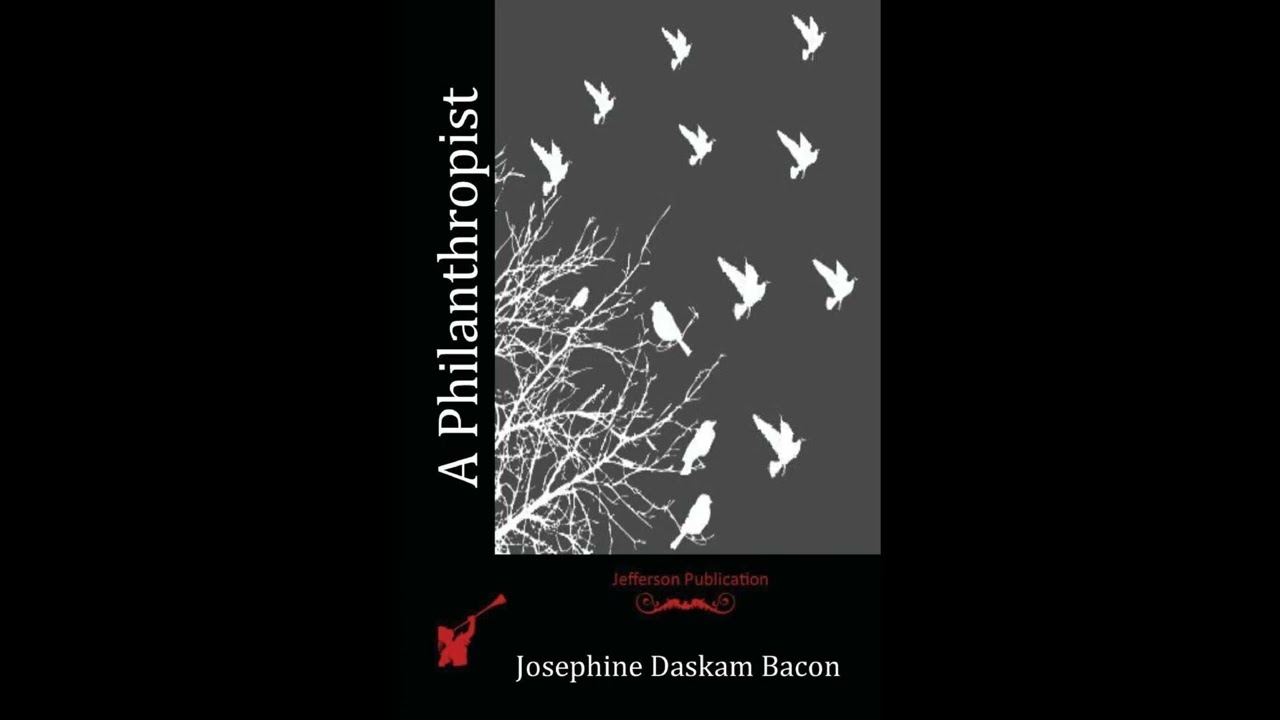
A Philanthropist
"A Philanthropist" introduces us to a world where good intentions often pave the road to unforeseen consequences, and where the lines between genuine charity and self-serving display blur with uncomfortable frequency. This astute novel by Josephine Daskam Bacon, published in the early years of the twentieth century, continues to resonate with contemporary ears, offering a shrewd examination of wealth, power, and the complex human motivations behind acts of giving. It asks us to look beyond the grand gestures and public accolades, prompting a vital consideration of what true philanthropy might actually entail, and whether it’s even possible to separate a benefactor from their own ego. Listeners today will find its questions surprisingly current, as we navigate our own era of immense fortunes and highly publicized efforts to "do good." The story centers on Eleanor, a young woman of privilege who grows up amidst the seemingly benevolent shadow of her father, a man widely celebrated as the titular philanthropist. He is a figure of considerable influence, his name adorning hospitals, libraries, and various charitable initiatives across the burgeoning American landscape. Eleanor initially perceives her father's activities through an idealistic lens, believing implicitly in the pure altruism that she is told underpins his every public-spirited endeavor. However, as she matures and begins to interact more directly with the world beyond her sheltered upbringing, a different picture slowly emerges. She observes the subtle manipulations, the bureaucratic inefficiencies, and the often-unintended impacts of her father's generosity. The narrative follows her awakening, her gradual disillusionment as she confronts the discrepancies between the public image of benevolence and the sometimes harsh, often messy realities of its execution. This dawning awareness creates a profound internal conflict for Eleanor. She is torn between her filial loyalty and her growing sense of moral unease, between the comfortable assurances of her upbringing and the unsettling truths she encounters. Her relationships are tested, her beliefs challenged, and she finds herself increasingly isolated in her evolving perception of true virtue. The novel carefully constructs a narrative that foregrounds Eleanor’s individual growth as she struggles to define her own moral compass in a world that often conflates reputation with genuine character. It sets her on a path to understand what constitutes meaningful contribution, independent of the inherited wealth and societal expectations that have shaped her life thus far. Josephine Daskam Bacon, born in Stamford, Connecticut in 1876, was a remarkably prolific and perceptive writer who graduated from Vassar College in 1898. Her early literary success was marked by her sharp observations of society and her keen understanding of human psychology, particularly regarding the experiences of women in a rapidly changing America. Before her marriage to lawyer Selden Bacon, she published under her maiden name, Josephine Daskam, quickly establishing a reputation for her engaging short stories and novels. She was known for a realistic, often satiric, approach to the social conventions and anxieties of the early 20th century. Her body of work showcases a consistent interest in the roles available to women—from young college graduates to established matrons—and how they navigated the evolving expectations of domesticity, professional life, and personal agency. Daskam Bacon's literary contributions extend beyond "A Philanthropist" to include popular works like "The Memoirs of a Baby" (1904), a humorous look at early childhood, and "The Middle Forties" (1910), which humorously examined middle-aged life. Her writing often possessed a quiet but biting social commentary, subtly critiquing the superficiality and hypocrisy she observed in the upper echelons of society. While not always at the forefront of the literary canon, Daskam Bacon's novels and stories offer an invaluable window into the intellectual and social currents of her time, positioning her as an insightful voice within the broader American realism movement, and particularly among women writers who were actively shaping the narrative of modern American life. One of the central themes running through "A Philanthropist" is the ambiguity of good intentions. The story demonstrates how actions undertaken with what seem like noble goals can, in practice, become entangled with self-interest, control, or simply misdirected efforts. Eleanor observes how her father's grand gestures often serve to bolster his public image or extend his influence more than they genuinely alleviate suffering or empower the recipients of his charity. For instance, an initiative to build a model housing project might come with strictures that inadvertently strip residents of their autonomy, revealing the paternalistic undercurrents of the giver's supposed generosity. The novel also carefully examines the theme of social responsibility, contrasting the immense wealth of the upper classes with the pressing needs of the working poor. It underscores the profound disconnect between the decision-makers in luxurious drawing rooms and the individuals directly affected by their policies, highlighting how the privileged often lack a true understanding of the struggles faced by those they claim to help. Eleanor's growing awareness of this chasm forms the emotional core of her awakening. Furthermore, the novel thoughtfully addresses the evolving role of women and the pursuit of individual moral agency. Eleanor is not merely a passive observer; her internal struggle represents a broader societal shift where women, increasingly educated and exposed to wider societal issues, began to question established norms and assert their own ethical frameworks. Her challenge to her father’s methods is not just a personal rebellion but a symbolic assertion of a more considered, empathetic approach to societal problems, one that prioritizes genuine impact over outward appearance. The narrative deftly illustrates how the public performance of virtue can obscure less admirable motivations, compelling listeners to consider the true meaning of generosity beyond its superficial manifestations. The early twentieth century, the period in which "A Philanthropist" was written, was a time of immense change and profound social commentary in America. It was the tail end of the Gilded Age, characterized by enormous industrial fortunes and stark wealth disparity, leading into the Progressive Era, a time defined by widespread social activism and political reform. Public figures like Andrew Carnegie and John D. Rockefeller were pioneering large-scale philanthropy, establishing foundations and funding public institutions, often alongside accusations of monopolistic business practices. This created a fertile ground for authors like Daskam Bacon to scrutinize the moral dimensions of wealth and the very concept of "charity." The era also saw a rise in women's education and their increasing participation in public life, including the burgeoning suffrage movement and social reform efforts, providing a potent backdrop for a character like Eleanor to develop a strong, independent moral voice that challenged patriarchal norms. Listening to "A Philanthropist" as an audiobook offers a uniquely intimate encounter with its thoughtful questions and rich character development. The novel's strength lies in its subtle characterization, its nuanced dialogue, and the internal monologue of Eleanor as she grapples with complex ethical dilemmas. A skilled narrator can bring to life the polite but often pointed conversations of high society, the quiet moments of Eleanor’s introspection, and the underlying tension between appearance and reality that permeates the story. The sustained listening experience allows the listener to fully immerse themselves in Eleanor’s emotional and intellectual evolution, hearing the gradual shift in her perceptions and the quiet strength she develops. Over its several-hour duration, this audiobook provides an opportunity for unhurried reflection, making the moral quandaries it poses feel deeply personal and immediate, just as they would have been for its original readers.
Enjoyed A Philanthropist? A few ways to support us
Audible & Amazon links are affiliate; we may earn a small commission at no extra cost.
About this production
Human narration by a volunteer reader from LibriVox.org, the public-domain audiobook project. LibriVox volunteers record literary works whose copyright has expired in the United States, releasing the resulting recordings into the public domain.
A Philanthropist by Josephine Daskam Bacon. The underlying text is in the U.S. public domain. We do not republish any modern copyrighted edition, translation, or commentary.
The 4K cinematic visuals accompanying this audiobook are generated by an AI image model from prompts derived from the source text. No copyrighted photos, paintings, or stock footage are used. AI generation is disclosed on every video on our YouTube channel as required by YouTube's altered/synthetic content policy.
English subtitles are transcribed from the LibriVox recording with OpenAI Whisper. Translations into the 11 other supported languages are produced by Meta's NLLB-200 neural translation model. No human translator's copyrighted translation is used.
Questions about sourcing or rights? See our DMCA & Sourcing policy or contact us.
Enjoyed this audiobook?
If you'd like to own a copy of A Philanthropist or hear a professionally produced edition, the links below help support free audiobook production at no extra cost to you.
As an Amazon Associate we earn from qualifying purchases. Audible / print links are affiliate.