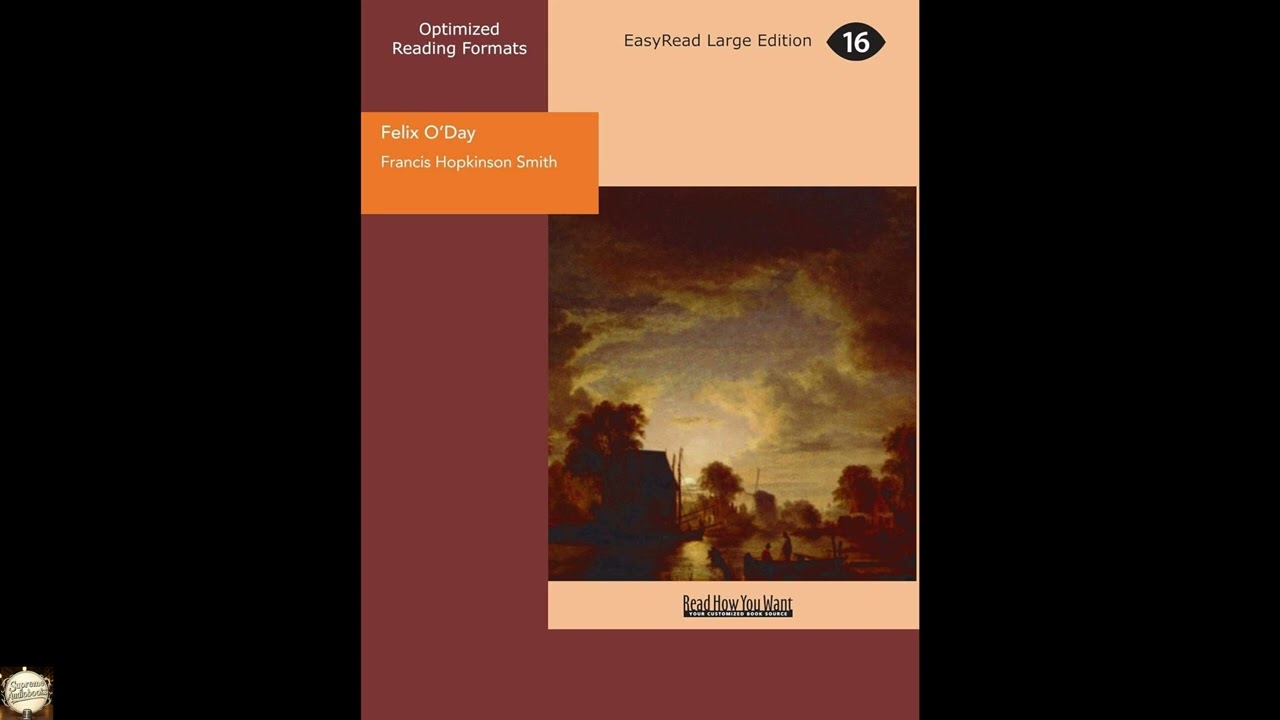
Felix O'Day
Supreme Audiobooks is proud to present a new recording of Francis Hopkinson Smith's final novel, Felix O'Day, a compelling character study that invites listeners into the heart of early twentieth-century New York. This is a story about the quiet pursuit of redemption, the weight of a hidden past, and the profound human need for connection and understanding. At its core, the novel asks whether a man can truly outrun his history and build a new life rooted in genuine goodness, a question that remains as pertinent today as it was when the book first appeared. We are drawn into a world where personal honor and social standing collide, where a single act of kindness can change a life, and where the dignity of quiet labor holds a value that transcends mere wealth. The narrative unfolds in a bustling, gaslit New York City, a place of both grandeur and humble anonymity, around the year 1915. Our central figure, Felix O'Day, arrives in a working-class neighborhood, a stranger seeking to lose himself among the city's myriad faces. He is a man of obvious refinement, his bearing and cultured speech hinting at a past far removed from the modest furniture repair shop he establishes. He settles into a boarding house inhabited by a diverse group of tenants: the kindly landlady, Mrs. De Peyster; a young woman named Elsie, whose own life holds its share of sorrow; and other ordinary New Yorkers who initially regard Felix with a mixture of curiosity and suspicion. Felix's desire for an unobtrusive existence is palpable. He dedicates himself to his craft, restoring beauty to worn pieces of furniture, and quietly assisting those around him with a generosity that belies his reserved demeanor. Yet, beneath his placid exterior simmers a profound inner turmoil, a secret he guards with immense care. His past, hinted at through veiled references and his cautious interactions, casts a long shadow, threatening to reclaim him at any moment. The story meticulously builds a sense of quiet suspense, as the threads of his former life slowly begin to fray the fabric of his carefully constructed present. The listener watches, holding their breath, as Felix strives to maintain his anonymity while earning the trust and affection of his new community, all the while knowing that his fragile peace could be shattered by a knock at the door or a chance encounter. Francis Hopkinson Smith, born in Baltimore, Maryland, in 1838 and passing away in New York City in 1915, was a true Renaissance man of his era. Beyond his distinguished literary career, Smith achieved considerable renown as a civil engineer, contributing significantly to projects such as the foundation for the Statue of Liberty and various lighthouses along the East Coast. He was also an accomplished artist, particularly noted for his atmospheric watercolor paintings. This remarkable breadth of experience provided a unique lens through which he viewed the world, imbuing his literary works with both a practical understanding of human endeavor and an artist's sensitivity to beauty and detail. Smith's literary output often celebrated a certain genteel Southern charm and the virtues of the honorable gentleman, even though he himself was a Northerner. His most celebrated character, Colonel Carter of Cartersville, embodies this ideal, and while Felix O'Day presents a different kind of protagonist, a similar sense of inherent nobility and moral rectitude pervades its pages. Other notable works include Caleb West, Master Diver and Tom Grogan, stories that often focused on strong, principled individuals facing challenges. He occupies a distinctive place in American letters, often associated with the local color movement, but always with a focus on character and the enduring power of decency. At its heart, Felix O'Day enacts several powerful themes, the first being the concept of redemption through honest labor and service. Felix, having arrived burdened by his past, finds a quiet solace and purpose in the manual work of furniture restoration. When he meticulously repairs a broken chair for a neighbor, he isn't just fixing wood; he is mending a piece of himself, investing his quiet humility into acts of tangible kindness. Another prevalent theme is the contrast between outward appearance and intrinsic worth. Though Felix lives in humble circumstances and dresses simply, his inherent dignity and refined manners consistently shine through, often perplexing those who judge him solely by his modest station. For instance, when he converses with the cultured yet somewhat condescending Mr. Kinkaid, Felix's quiet wisdom and command of language subtly reveal his true intellectual depth, suggesting that true nobility resides within the soul, not in one's material possessions or social standing. The story also illuminates the theme of community and the power of compassion. Despite the initial wariness of some, the diverse residents of the boarding house and the neighborhood slowly open their hearts to Felix. Mrs. De Peyster's steadfast belief in his goodness, and Elsie's growing affection, demonstrate how genuine human connection can offer solace and a chance for new beginnings, even to the most guarded of souls. Finally, Smith examines the enduring nature of personal honor and integrity. Even in his self-imposed exile, Felix consistently adheres to a strict moral code, refusing to compromise his principles for personal gain or to evade his past. This unwavering commitment to what he believes is right, even when it means facing difficult consequences, defines his character and ultimately forms the backbone of his quiet heroism. Felix O'Day was published in 1915, a pivotal moment in American history. The nation stood on the precipice of global conflict, but domestically, it was a period of rapid industrialization, urbanization, and significant social change. The Gilded Age's excesses were giving way to the Progressive Era, yet a lingering nostalgia for simpler times and traditional values persisted. Smith's novel, appearing at the very end of his life, can be seen as a reflection of these cultural currents. It champions a set of virtues—dignity, personal responsibility, quiet heroism, and the power of individual character—that perhaps felt increasingly threatened by the impersonal forces of modernity. It emerged from an author who had personally witnessed immense societal shifts and chose, in his final work, to reaffirm the timeless importance of a good heart and an honest spirit, a quiet appeal for human decency in a world that was becoming increasingly complex. Listening to Felix O'Day as an audiobook transforms the experience, allowing the listener to sink into its atmospheric setting and the nuanced portrayal of its characters over several hours. The narrator's voice becomes crucial in conveying Felix's understated resolve, the distinct personalities of the New York denizens, and the subtle emotional currents that flow beneath the story's calm surface. Pay close attention to the pacing, which thoughtfully mirrors Felix's own measured approach to life, building tension gradually rather than through dramatic bursts. The dialogue, with its period-specific cadences, helps to establish the novel's historical context, while the descriptive passages paint vivid pictures of the bustling streets, the quiet boarding house, and the worn furniture in Felix's shop. It is a story to be savored, one that encourages reflection on the quiet heroism found in everyday acts and the profound impact of genuine human kindness.
Enjoyed Felix O'Day? A few ways to support us
Audible & Amazon links are affiliate; we may earn a small commission at no extra cost.
About this production
Human narration by a volunteer reader from LibriVox.org, the public-domain audiobook project. LibriVox volunteers record literary works whose copyright has expired in the United States, releasing the resulting recordings into the public domain.
Felix O'Day by Francis Hopkinson Smith. The underlying text is in the U.S. public domain. We do not republish any modern copyrighted edition, translation, or commentary.
The 4K cinematic visuals accompanying this audiobook are generated by an AI image model from prompts derived from the source text. No copyrighted photos, paintings, or stock footage are used. AI generation is disclosed on every video on our YouTube channel as required by YouTube's altered/synthetic content policy.
English subtitles are transcribed from the LibriVox recording with OpenAI Whisper. Translations into the 11 other supported languages are produced by Meta's NLLB-200 neural translation model. No human translator's copyrighted translation is used.
Questions about sourcing or rights? See our DMCA & Sourcing policy or contact us.
Enjoyed this audiobook?
If you'd like to own a copy of Felix O'Day or hear a professionally produced edition, the links below help support free audiobook production at no extra cost to you.
As an Amazon Associate we earn from qualifying purchases. Audible / print links are affiliate.