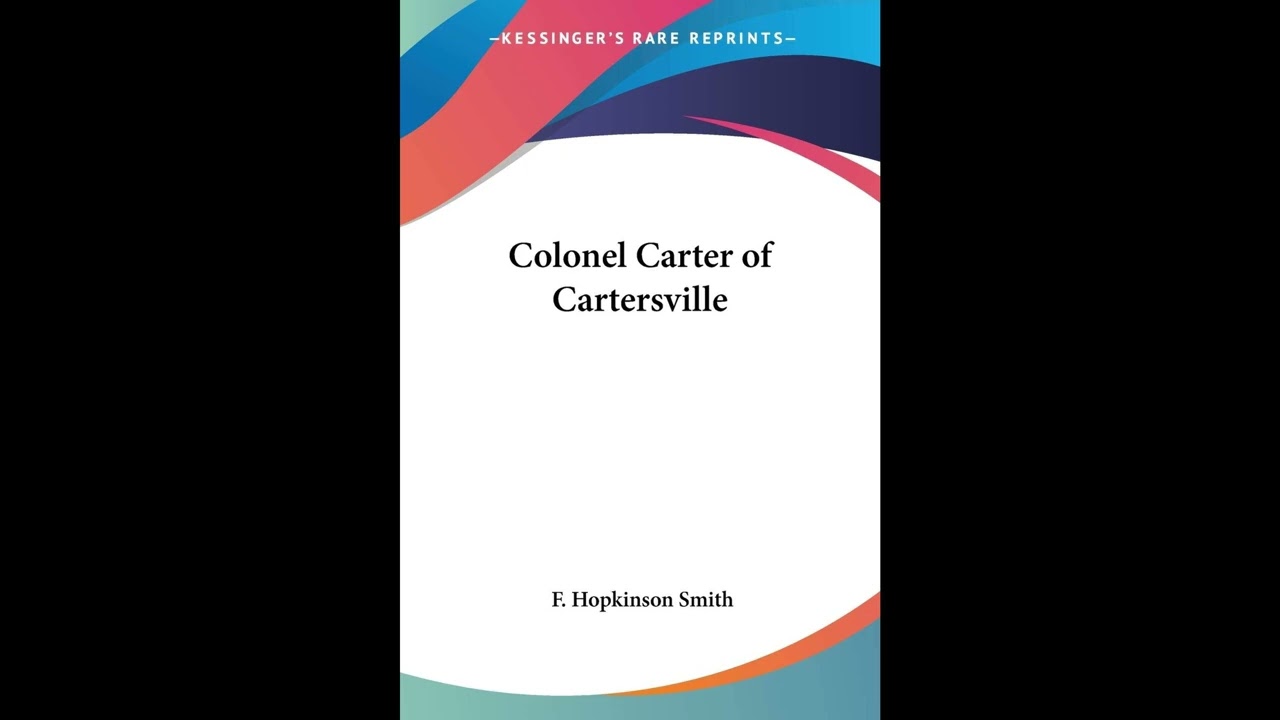
Colonel Carter of Cartersville
Few figures in American literature possess the enduring, gentle charm of Colonel Carter of Cartersville. This beloved classic by F. Hopkinson Smith introduces listeners to a quintessential Southern gentleman, a man who lives as much in the glorious past as in the present. It is a book that invites us to slow down, to appreciate the art of storytelling, and to consider what it means to uphold a personal code of honor and optimism when the world around you has profoundly changed. For those seeking a respite from the hurried pace of modern life, or simply a heartwarming tale populated by unforgettable characters, the Colonel's world offers a delightful and surprisingly resonant experience, reminding us that grace and good humor can be found even in adversity. The narrative transports us to a specific corner of post-Civil War Richmond, Virginia, where the redoubtable Colonel Carter maintains a household that, while outwardly modest, is internally imbued with the grandeur of his ancestral estate, Cartersville. The story is largely told through the eyes of Mr. Fitzpatrick, a New York engineer who finds himself living in a boarding house adjacent to the Colonel's and quickly becomes an admiring observer of his neighbor's peculiar habits and unfailing politeness. The Colonel himself is a man of striking presence: immaculately dressed, unfailingly courteous, and perpetually brimming with tales of Cartersville – tales that grow ever more elaborate and fantastical with each telling. His central preoccupation is the restoration of his family's honor and fortunes, often revolving around a grand, if financially dubious, scheme to build a railway line through his (largely imagined) vast Cartersville lands. Despite repeated setbacks and the ever-present shadow of genteel poverty, Colonel Carter never loses his buoyant spirit, his profound belief in the intrinsic goodness of people, or his deep affection for his loyal household, including his devoted cook and his dignified, elderly servant. The story unfolds as a series of vignettes, revealing the Colonel's unwavering principles, his ingenious (and often naive) solutions to financial woes, and his profound capacity for hospitality and generosity, even when he has little to give. Francis Hopkinson Smith, the author, was a truly remarkable figure of the late nineteenth and early twentieth centuries, born in Baltimore in 1838 and passing away in New York City in 1915. He was a man of extraordinary versatility and talent, achieving significant success in several distinct professions. By trade, Smith was a civil engineer of considerable repute, involved in major projects such as the foundation for the Statue of Liberty, the construction of lighthouses, and the building of jetties along the coast. He was also an accomplished artist, celebrated for his landscape and marine paintings, which captured the misty atmosphere and rugged beauty of the coastal regions he often worked in. It was, however, his literary career that brought him widespread fame. "Colonel Carter of Cartersville," published in 1891, became his breakout success, quickly followed by other popular novels like "Caleb West, Master Diver" and "The Fortunes of Oliver Horn." Smith's writing falls generally within the local color tradition of American literature, focusing on regional settings and distinctive character types. His work often showcased a fondness for the picturesque and the heroic, reflecting a sentimentality that resonated deeply with readers of his era. He held a unique position as a Northern-born author who wrote with great warmth and understanding about the American South, contributing to a body of literature that, while sometimes romanticized, aimed to bridge regional divides in the aftermath of the Civil War. One of the most prominent themes running through "Colonel Carter of Cartersville" is the enduring power of nostalgia and the idealized past. The Colonel’s entire existence is shaped by his fervent recollections of Cartersville, a place that, in his imagination, remains a bastion of antebellum grace and prosperity. He recounts tales of lavish hospitality, the beauty of his family's estate, and the unwavering loyalty of his former slaves with such vivid detail that the listener almost believes they are hearing firsthand accounts of a bygone golden age. This narrative method, exemplified when he describes the supposed magnificence of his ancestral home or the vastness of his properties, allows Smith to examine how memory and invention can sustain identity in the face of harsh present-day realities. Another central theme is the unwavering adherence to honor and the Southern code of chivalry. Despite his financial struggles, the Colonel insists on maintaining impeccable appearances, paying his debts (even if it requires great ingenuity), and treating everyone with a courtly politeness that seems almost out of time. His insistence on offering a grand welcome to visitors, even if it stretches his meager resources, and his dignified manner in all interactions, such as his carefully chosen words or his refusal to compromise his gentlemanly principles, demonstrate how deeply ingrained this sense of honor is within him, regardless of his current circumstances. The late nineteenth century, when F. Hopkinson Smith penned this work, was a period of profound transition in America. The nation was still grappling with the aftermath of the Civil War and the Reconstruction era, which had left deep scars, particularly in the South. While some regions were rapidly industrializing and modernizing, there was a widespread yearning for simpler times and a search for a distinct American identity amidst rapid change. In the literary world, realism and naturalism were gaining ground, but concurrently, there was a strong movement for regionalism and local color fiction. Authors sought to capture the unique dialects, customs, and landscapes of various American locales before they were homogenized by industrial progress. "Colonel Carter of Cartersville" emerged as a prominent example of this regionalist impulse. It offered readers, both Northern and Southern, a comforting, often romanticized glimpse into a particular kind of Southern character – one defined by charm, resilience, and a deep attachment to tradition, even if those traditions were increasingly at odds with contemporary life. The book provided a gentle, humorous, and non-confrontational narrative that allowed for a degree of national reconciliation, presenting a Southern figure who was endearing rather than threatening, and whose struggles were more personal than political. Listening to "Colonel Carter of Cartersville" as an audiobook truly enhances the appreciation of Smith's creation. The very essence of the Colonel lies in his voice—his distinctive cadence, his elaborate phrasing, and the sheer joy he takes in telling his stories. A skilled narrator can bring to life the Colonel's courtly Southern accent, his booming pronouncements, and the gentle humor that permeates his interactions. Listen for the subtle shifts in tone as the narrator, Mr. Fitzpatrick, moves from detached observation to genuine affection, and the way the vocal performance distinguishes between the Colonel's grand pronouncements and the quieter, more practical voices around him. The duration of several hours is perfect for settling in and allowing yourself to be fully immersed in this charming, character-driven world, appreciating the nuances of dialogue and the rich atmosphere that unfolds with each spoken word.
Enjoyed Colonel Carter of Cartersville? A few ways to support us
Audible & Amazon links are affiliate; we may earn a small commission at no extra cost.
About this production
Human narration by a volunteer reader from LibriVox.org, the public-domain audiobook project. LibriVox volunteers record literary works whose copyright has expired in the United States, releasing the resulting recordings into the public domain.
Colonel Carter of Cartersville by Francis Hopkinson Smith. The underlying text is in the U.S. public domain. We do not republish any modern copyrighted edition, translation, or commentary.
The 4K cinematic visuals accompanying this audiobook are generated by an AI image model from prompts derived from the source text. No copyrighted photos, paintings, or stock footage are used. AI generation is disclosed on every video on our YouTube channel as required by YouTube's altered/synthetic content policy.
English subtitles are transcribed from the LibriVox recording with OpenAI Whisper. Translations into the 11 other supported languages are produced by Meta's NLLB-200 neural translation model. No human translator's copyrighted translation is used.
Questions about sourcing or rights? See our DMCA & Sourcing policy or contact us.
Enjoyed this audiobook?
If you'd like to own a copy of Colonel Carter of Cartersville or hear a professionally produced edition, the links below help support free audiobook production at no extra cost to you.
As an Amazon Associate we earn from qualifying purchases. Audible / print links are affiliate.