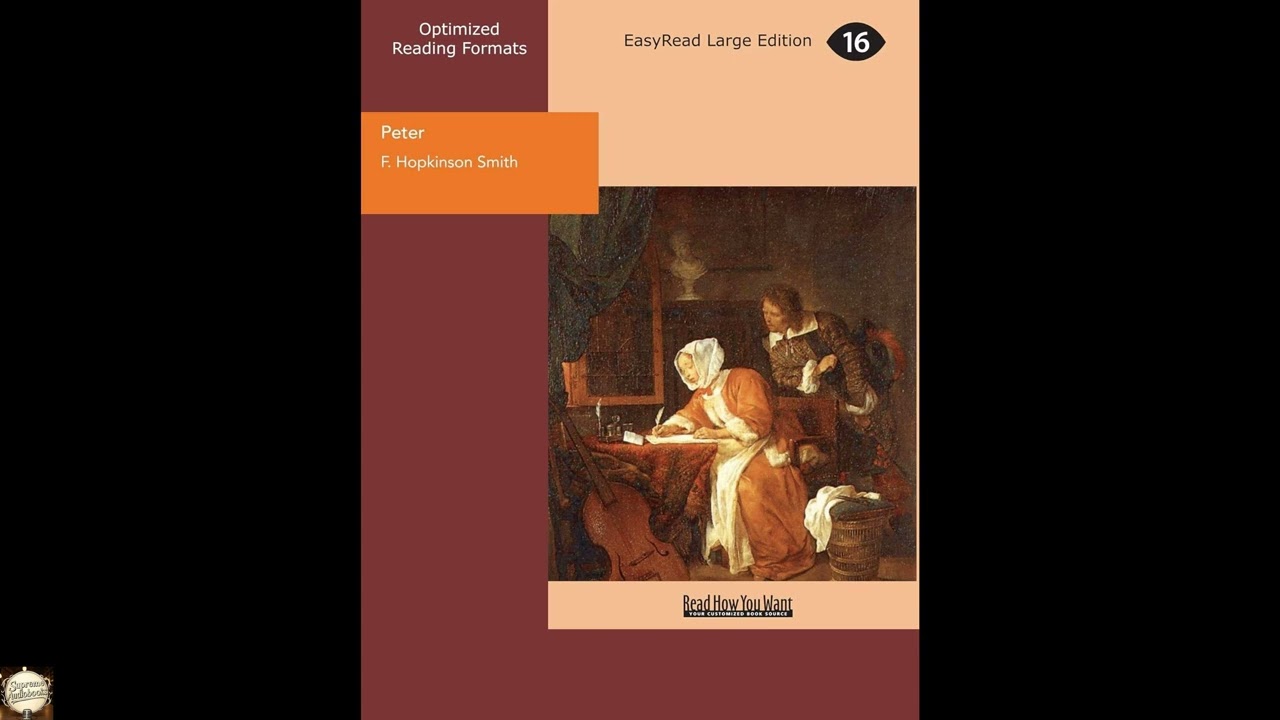
Peter: A Novel Of Which He Is Not the Hero
What does it mean to be a hero? Is it about grand, sweeping gestures, or the quiet fortitude shown in everyday struggles? Francis Hopkinson Smith’s novel, Peter: A Novel Of Which He Is Not the Hero, offers a wonderfully insightful and perhaps even discomfiting examination of this question through the eyes of its titular character, a man who consistently finds himself on the periphery of true consequence. This compelling narrative, first published in an era grappling with rapid social change, provides a mirror to our own contemporary anxieties about success, recognition, and the often-unacknowledged figures who truly shape the world around us. It’s a story not of a shining exemplar, but of a thoroughly human individual whose journey illuminates the very nature of admirable character by its conspicuous absence from his own person, prompting listeners to ponder where real valor lies in their own lives and the lives of others. The story unfolds in the bustling, ambitious landscape of America during the late nineteenth and early twentieth centuries, a period of immense industrial growth and social stratification. We meet Peter, a character who, from the outset, embodies a certain amiable passivity. He is a man of good intentions, perhaps, but consistently lacks the decisive conviction or the moral fiber to truly take charge of his own destiny or to make a significant, lasting impact on those around him. Peter frequently finds himself in situations that demand strength, foresight, or principled action, yet he reliably falters, often allowing opportunities to slip through his grasp or deferring to the judgment of others. He might start a new business venture with enthusiasm, for instance, only to see it languish due to his own indecision, while a more determined associate steps in to salvage the enterprise, becoming the true engine of success. The central conflict, then, is not an external struggle against a villain or an impossible task, but an internal one within the social fabric Peter inhabits. He is surrounded by individuals who do possess those heroic qualities – unwavering loyalty, shrewd practicality, artistic genius, or profound integrity. These characters, often women or men of quiet competence, frequently have to navigate the consequences of Peter’s wavering nature, or step up to solve problems Peter himself has inadvertently created or failed to address. The arc of the story follows Peter through various personal and professional endeavors, illustrating how his charming but ineffectual personality affects his relationships, his career prospects, and his overall standing in the world, always with the underlying current that someone else will ultimately rise to meet the challenges he cannot. Francis Hopkinson Smith, born in Baltimore, Maryland in 1838, was a man of truly remarkable and diverse talents. He was not only a celebrated author but also a distinguished civil engineer and a respected landscape painter. This unique blend of professions deeply informed his literary output. As an engineer, Smith was responsible for significant projects, including the construction of the Race Rock Lighthouse off the coast of Connecticut and various sea walls and foundations. This practical, hands-on experience with the physical world, coupled with an artist’s eye for detail and beauty, gave his writing a grounded realism and vivid descriptive power. His career spanned from the Gilded Age well into the early twentieth century, until his death in New York City in 1915. Smith’s literary contributions often placed him within the tradition of American regionalism and local color fiction. He became widely known for his charming characterizations and his affectionate depictions of Southern life, particularly in works like his popular novel Colonel Carter of Cartersville and Caleb West, Master Diver, a story also rooted in his engineering background. His work often carried a sentimental warmth, yet it was frequently underpinned by keen observations of human nature and the societal shifts occurring around him. The Fortunes of Oliver Horn is another notable title that showcases his ability to blend character study with broader social commentary, securing his place as a popular and respected figure in American letters of his time. Peter keenly examines several significant themes, beginning most prominently with the nature of heroism itself. Peter’s character acts as a foil, highlighting what it means to not be the hero. For instance, in a scene involving a crucial business deal, Peter might hesitate, caught between two competing interests, only for a seemingly minor character, perhaps his quiet secretary or a business partner, to step forward with a decisive, ethically sound solution that saves the day. This illustrates that heroism isn't always about bold action, but often about moral courage and unwavering principle, qualities Peter largely lacks. Another theme is the illusion of success and social standing. Peter might appear to be a respectable figure, but the narrative subtly reveals that his achievements are often built on the efforts or sacrifices of others, challenging the superficial metrics of public esteem. Furthermore, the novel explores the quiet strength found in ordinary individuals. Peter’s narrative arc serves to elevate the true grit and integrity of those around him, those who often operate without seeking recognition. A moment where Peter’s impulsive decision leads to a financial setback for a friend, only for that friend to face the consequences with dignified resilience and rebuild their life through hard work, underscores the theme of true character emerging from adversity. It is a story, then, that celebrates the unsung heroes and the steadfast nature of those who possess genuine inner substance, contrasting them sharply with Peter’s well-intentioned but ultimately unheroic meanderings through life. The emergence of Peter fits neatly into the broader cultural and literary landscape of its era. Published when America was rapidly industrializing and urbanizing, the period saw immense wealth creation alongside stark social inequalities. The concept of the "self-made man" was pervasive, yet Smith's novel subtly questions what "making oneself" truly entails. Was it simply accumulating wealth or status, or did it involve a deeper ethical and personal development? The novel also reflects the literary trends of the time, moving beyond pure romanticism towards a more nuanced realism that examined human foibles and societal pressures, even while retaining a certain genial charm. Smith's ability to ground his stories in believable settings and human-scale drama resonated with readers navigating the complexities of modern life and re-evaluating traditional notions of virtue and achievement. Listening to Peter: A Novel Of Which He Is Not the Hero as an audiobook brings Smith’s intricate character study to life with compelling intimacy. The run length of several hours allows for sustained engagement, making it ideal for daily commutes, long walks, or dedicated quiet listening. A skilled narrator can deftly convey the nuances of Peter’s personality – his moments of self-doubt, his occasional flashes of insight, and his often-unspoken desires – through vocal inflections and pacing. The distinct voices given to the supporting characters, particularly those who demonstrate true heroism and integrity, can highlight the contrast with Peter, making their steadfastness even more pronounced. The rich descriptions of Gilded Age settings and social interactions, whether in drawing rooms or bustling city streets, are rendered more atmospheric through the spoken word, drawing listeners directly into the world and its gentle, yet profound, meditations on what it truly means to live a meaningful life.
Enjoyed Peter: A Novel Of Which He Is Not the Hero? A few ways to support us
Audible & Amazon links are affiliate; we may earn a small commission at no extra cost.
About this production
Human narration by a volunteer reader from LibriVox.org, the public-domain audiobook project. LibriVox volunteers record literary works whose copyright has expired in the United States, releasing the resulting recordings into the public domain.
Peter: A Novel Of Which He Is Not the Hero by Francis Hopkinson Smith. The underlying text is in the U.S. public domain. We do not republish any modern copyrighted edition, translation, or commentary.
The 4K cinematic visuals accompanying this audiobook are generated by an AI image model from prompts derived from the source text. No copyrighted photos, paintings, or stock footage are used. AI generation is disclosed on every video on our YouTube channel as required by YouTube's altered/synthetic content policy.
English subtitles are transcribed from the LibriVox recording with OpenAI Whisper. Translations into the 11 other supported languages are produced by Meta's NLLB-200 neural translation model. No human translator's copyrighted translation is used.
Questions about sourcing or rights? See our DMCA & Sourcing policy or contact us.
Enjoyed this audiobook?
If you'd like to own a copy of Peter: A Novel Of Which He Is Not the Hero or hear a professionally produced edition, the links below help support free audiobook production at no extra cost to you.
As an Amazon Associate we earn from qualifying purchases. Audible / print links are affiliate.