Escape, and Other Essays
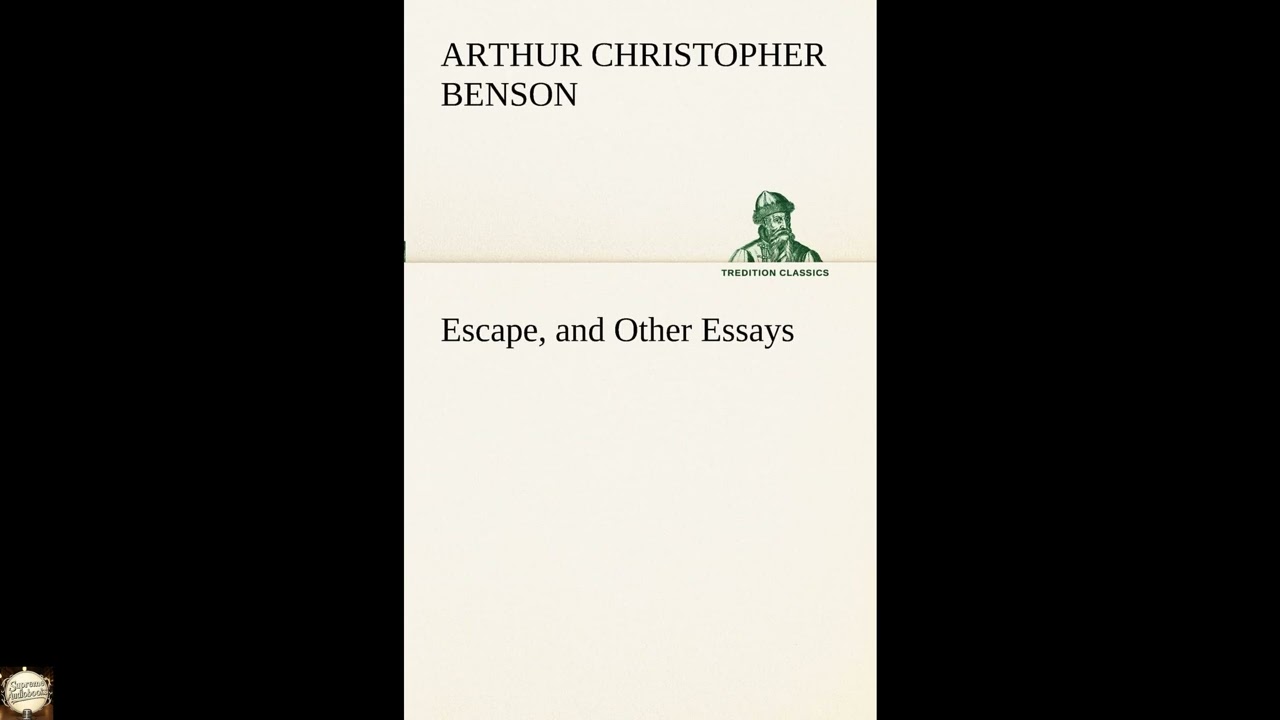
In a world that seems perpetually to accelerate, where the clamor of information and the demands of constant connection often drown out the quieter stirrings of the soul, there remains a profound human need for pause, for reflection, for a moment to simply be. Arthur Christopher Benson’s collection, Escape, and Other Essays, offers precisely this sanctuary. Published in 1915, at the precipice of an era defined by immense upheaval, Benson’s prose acts as a gentle, yet insistent invitation to step away from the noise, to cultivate an inner landscape of peace, and to rediscover the profound beauty in the unhurried observation of everyday life. This is not an escape from reality, but rather an escape into a deeper, more thoughtful engagement with it – a necessary antidote for any spirit feeling overwhelmed by the relentless pace of modern existence. These essays do not unfold with a traditional narrative or a dramatic cast of characters. Instead, the collection functions as a series of carefully crafted thought experiments, each essay a window into the contemplative mind of its author. The setting frequently shifts between the serene cloisters of an ancient university, the verdant paths of an English garden, or the quietude of a personal study, all rendered with an affectionate precision that makes these spaces feel immediately familiar. The central 'character' is the reflective individual – often Benson himself – grappling with the ephemeral nature of time, the elusive quality of happiness, and the persistent desire for personal meaning. The 'conflict' is a subtle, internal one: the struggle to maintain authenticity and inner peace amidst external pressures, the gentle pushback against the trivializing forces of haste and superficiality. Benson guides the listener through a landscape of introspection, touching upon themes as varied as the art of conversation, the solace found in literature, the quiet joy of amateur gardening, and the often-overlooked dignity of mundane routines. He moves effortlessly from the particular — a description of a specific bird's song, the pattern of shadows across a lawn — to the universal, drawing out larger truths about human nature and the pursuit of contentment. The arc of these essays is not one of dramatic revelation but of quiet unfolding; they offer an accumulating wisdom, a growing sense of calm understanding that settles over the listener like a gentle dusk. Through his observant eye and gentle rumination, Benson encourages a deeper appreciation for the moments often missed, transforming the ordinary into something luminous and significant. Arthur Christopher Benson, born in 1862, was the son of Edward White Benson, who would later become the Archbishop of Canterbury. This familial connection placed him at the heart of Victorian intellectual and spiritual life from an early age, though his own temperament leaned more towards quiet scholarship and sensitive introspection than public oratory. He was educated at Eton College and King's College, Cambridge, and went on to have a distinguished career as an academic, serving as a Fellow of Magdalene College, Cambridge, and eventually becoming its Master in 1915 – the very year Escape, and Other Essays was published. Benson was a remarkably prolific writer, producing numerous volumes of poetry, literary criticism, biographies, and, most famously, essays. He is also remembered for writing the lyrics to Edward Elgar's iconic patriotic song, "Land of Hope and Glory." Beyond his published works, Benson maintained an extensive private diary, which eventually reached an astonishing four million words, a testament to his dedication to self-examination and his detailed chronicling of daily life and thought. His literary output often explored themes of memory, nature, education, and the inner life, marking him as a significant voice within the Edwardian and Georgian literary landscape, a period characterized by both great social change and a lingering affection for traditional contemplative pursuits. The essays in this collection enact several key themes that resonate deeply even a century after their writing. One prominent idea is the profound value of solitude and contemplation. Benson frequently portrays himself as a figure apart, observing the world from his study window or from a secluded garden bench, finding a restorative power in quiet reflection. For instance, in an essay that might touch on the simple act of watching birds, he doesn't just describe their movements but uses them as a springboard for meditations on freedom, the passage of seasons, and the delicate balance of nature. Another recurring theme is the search for contentment not in grand achievements but in the beauty of small, everyday things. He highlights how the warmth of a fire on a chilly evening, a well-chosen book, or a thoughtful conversation can provide deeper satisfaction than more ambitious pursuits. He gently champions the art of living deliberately, finding meaning in the immediate and the tangible, rather than perpetually chasing distant, often illusory, goals. The academic life also serves as a fertile ground for his musings. Benson, himself deeply embedded in the collegiate world, reflects on the rhythm of university life, the intellectual friendships that sustain it, and the quiet pursuit of knowledge that defines its essence. He values the continuity of tradition and the sanctuary that institutions of learning provide against the more turbulent currents of the outside world. Moreover, he often confronts the subtle melancholy that can accompany an intensely felt inner life, offering it not as a cause for despair but as a necessary counterpoint to joy, a deeper shade in the emotional palette that allows for greater appreciation of brighter moments. Escape, and Other Essays emerged into a world teetering on a precipice. Published in 1915, Europe was already embroiled in the Great War, a conflict that would irrevocably alter the course of the twentieth century and challenge many long-held assumptions about progress and civilization. In this context, Benson's work stands as a quiet counter-narrative, a deliberate turn away from the escalating violence and the accelerating pace of industrial modernity. His essays represent a continuation of the great English essay tradition – following in the footsteps of writers like Charles Lamb, William Hazlitt, and Robert Louis Stevenson – but adapted for an increasingly anxious age. They offered a refuge, a mental sanctuary for readers grappling with unprecedented global events, an invitation to maintain a hold on the values of introspection, beauty, and personal dignity when the world outside seemed determined to tear them asunder. His work captured an Edwardian sensibility that valued refinement, quiet intellectualism, and a connection to nature, even as those values were being tested by the relentless march of history. Listening to Escape, and Other Essays as an audiobook transforms the experience of these contemplative pieces. The voice of the narrator becomes an intimate guide, allowing the listener to fully absorb Benson’s measured pace and elegant syntax without the visual distraction of text. The several hours of content unfold gradually, perfectly suited for unhurried engagement – whether during a quiet walk, a moment of repose at home, or during a commute when one seeks mental stillness. The subtle inflections in the narration bring out the gentle humor and profound insights embedded in Benson’s prose, making his observations on solitude, nature, and the human condition feel deeply personal and immediate. It is an opportunity to truly inhabit the thoughtful atmosphere Benson creates, allowing his words to wash over the mind and provide a much-needed respite for thoughtful reflection.
Enjoyed Escape, and Other Essays? A few ways to support us
Audible & Amazon links are affiliate; we may earn a small commission at no extra cost.
About this production
Human narration by a volunteer reader from LibriVox.org, the public-domain audiobook project. LibriVox volunteers record literary works whose copyright has expired in the United States, releasing the resulting recordings into the public domain.
Escape, and Other Essays by Arthur Christopher Benson. The underlying text is in the U.S. public domain. We do not republish any modern copyrighted edition, translation, or commentary.
The 4K cinematic visuals accompanying this audiobook are generated by an AI image model from prompts derived from the source text. No copyrighted photos, paintings, or stock footage are used. AI generation is disclosed on every video on our YouTube channel as required by YouTube's altered/synthetic content policy.
English subtitles are transcribed from the LibriVox recording with OpenAI Whisper. Translations into the 11 other supported languages are produced by Meta's NLLB-200 neural translation model. No human translator's copyrighted translation is used.
Questions about sourcing or rights? See our DMCA & Sourcing policy or contact us.
Enjoyed this audiobook?
If you'd like to own a copy of Escape, and Other Essays or hear a professionally produced edition, the links below help support free audiobook production at no extra cost to you.
As an Amazon Associate we earn from qualifying purchases. Audible / print links are affiliate.