Sketches from Concord and Appledore
For those who feel the pull of American intellectual history, for listeners who wish to stand in the shadow of giants and feel the very air they breathed, Frank Preston Stearns's "Sketches from Concord and Appledore" offers a rare and intimate encounter. Published at the close of the nineteenth century, this collection is more than a series of observations; it is a fond, deeply personal reconstruction of the luminaries and landscapes that shaped America's literary and philosophical soul. It invites us to consider how place influences thought, how genius manifests in daily life, and why the echoes of past conversations continue to shape our present understanding of ourselves and our nation. This is a chance to commune directly with the spirit of an era, providing not just historical data, but a palpable sense of presence. "Sketches from Concord and Appledore" does not present a single linear narrative in the conventional sense, but rather a series of perceptive character studies and evocative scene-settings, primarily centered around two distinct yet interconnected geographical locations. Concord, Massachusetts, of course, serves as the spiritual heart, the crucible where the profound and often challenging ideas of Transcendentalism found their voice. Here, Stearns provides not just biographical details of figures like Ralph Waldo Emerson, Henry David Thoreau, and Nathaniel Hawthorne, but also vivid impressions of their mannerisms, their conversational styles, their personal habits, and the physical spaces they inhabited – from Emerson's study to Thoreau's cabin at Walden Pond. The author's eye for detail paints a picture of these men not as distant, mythic figures, but as flesh-and-blood individuals wrestling with profound questions in ordinary settings. In contrast, the island of Appledore, part of the Isles of Shoals off the coast of New Hampshire and Maine, offers a different kind of retreat and inspiration. This rugged, windswept outpost became a summer haven for artists, writers, and intellectuals, drawn by its stark beauty and its liberating remoteness. Stearns captures the bohemian spirit of this community, where conversations flowed as freely as the sea air, and creativity blossomed outside the confines of societal expectation. He paints portraits of the social interactions, the philosophical debates, and the artistic endeavors that characterized these summer gatherings, highlighting how a change of scenery could stimulate different facets of the mind. The underlying arc of the collection traces an informal intellectual pilgrimage, moving from the grounded philosophical core of Concord to the expansive, liberating artistic spirit of Appledore, showing how both environments nurtured unique forms of American genius. Frank Preston Stearns, born in 1846 and passing in 1917, was an American author, art critic, and biographer whose work frequently circled back to the intellectual and artistic currents of his native New England. The son of a prominent Massachusetts minister, Stearns received his education at Harvard University, a training that grounded him firmly in the classical and philosophical traditions. He then spent significant time studying art in Europe, an experience that honed his aesthetic sensibilities and gave him a keen eye for character and form, qualities evident in his literary portraits. Upon returning to America, he established himself as a respected voice, particularly in the realm of art criticism. Stearns's literary output included significant biographies of prominent figures such as Nathaniel Hawthorne, the Unitarian minister Charles A. Bartol, and even Abraham Lincoln, demonstrating his sustained interest in understanding and interpreting the lives of influential Americans. "Sketches from Concord and Appledore," published in 1895, positions him as a crucial chronicler of the fading Transcendentalist era. He was not a Transcendentalist himself in the generation of its founders, but rather a keen observer from the subsequent generation, offering a retrospective lens on the movement's last gasps and enduring legacy. His place in the canon is that of a dedicated interpreter, one who sought to preserve the memories and intellectual spirit of a foundational period in American thought, providing accessible and often anecdotal insights for future generations. One of the central themes running through Stearns's "Sketches" is the profound connection between place and intellectual development. He repeatedly illustrates how the serene, pastoral setting of Concord, with its quiet woods and tranquil ponds, fostered introspection and deep philosophical thought among figures like Thoreau and Emerson. We see this enacted through observations of Thoreau's solitary walks and his intimate communion with nature at Walden Pond, suggesting that the very landscape became an extension of his philosophical quest for self-reliance and simplicity. Similarly, the wild, untamed beauty of Appledore, with its crashing waves and isolated charm, is shown to inspire a different kind of creative freedom and communal artistic expression, allowing individuals to shed the constraints of conventional society and pursue their muse without inhibition. Another significant theme is the enduring power of personal influence and intellectual inheritance. Stearns focuses not merely on the ideas of these great minds, but on the tangible impact they had on those around them and on subsequent generations. He recounts anecdotes that highlight Emerson's moral authority and his magnetic presence in conversation, demonstrating how his very being inspired others to higher thought. The book shows how these figures, through their spoken words, their daily actions, and their published writings, cast long shadows, shaping the intellectual landscape for decades after their prime. Stearns, himself writing from a later period, acts as a testament to this, bearing witness to the continuing resonance of their thoughts and lives. The cultural and political landscape of the United States in the late nineteenth century, when "Sketches from Concord and Appledore" was written and published, provides a crucial backdrop for the work's emergence. America was experiencing the dramatic transformations of the Gilded Age – rapid industrialization, burgeoning cities, significant immigration, and the rise of new wealth. This era often brought with it a sense of national self-consciousness and a yearning for an earlier, perhaps purer, American identity. In the literary world, realism and nascent naturalism were gaining prominence, moving away from the idealism that characterized the mid-century. In this context, Stearns's collection served as a vital look back, a comforting and insightful retrospective on the "golden age" of New England letters and the Transcendentalist movement. It offered a connection to a period of profound philosophical inquiry and moral earnestness that felt increasingly distant in the face of the era's material concerns. The book arose from a desire to preserve and interpret the legacy of figures whose ideas still held weight, even as society shifted dramatically. It was a reaffirmation of the intellectual foundations of American culture, providing a sense of continuity and reminding readers of the powerful wellsprings of thought that had shaped the nation. Listening to "Sketches from Concord and Appledore" as an audiobook offers a particularly immersive and intimate encounter with this historical material. The spoken word allows the listener to absorb Stearns's finely tuned observations and anecdotal insights at a measured pace, much like hearing a thoughtful friend recount tales of beloved figures. A skilled narrator can bring out the nuances in Stearns's conversational yet learned prose, infusing the character sketches with distinct vocal qualities or subtle shifts in tone that convey personality and atmosphere. With a run length of several hours, this audiobook provides ample time to sink into the intellectual world of nineteenth-century New England, letting the descriptions of Concord's intellectual intensity and Appledore's artistic freedom wash over you. Pay attention to how the narration helps differentiate between Stearns's own reflections and his recounting of the words and deeds of Emerson, Thoreau, and others, creating a feeling of direct participation in these significant historical moments.
Enjoyed Sketches from Concord and Appledore? A few ways to support us
Audible & Amazon links are affiliate; we may earn a small commission at no extra cost.
About this production
Human narration by a volunteer reader from LibriVox.org, the public-domain audiobook project. LibriVox volunteers record literary works whose copyright has expired in the United States, releasing the resulting recordings into the public domain.
Sketches from Concord and Appledore by Frank Preston Stearns. The underlying text is in the U.S. public domain. We do not republish any modern copyrighted edition, translation, or commentary.
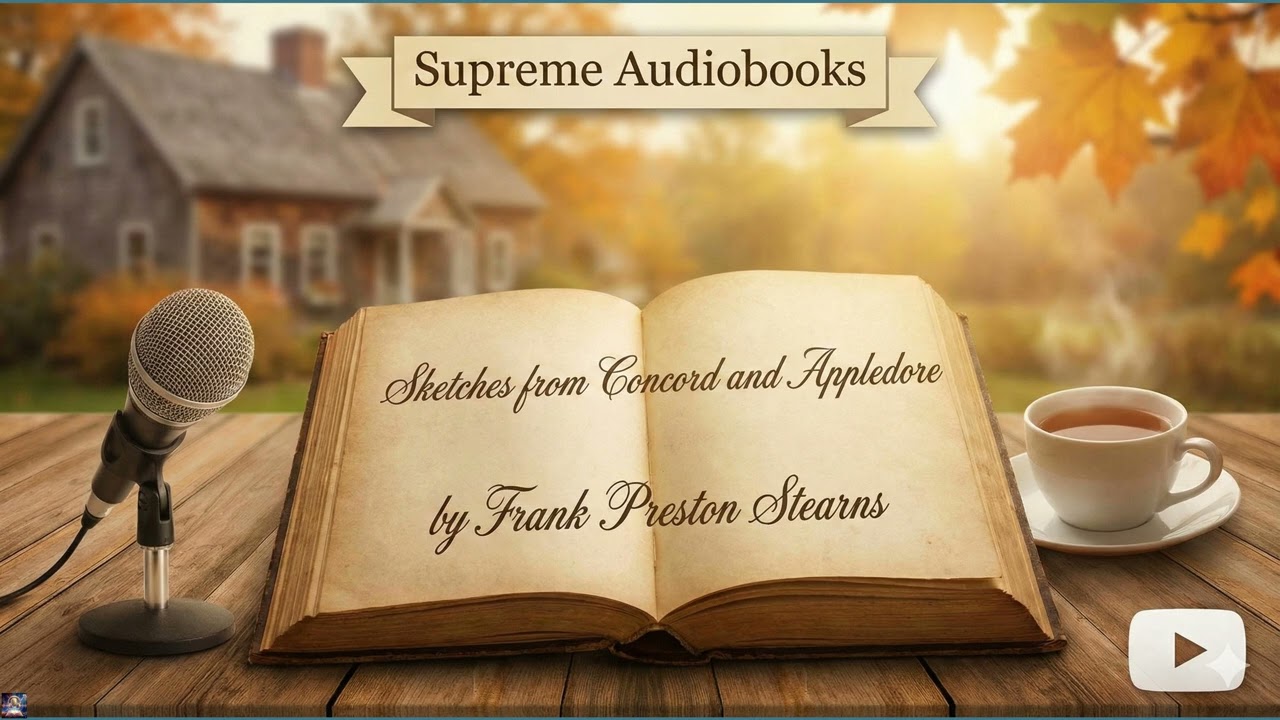
The 4K cinematic visuals accompanying this audiobook are generated by an AI image model from prompts derived from the source text. No copyrighted photos, paintings, or stock footage are used. AI generation is disclosed on every video on our YouTube channel as required by YouTube's altered/synthetic content policy.
English subtitles are transcribed from the LibriVox recording with OpenAI Whisper. Translations into the 11 other supported languages are produced by Meta's NLLB-200 neural translation model. No human translator's copyrighted translation is used.
Questions about sourcing or rights? See our DMCA & Sourcing policy or contact us.
Enjoyed this audiobook?
If you'd like to own a copy of Sketches from Concord and Appledore or hear a professionally produced edition, the links below help support free audiobook production at no extra cost to you.
As an Amazon Associate we earn from qualifying purchases. Audible / print links are affiliate.