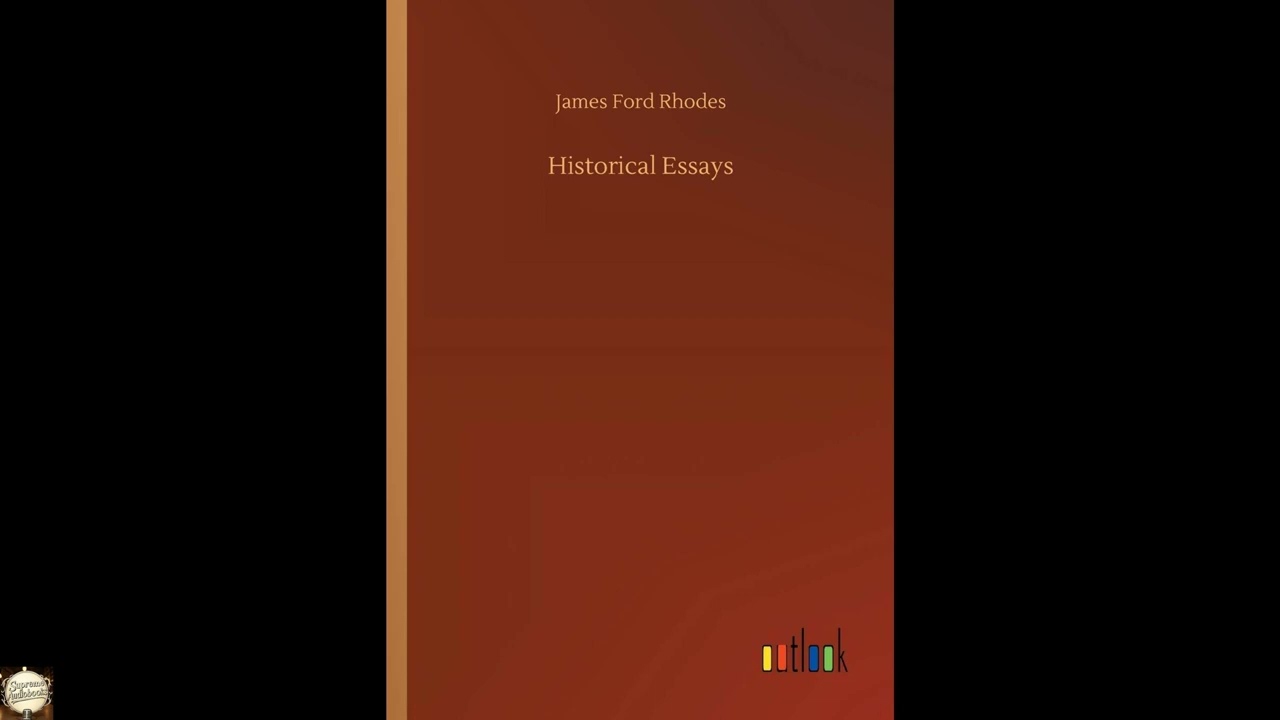
Historical Essays
Step into the intellectual arena where history is not just recounted but vigorously debated and meticulously analyzed. Historical Essays by James Ford Rhodes offers a window into the sharp mind of one of America's most influential historians, presenting a collection of his insightful examinations into the nation's past. Far from a dusty recitation of facts, these essays remain strikingly relevant today, inviting listeners to grapple with enduring questions about national identity, the causes and consequences of conflict, and the very nature of historical truth. They illuminate the profound challenges faced by leaders and citizens alike during critical junctures in American development, urging us to consider how past decisions continue to resonate in our present moment and shape our collective future. Rather than a single, continuous narrative, Historical Essays presents a series of incisive examinations of pivotal moments and figures in American history, primarily focusing on the nineteenth century. Rhodes invites the listener into the intellectual crucible of events like the build-up to the Civil War, the wartime leadership of Abraham Lincoln, the complex period of Reconstruction, and the societal shifts that followed. Each essay acts as a focused lens, dissecting particular policies, scrutinizing the motivations of key political actors such as Stephen A. Douglas or Ulysses S. Grant, and weighing the competing forces that shaped the nation’s destiny. The central point of intellectual engagement across the collection is often the struggle to reconcile ideals with realities, to understand the moral dimensions of political action, and to assess the long-term repercussions of choices made in times of national crisis. Listeners will find Rhodes meticulously building arguments, presenting evidence drawn from extensive research, and engaging with the historical record to illuminate the deeper currents of American development, rather than offering a simple chronology. He examines how economic forces intersected with moral imperatives, how individual leadership could sway national outcomes, and how the interpretation of events evolved over time. James Ford Rhodes, born in Cleveland, Ohio, in 1848, was an improbable figure to become one of America’s most respected historians. Unlike many of his academic contemporaries who followed a traditional path through university history departments, Rhodes initially pursued a career in his family’s successful coal and iron business. This early life in industry, however, provided him with more than just financial security; it instilled in him a pragmatic understanding of economic forces and a discipline for thorough investigation that would later define his historical method. At the age of 41, Rhodes made the bold decision to retire from business, dedicating the remainder of his life to historical scholarship. Entirely self-taught as a historian, he approached his new vocation with an almost obsessive rigor, immersing himself in primary sources, government documents, and personal memoirs. His magnum opus, the multi-volume History of the United States from the Compromise of 1850, became a landmark work, widely acclaimed for its exhaustive research and its effort to present a balanced, comprehensive account of a deeply divisive era. Rhodes earned numerous accolades, including the presidency of the American Historical Association, solidifying his place as a leading voice in American historiography. The essays collected here reflect several profound themes that preoccupied Rhodes throughout his career. One prominent theme is the burden of leadership during crisis. An essay might, for example, dissect President Lincoln’s ethical dilemmas in wartime, analyzing the immense pressure he faced in balancing the preservation of the Union with the abolition of slavery. Rhodes would likely use specific legislative debates or military strategies to illustrate the tightrope walk of presidential decision-making. Another recurring theme is the role of moral imperatives in shaping national destiny, particularly evident in his discussions of slavery. He saw the institution not merely as an economic or political issue, but as a fundamental moral failing that inevitably led to national conflict, using textual evidence to show how this moral issue permeated every aspect of antebellum society. A third significant theme is the nature of historical interpretation itself. Rhodes often engaged with other historians' arguments, demonstrating how different perspectives could arise from the same body of evidence, and advocating for a rigorous, evidence-based approach to history. He might illustrate this by comparing contemporary accounts of a Reconstruction policy with later evaluations, showing how biases or new information changed understanding. Finally, the evolution of American national character and unity consistently underpins his work. He examined how the trials of war and reconstruction forged a new, albeit fragile, sense of nationhood from disparate regional loyalties, perhaps referencing debates over federal power and states’ rights to show the slow, difficult process of unification. When James Ford Rhodes was writing, America was undergoing profound changes. The late nineteenth and early twentieth centuries were a period of rapid industrialization, growing national wealth, and increasing social stratification, often termed the Gilded Age. Culturally, there was a growing desire to understand the cataclysm of the Civil War and its aftermath, to reconcile the trauma of division with aspirations for national progress. Politically, the legacy of Reconstruction was still hotly debated, with questions of race, citizenship, and federal power central to public discourse. In the literary and academic worlds, history was professionalizing, moving away from amateur chronicling towards a more "scientific" approach emphasizing archival research and objective analysis, often influenced by German academic models. Rhodes’s work emerged from this environment, striving to provide a meticulously researched and balanced narrative that could bridge regional divides and offer a definitive account of a pivotal era, even as his own interpretations would later be re-examined by subsequent generations of historians. Listening to Historical Essays as an audiobook transforms the experience of engaging with historical scholarship. Rather than flipping pages, you can absorb Rhodes's meticulously constructed arguments and detailed historical accounts through the clear articulation of a skilled narrator. The run length, several hours in total, is perfectly suited for extended periods of focused listening, whether during commutes, while performing household tasks, or simply relaxing in a comfortable chair. The pacing allows for thoughtful contemplation, giving space to digest complex ideas and follow intricate lines of reasoning. The narrator's voice, carefully chosen for clarity and gravitas, becomes your guide through the historical landscape, allowing Rhodes's prose to unfold with a natural rhythm. Without the distraction of visual text, you can fully immerse yourself in the atmosphere of scholarly inquiry, tracing the intellectual steps of a historian dedicated to understanding the past's profound lessons.
Enjoyed Historical Essays? A few ways to support us
Audible & Amazon links are affiliate; we may earn a small commission at no extra cost.
About this production
Human narration by a volunteer reader from LibriVox.org, the public-domain audiobook project. LibriVox volunteers record literary works whose copyright has expired in the United States, releasing the resulting recordings into the public domain.
Historical Essays by James Ford Rhodes. The underlying text is in the U.S. public domain. We do not republish any modern copyrighted edition, translation, or commentary.
The 4K cinematic visuals accompanying this audiobook are generated by an AI image model from prompts derived from the source text. No copyrighted photos, paintings, or stock footage are used. AI generation is disclosed on every video on our YouTube channel as required by YouTube's altered/synthetic content policy.
English subtitles are transcribed from the LibriVox recording with OpenAI Whisper. Translations into the 11 other supported languages are produced by Meta's NLLB-200 neural translation model. No human translator's copyrighted translation is used.
Questions about sourcing or rights? See our DMCA & Sourcing policy or contact us.
Enjoyed this audiobook?
If you'd like to own a copy of Historical Essays or hear a professionally produced edition, the links below help support free audiobook production at no extra cost to you.
As an Amazon Associate we earn from qualifying purchases. Audible / print links are affiliate.