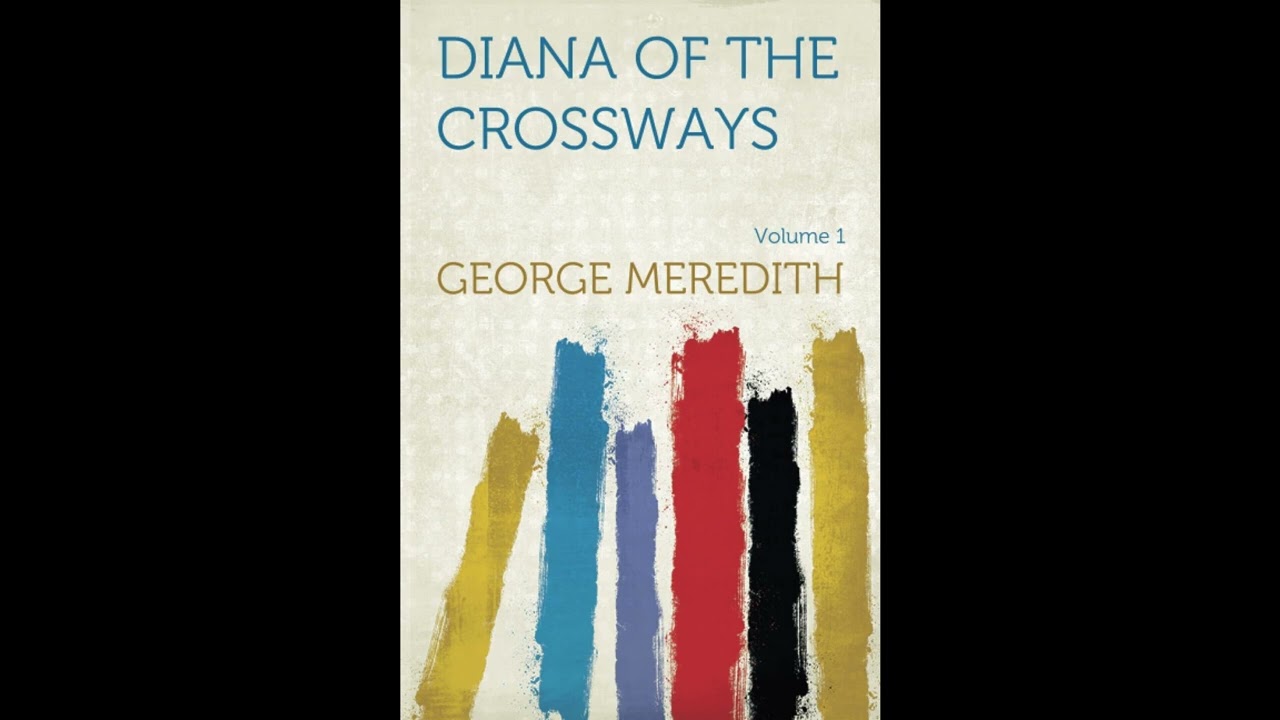
Diana of the Crossways
George Meredith’s Diana of the Crossways stands as a compelling and acutely observed portrait of a spirited woman navigating the treacherous social landscape of Victorian England. Published in 1885, this novel offers far more than a period romance; it presents a cutting critique of societal expectations for women, the devastating power of public opinion, and the struggle for intellectual and personal autonomy. In an era when a woman’s reputation was her most fragile and valuable asset, Diana Warwick challenges the very foundations of her world with her wit, her independent mind, and her refusal to be easily categorized. Listeners today will find in Diana a resonant figure, a woman striving to define herself outside the confines of conventional marriage and gossip, facing questions of identity, financial independence, and media scrutiny that echo profoundly in our own time. The story introduces us to Diana Merion, a young Irishwoman of exceptional beauty, intellect, and vivacity, who quickly becomes the toast of London society. She marries Augustus Warwick, an older man whose initial charm soon gives way to a controlling and jealous nature, compounded by his mounting financial difficulties. Diana finds herself trapped in a marriage that stifles her intellectual spirit and leaves her craving genuine companionship and a purpose beyond domesticity. She forms deep, platonic friendships with several influential men, including a shrewd newspaper editor, Danvers, and a rising politician, Redworth. These relationships, born of intellectual affinity rather than romantic attachment, become sources of both solace and scandal in a society ever eager to condemn independent women. As Diana's marriage deteriorates and her husband's demands grow more oppressive, she eventually separates from him. Her precarious financial situation forces her to consider earning a living through writing, a challenging path for a woman of her standing. The narrative follows her attempts to carve out a life of her own, facing social ostracism and the relentless pressure of gossip. The central conflict intensifies when Diana becomes privy to a political secret involving a powerful figure, Percy Dacier, with whom she has a complicated relationship. Her subsequent actions regarding this secret lead to a devastating public scandal, threatening to destroy her reputation and her very livelihood, forcing her to confront the unforgiving scrutiny of the press and society. George Meredith, born in 1828 in Portsmouth, England, was a novelist and poet whose unique voice helped shape the literary landscape of the late Victorian era. His early life was marked by hardship; his mother died when he was five, and his father, a tailor, squandered his inheritance, leading to Meredith's early education at the Moravian School in Neuwied, Germany, an experience that profoundly influenced his intellectual development. He faced further personal turmoil with the breakdown of his first marriage to Mary Ellen Nicolls, daughter of Thomas Love Peacock, which provided a stark personal understanding of the complexities and injustices of Victorian marriage. This difficult period, particularly the societal judgment surrounding divorce, informed his subsequent literary concerns. Meredith later found happiness in his second marriage to Marie Vulliamy and settled in Box Hill, Surrey, where he wrote many of his most celebrated works. He was a prolific writer, known for novels like The Ordeal of Richard Feverel, a poignant exploration of an oppressive father-son relationship, and The Egoist, a satirical examination of self-love and social convention. His poetry collection, Modern Love, stands as a powerful sequence dissecting the nuances of a failing marriage. Though sometimes challenging for his contemporary readers due to his dense, aphoristic prose and psychological depth, Meredith earned the admiration of fellow writers, including Virginia Woolf and Robert Louis Stevenson, for his intellectual rigor and his pioneering approach to character, particularly his nuanced portrayal of women. He died in 1909, leaving a legacy as a writer who bridged the gap between traditional Victorian realism and the emerging psychological complexities of modernism. Diana of the Crossways keenly illustrates several significant themes. Foremost among these is the theme of women’s independence and intellectualism. Diana's sharp mind and desire for intellectual engagement clash constantly with the narrow roles prescribed for women of her time. We see this in her attempts to support herself through writing, where she faces skepticism and condescension, and in her witty, often provocative conversations that are frequently misunderstood or deemed inappropriate by those around her. Her intelligence is both her greatest asset and her most dangerous liability in a society that preferred women to be decorative and demure. Another central theme is the devastating power of reputation and scandal. The novel brilliantly exposes how Victorian society, fueled by gossip and the burgeoning popular press, could construct and demolish a woman's social standing with little regard for truth or justice. Diana's experiences after the political secret becomes public demonstrate the intense scrutiny and moral judgment applied to women who stepped outside conventional boundaries, highlighting the fragility of a female public figure's good name and the swiftness with which it could be tarnished. The novel also powerfully examines the restrictive nature of marriage and its financial and social constraints on women, as seen in Diana's suffocating union with Augustus Warwick, which ultimately denies her autonomy and personal fulfillment. The novel's emergence in 1885 places it squarely in the late Victorian period, a time of significant social and cultural shifts in Britain. This era saw the burgeoning "New Woman" movement, a cultural phenomenon advocating for greater independence, education, and professional opportunities for women, challenging traditional gender roles. Meredith's Diana, with her intellectual ambition and desire for self-determination, can be seen as a literary precursor to these "New Woman" figures, reflecting a growing societal awareness of women's rights, including property rights and the right to an independent income. The plot itself draws inspiration from real-life events, notably the struggles of Caroline Norton, a relative by marriage of Meredith's first wife, who, after a scandalous divorce, fought tirelessly for women's legal rights, particularly regarding married women's property. The novel thus engages directly with contemporary legal and social debates, illustrating how changing journalistic practices, with their increasing emphasis on sensationalism, could both reflect and influence public opinion, shaping individual fates. Listening to Diana of the Crossways as an audiobook provides a unique gateway into Meredith’s distinctive prose and the complex world he creates. A skilled narrator can make Meredith's often elaborate sentence structures and richly layered dialogue feel immediate and clear, guiding the listener through the philosophical musings and sharp social commentary embedded within the narrative. The several hours of listening time allow for a complete immersion in Diana’s journey, offering an opportunity to absorb the subtle nuances of her character and the intricate social dynamics that shape her destiny. Pay close attention to the narrator’s delivery of Diana’s witty remarks and the varied voices of the society figures who orbit her, as these vocal performances enhance the irony and emotional depth of Meredith's writing, bringing the drawing rooms, political corridors, and whispered conversations of Victorian London vividly to life.
Enjoyed Diana of the Crossways? A few ways to support us
Audible & Amazon links are affiliate; we may earn a small commission at no extra cost.
About this production
Human narration by a volunteer reader from LibriVox.org, the public-domain audiobook project. LibriVox volunteers record literary works whose copyright has expired in the United States, releasing the resulting recordings into the public domain.
Diana of the Crossways by George Meredith. The underlying text is in the U.S. public domain. We do not republish any modern copyrighted edition, translation, or commentary.
The 4K cinematic visuals accompanying this audiobook are generated by an AI image model from prompts derived from the source text. No copyrighted photos, paintings, or stock footage are used. AI generation is disclosed on every video on our YouTube channel as required by YouTube's altered/synthetic content policy.
English subtitles are transcribed from the LibriVox recording with OpenAI Whisper. Translations into the 11 other supported languages are produced by Meta's NLLB-200 neural translation model. No human translator's copyrighted translation is used.
Questions about sourcing or rights? See our DMCA & Sourcing policy or contact us.
Enjoyed this audiobook?
If you'd like to own a copy of Diana of the Crossways or hear a professionally produced edition, the links below help support free audiobook production at no extra cost to you.
As an Amazon Associate we earn from qualifying purchases. Audible / print links are affiliate.