Six Women
In an era often idealized for its elegant manners and strict social codes, a powerful counter-narrative emerged, one that gave voice to the private desires and public struggles of women chafing against the confines of their time. Victoria Cross’s Six Women stands as a compelling example of such literature, an intimate study of lives lived under scrutiny, where personal conviction often battled fiercely with societal expectation. This novel, a significant work from the turn of the twentieth century, compels us to consider the enduring questions of female agency, the price of independence, and the true cost of conformity—themes that resonate with striking clarity even in our contemporary world. It is a testament to the enduring human spirit in its many forms, offering a window into the souls of individuals striving for self-definition. The narrative of Six Women unfolds not as a single sweeping drama but as a series of interconnected portraits, each illuminating a distinct facet of womanhood in an age of profound social change. We are introduced to a diverse assembly of characters, whose circumstances range from the gilded cages of high society to the quiet desperation of more humble existences. There is, for instance, the fiercely intelligent intellectual woman, grappling with a mind too sharp for the domestic sphere prescribed for her; a woman of unconventional beauty, whose passionate nature makes her an object of both fascination and scandal; and a seemingly demure young woman, whose hidden depths conceal a startling capacity for rebellion. Each woman’s story begins with her seemingly established place in the world, only for the narrative to peel back the layers of pretense and reveal the internal conflicts simmering beneath the surface. As the stories progress, their lives, though often disparate, converge through shared experiences of desire, disillusionment, and the relentless pressure of a patriarchal society. Some find themselves entangled in clandestine affairs, others yearn for artistic expression denied them, and still others face the agonizing choice between a loveless marriage of convenience and a life of precarious independence. The central conflict for each protagonist lies in her battle against the invisible chains of expectation—the roles dictated by family, class, and gender—and her yearning for an authentic existence. While some might seek solace in defiance, others navigate their predicaments with quiet cunning, each charting her own perilous course through a world that offers little quarter for those who deviate from the prescribed path. The book offers no easy answers, instead presenting a nuanced, often unsettling, view of women striving to find freedom and fulfillment against formidable odds. The author known as Victoria Cross was, in fact, Annie Sophie Cory, born in 1863 in Lahore, British India, where her father served in the army. Her early life in India provided her with a unique perspective, a sense of distance from traditional British society that would later inform her writing. She belonged to a remarkable literary family; her sisters were also authors—Isabel Cory, who wrote under the pseudonym Laurence Hope, and Adela Florence Nicolson, known as Violet Fane. Unlike her more romantically inclined sisters, Annie Sophie developed a reputation for her boldly unconventional and often scandalous novels. After returning to England, she lived a largely itinerant life, traveling extensively in Europe, particularly to Italy, which became her adopted home for many years until her death in 1952. Cross became a prominent, if controversial, figure among the “New Woman” writers of the late 19th and early 20th centuries. Her debut novel, The Woman Who Did, published in 1895, caused a sensation for its frank portrayal of a woman who rejects marriage and societal norms in favor of free love and individual liberty. This and subsequent works like Anna Lombard cemented her image as a daring provocateur, challenging the moral prudery of Victorian and Edwardian society head-on. She was unafraid to tackle themes of female sexuality, desire, and independence, often depicting women who made choices that were considered shocking and immoral by the standards of her day. Her place in the literary canon, while perhaps not as widely recognized as some of her contemporaries, is significant for her unapologetic contributions to the burgeoning feminist discourse in literature. Six Women particularly demonstrates Cross’s keen insight into the societal strictures placed upon women, especially concerning their personal desires and autonomy. One prominent theme is the struggle for female agency, exemplified by characters who actively, sometimes desperately, seek control over their own lives rather than passively accepting their predetermined roles. Consider, for instance, the woman who chooses intellectual pursuits over a conventional marriage, enduring social ostracization for the sake of her mind's freedom, or the character who risks scandal to pursue a love affair that offers genuine emotional connection, even if it defies all propriety. Another significant theme is the pervasive hypocrisy of social morality, where outward appearances and reputation are often prized above genuine virtue or happiness. This is vividly illustrated through the contrasting fates of characters—those who adhere to strict moral codes yet suffer silently, and those who bravely (or recklessly) flout convention only to face condemnation, regardless of the purity of their intentions. The novel also examines the complex nature of love and desire, often contrasting romantic ideals with the brutal realities of economic necessity and societal pressure. Cross shows how desire, particularly female desire, was viewed as a dangerous force, something to be controlled or suppressed, yet it remains a powerful motivator for her characters. This is evident in scenes where women are forced to marry for security rather than affection, or where their true passions are hidden away, only to erupt with devastating consequences. Furthermore, the book scrutinizes the weight of reputation and the double standards applied to men and women. A woman's entire social standing, her very identity, could be irrevocably destroyed by a single transgression, while men often escaped similar censure. Through these interwoven stories, Cross reveals the often-crushing burden of these expectations and the varying ways her protagonists choose to shoulder, resist, or ultimately succumb to them. The period during which Victoria Cross wrote Six Women—the late 19th and early 20th centuries—was a time of immense social and cultural upheaval. It was the era of the "New Woman," a cultural phenomenon that saw women pushing back against traditional gender roles, demanding greater independence, education, and political rights. This was a direct challenge to the deeply entrenched patriarchal structures of Victorian society, which had largely confined women to the domestic sphere. The burgeoning suffrage movement, debates over divorce laws, and increasing opportunities for women in education and employment all contributed to an environment ripe for literary works that questioned the status quo. Six Women emerged directly from this ferment, reflecting and contributing to the evolving dialogue around women’s place in society. Literary movements of the time, such as Realism and Naturalism, also influenced Cross’s approach, encouraging a more unvarnished depiction of life and human psychology, a stark contrast to the sentimental romances that had previously dominated popular fiction. Writers like Cross used their platforms to expose the often-unspoken truths about women’s lives, including their sexual desires, their frustrations, and their intellectual aspirations, which had long been ignored or actively suppressed in literature. Her work, though often sensationalized, was part of a larger, vital conversation that laid the groundwork for modern feminism and irrevocably changed the landscape of women's writing. Listening to Six Women as an audiobook offers a particularly immersive experience, allowing the nuanced emotional landscape of each character to unfold with direct intimacy. The performance becomes crucial in differentiating the voices and internal worlds of these six distinct women, capturing their varying social standings, temperaments, and internal struggles. Listen for the subtle shifts in tone that convey suppressed anger, quiet defiance, or the faint hope for change. The run length, measured in several hours, provides ample opportunity to truly settle into the narrative, allowing each character's predicament to sink in without interruption. A skilled narrator can amplify the atmosphere of constraint and aspiration, emphasizing the poignant dialogue and internal monologues that reveal the true complexity of these women's lives. The spoken word brings a fresh dimension to Victoria Cross’s pioneering spirit, making the struggles and triumphs of these women feel remarkably present and relevant to listeners today.
Enjoyed Six Women? A few ways to support us
Audible & Amazon links are affiliate; we may earn a small commission at no extra cost.
About this production
Human narration by a volunteer reader from LibriVox.org, the public-domain audiobook project. LibriVox volunteers record literary works whose copyright has expired in the United States, releasing the resulting recordings into the public domain.
Six Women by Victoria Cross. The underlying text is in the U.S. public domain. We do not republish any modern copyrighted edition, translation, or commentary.
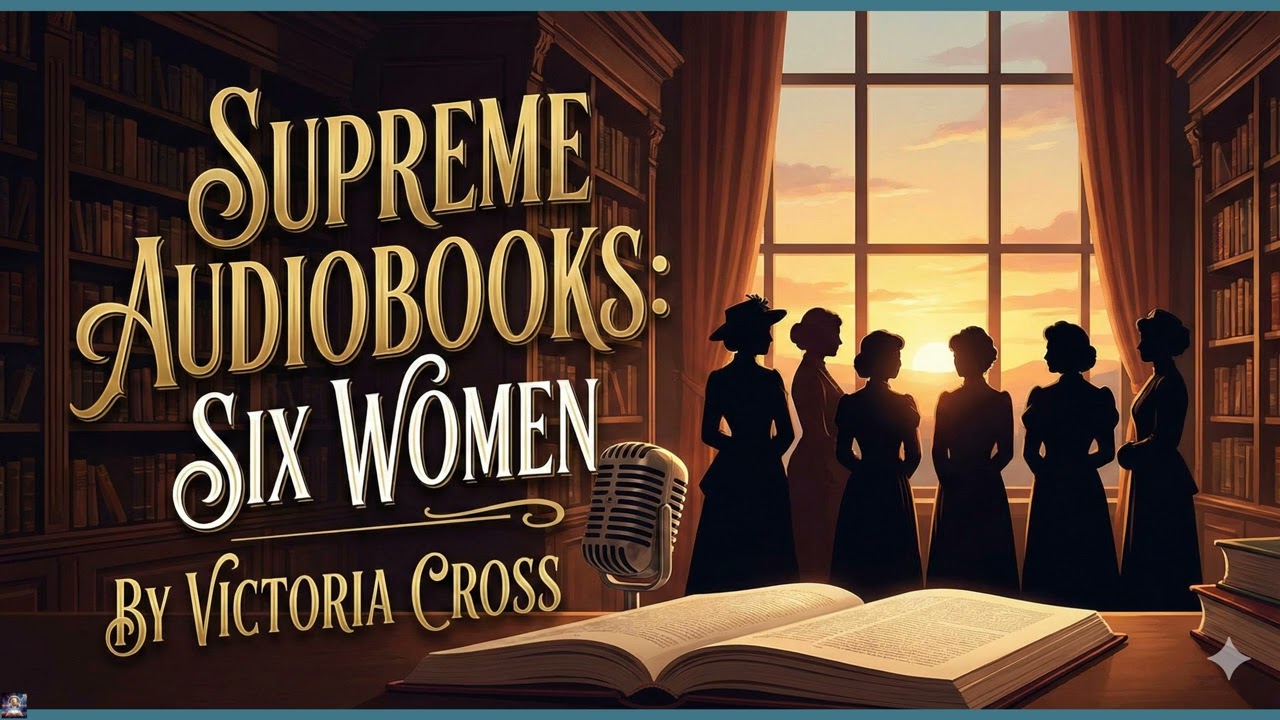
The 4K cinematic visuals accompanying this audiobook are generated by an AI image model from prompts derived from the source text. No copyrighted photos, paintings, or stock footage are used. AI generation is disclosed on every video on our YouTube channel as required by YouTube's altered/synthetic content policy.
English subtitles are transcribed from the LibriVox recording with OpenAI Whisper. Translations into the 11 other supported languages are produced by Meta's NLLB-200 neural translation model. No human translator's copyrighted translation is used.
Questions about sourcing or rights? See our DMCA & Sourcing policy or contact us.
Enjoyed this audiobook?
If you'd like to own a copy of Six Women or hear a professionally produced edition, the links below help support free audiobook production at no extra cost to you.
As an Amazon Associate we earn from qualifying purchases. Audible / print links are affiliate.