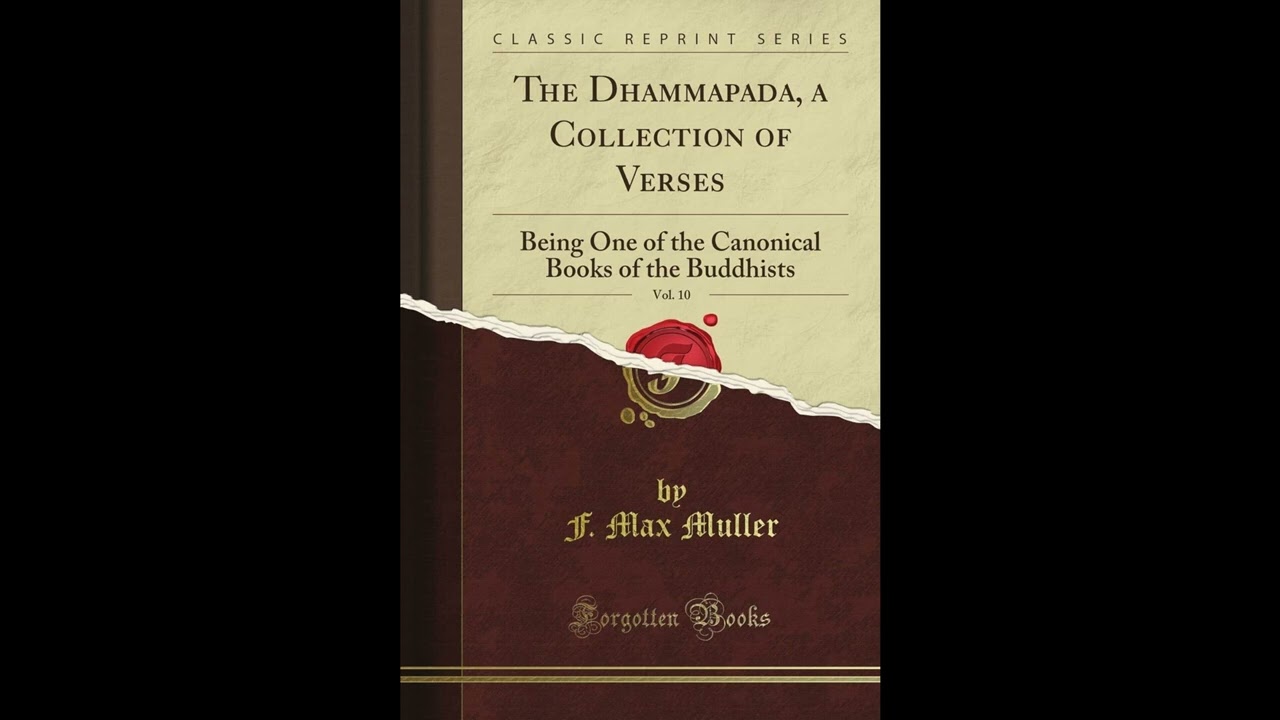
Dhammapada, a Collection of Verses; Being One of the Canonical Books of the Budd
Among the vast libraries of human wisdom, certain texts stand as enduring beacons, their light undiminished by the passage of centuries, continuing to illuminate the human condition with profound clarity. The Dhammapada, a collection of verses from the canonical scriptures of Buddhism, is precisely such a work. Far from being a relic of an ancient faith, it presents a distilled essence of practical philosophy and spiritual insight that resonates powerfully with the challenges and aspirations of contemporary life. In a world often characterized by noise, distraction, and moral ambiguity, these elegant pronouncements offer a serene counterpoint, guiding the listener towards inner peace, ethical conduct, and a deeper understanding of the self and others. It is a guide, not to dogma, but to a way of living that cultivates compassion, wisdom, and liberation from suffering—principles as vital and urgent today as they were millennia ago. While the Dhammapada is not a narrative with a traditional plot, its structure forms a coherent progression of understanding, inviting the listener on an inward path. Imagine it as a series of reflections, like stepping stones across a river of human experience, each verse a concise pronouncement on an aspect of existence. The setting is the universal landscape of the human mind and its interaction with the world, as observed and articulated by the Buddha. The primary "characters" are, in a sense, the conceptual archetypes: the wise person, the foolish person, the angry individual, the compassionate soul, the disciplined ascetic, and the seeker striving for insight. The central "conflict" is the universal struggle within each person—between delusion and clarity, between craving and contentment, between attachment and freedom. The arc of the Dhammapada begins with foundational principles, such as the paramount influence of the mind on one's experience: "All that we are is the result of what we have thought; it is founded on our thoughts, it is made up of our thoughts." From this fundamental insight, it moves through discussions of moral responsibility, the consequences of actions (karma), and the importance of ethical behavior in speech, body, and mind. It then guides the listener through the cultivation of self-control, patience, and detachment, illustrating the benefits of monastic life and the path of the spiritual practitioner. The compilation gradually builds towards the understanding of ultimate liberation, revealing the nature of enlightenment and the qualities of those who have attained it, all without ever prescribing a rigid narrative conclusion but rather pointing towards an awakened state of being. The actual authorship of the Dhammapada, like many ancient religious and philosophical texts, is attributed to "Unknown." This is not a deficiency, but rather a testament to its collective wisdom, drawing directly from the oral teachings of the Buddha himself, Siddhartha Gautama, who lived in northern India around the fifth century BCE. This collection of verses is considered one of the most accessible and widely read parts of the Pali Canon, the standard collection of scriptures in the Theravada Buddhist tradition. It belongs to the Khuddaka Nikaya, or "Collection of Minor Texts," a section devoted to shorter, often poetic works. The compilation process itself occurred over several centuries after the Buddha's passing, as his disciples and subsequent generations of monastics meticulously preserved and codified his spoken teachings. These verses were originally memorized and recited by generations of monks, forming a living tradition long before they were committed to writing. The text, therefore, is a communal heritage, representing the distilled essence of early Buddhist thought, shaped by the collective memory and understanding of its early adherents, rather than the singular expression of one individual's literary genius. It is a voice echoing through time, preserving the authentic spirit of the Buddha's original message, making it a cornerstone of Buddhist instruction and a revered source of inspiration. The Dhammapada enacts several profound themes with striking clarity. One central theme is the primacy of mind and its absolute influence over our experience. For instance, many verses demonstrate how negative mental states like hatred, anger, and delusion are internal fires that consume the individual, while positive states like loving-kindness and compassion bring peace. "Hatred is never appeased by hatred in this world; by non-hatred alone is hatred appeased. This is an eternal law," declares one verse, illustrating how inner transformation is the only true path to outer harmony. Another significant theme is the law of karma and ethical responsibility. The text repeatedly emphasizes that every action, word, and thought bears consequences, likening a good deed to a seed that yields sweet fruit and a bad deed to one that yields bitter. The difference between the "foolish person" and the "wise person" is a recurring motif, showing how the former acts impulsively and ignorantly, accumulating suffering, while the latter acts with mindfulness and understanding, moving towards liberation. A third major theme is the impermanence of all phenomena and the nature of suffering. The verses consistently remind the listener that attachment to transient things—wealth, reputation, even life itself—is a source of disappointment and sorrow. By understanding that "all conditioned things are impermanent" and "all conditioned things are sorrowful," the text gently steers the mind away from craving and towards a more realistic, liberating perspective. Finally, the theme of self-discipline and the path of practice is woven throughout. It advocates for diligent effort in meditation, ethical conduct, and the cultivation of wisdom, presenting these not as rigid rules, but as practical steps towards inner freedom. The famous analogy of the fletcher straightening his arrow is used to describe the mind's ability to straighten its own crooked thoughts, a concrete image of focused self-mastery. The historical context surrounding the compilation of the Dhammapada is rooted in the vibrant intellectual and spiritual landscape of ancient India. Following the Buddha's parinirvana, or passing, his teachings were initially preserved through oral recitation by his monastic community. As the Sangha, the Buddhist monastic order, grew and spread, there arose a need to codify and systematize these teachings to ensure their purity and accessibility. This period, roughly from the 3rd century BCE to the 1st century BCE, saw the emergence of the Pali Canon, a comprehensive collection of Buddhist scriptures written in the Pali language, a Middle Indo-Aryan dialect related to Sanskrit. The Dhammapada itself likely coalesced during this early era of textual compilation, serving as a didactic and inspirational compendium for both monks and lay followers. It emerged in a time when numerous philosophical and religious schools flourished across India, each offering distinct paths to understanding life's mysteries. Buddhism distinguished itself by emphasizing direct experience, ethical conduct, and personal liberation over ritualistic practices or reliance on deities. The Dhammapada, with its clear, direct, and non-sectarian presentation of fundamental truths, became an essential text for conveying the practical wisdom of the Buddha to a wide audience, providing a concise moral and spiritual framework for daily living within a rapidly developing religious movement. Listening to the Dhammapada as an audiobook offers a uniquely contemplative and immersive experience, distinct from reading the text on a page. The act of hearing these verses recited allows their inherent rhythm and poetic quality to come to the fore, transforming them from mere words into resonant meditations. A skilled narration brings out the calm authority, the gentle guidance, and the profound simplicity embedded in each aphorism. The run length, several hours, makes it an ideal companion for moments of quiet reflection, during a meditative walk, or as a serene background for focused work. Listen for the deliberate pacing that allows each verse to settle, for the voice that conveys both the intellectual clarity and the emotional depth of the teachings. The spoken word can underscore the continuity of themes and the progression of ideas, fostering a deeper, more intuitive connection with this ancient, yet utterly relevant, treasury of wisdom.
Enjoyed Dhammapada, a Collection of Verses; Being One of the Canonical Books of the Budd? A few ways to support us
Audible & Amazon links are affiliate; we may earn a small commission at no extra cost.
About this production
Human narration by a volunteer reader from LibriVox.org, the public-domain audiobook project. LibriVox volunteers record literary works whose copyright has expired in the United States, releasing the resulting recordings into the public domain.
Dhammapada, a Collection of Verses; Being One of the Canonical Books of the Budd. The underlying text is in the U.S. public domain. We do not republish any modern copyrighted edition, translation, or commentary.
The 4K cinematic visuals accompanying this audiobook are generated by an AI image model from prompts derived from the source text. No copyrighted photos, paintings, or stock footage are used. AI generation is disclosed on every video on our YouTube channel as required by YouTube's altered/synthetic content policy.
English subtitles are transcribed from the LibriVox recording with OpenAI Whisper. Translations into the 11 other supported languages are produced by Meta's NLLB-200 neural translation model. No human translator's copyrighted translation is used.
Questions about sourcing or rights? See our DMCA & Sourcing policy or contact us.
Enjoyed this audiobook?
If you'd like to own a copy of Dhammapada, a Collection of Verses; Being One of the Canonical Books of the Budd or hear a professionally produced edition, the links below help support free audiobook production at no extra cost to you.
As an Amazon Associate we earn from qualifying purchases. Audible / print links are affiliate.
More by Unknown

The Poetical Works; Gay's Fables; and Somerville's Chase. With Memoirs and Critical

The Purple Land: Being The Narrative Of One Richard Lamb's Adventures In The Banda

Shakespeare And Montaigne: An Endeavour To Explain The Tendency Of 'Hamlet' From Al

Letters on the Nicobar Islands, Their Natural Productions and the Manners, Customs
More Audiobooks

Buddhism in the Modern World
Buddhism and Buddhists in China

The Religion of the Samurai: A Study of Zen Philosophy and Discipline in China and J- Full Audiobook
Wisdom of the East - Buddhist Psalms - Translated from the Japanese of Shinran Shoni- Full Audiobook