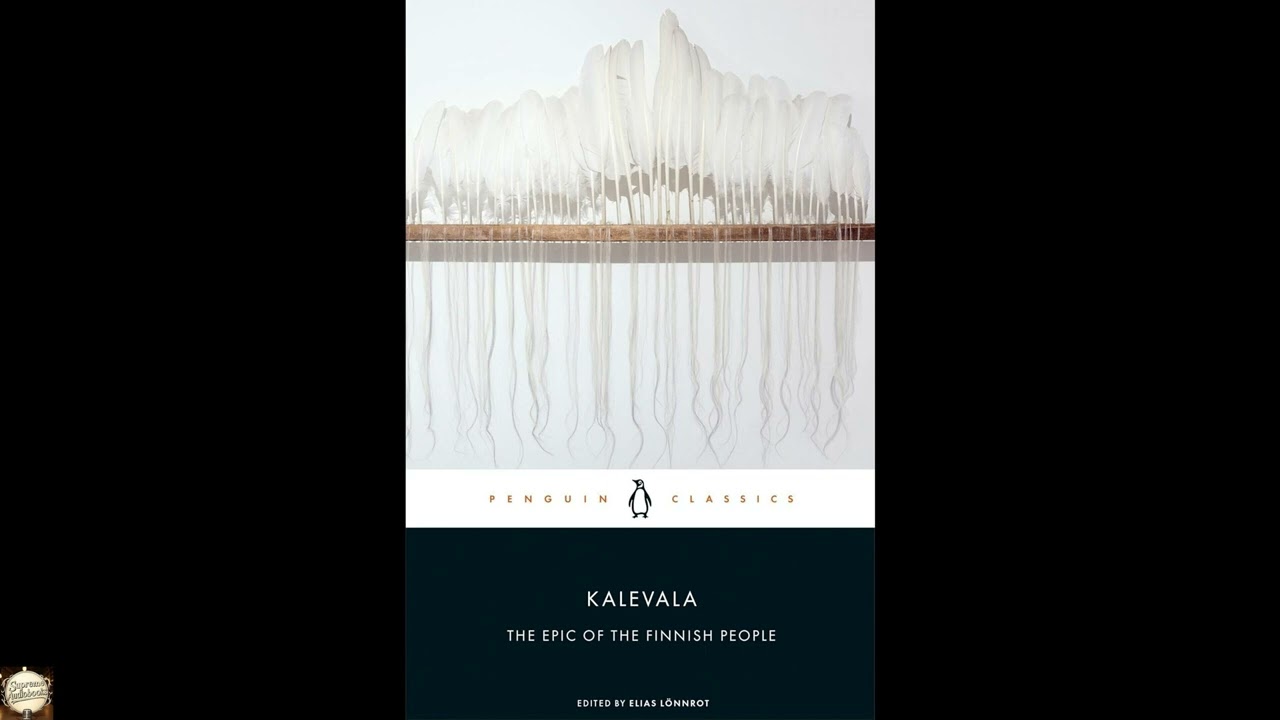
Kalevala: The Epic of the Finnish People
Step into a world spun from ancient song and forest lore, where shamans sing the world into being and heroes contend with magic and myth. Elias Lonnrot's Kalevala: The Epic of the Finnish People stands not merely as a collection of old tales but as the very foundation of a nation's soul, offering a window into a culture forged in the crucible of ice and fire, wilderness and wisdom. For listeners today, this extraordinary work resonates with the universal human need for origin stories, for understanding our place in the cosmos, and for finding heroism in both grand deeds and the power of words. It is a testament to the enduring power of oral tradition and a captivating saga that speaks to identity, fate, and the profound connection between humanity and the natural world, all rendered with a stark, compelling beauty that still holds sway centuries after its verses were first chanted. The epic unfurls in the mythical land of Kalevala, a realm of deep woods, countless lakes, and shimmering northern lights, distinct from its rival, the dark and fearsome Pohjola, the Northland. At its heart stands Väinämöinen, the ancient, wise, and powerful shaman-singer, whose birth follows the very creation of the world from a duck's egg upon the knee of the primeval spirit, Ilmatar. With words and music as his primary weapons, Väinämöinen shapes the landscape and conjures magic. He is joined by Ilmarinen, the eternal smith, a master craftsman capable of forging anything imaginable, and the often reckless but charismatic Lemminkäinen, a warrior whose adventures frequently lead him into peril and back again through sheer audacity. These heroes, along with others, find themselves in recurring conflict with Louhi, the formidable and often malevolent mistress of Pohjola, whose magical powers and cunning present constant challenges. The central conflict frequently revolves around the Sampo, a wondrous artifact forged by Ilmarinen for Louhi as a bride-price, a mill that grinds out prosperity, salt, and grain, but whose true nature remains mysterious and symbolic. Its theft and recovery form a significant arc within the larger narrative, demonstrating the constant struggle between light and shadow, creation and destruction, abundance and scarcity. The story progresses not with a single linear plot, but through a series of interconnected poems, or runes, chronicling creation myths, courtship rituals, heroic quests for magical objects, and contests of skill and knowledge, all interspersed with profound laments and joyous celebrations. Each episode builds upon the last, painting a vivid picture of a world where gods and humans interact, where animals speak, and where the line between reality and enchantment blurs, culminating in a grand, sweeping saga of cultural emergence and the eventual shift of power. Elias Lonnrot, born in Sammatti, Finland, in 1802, was far more than a simple recorder; he was the meticulous architect of the Kalevala. Trained as a physician, Lonnrot's true passion lay in the language and oral traditions of his homeland. Beginning in the late 1820s, he undertook a series of arduous collecting expeditions, traveling extensively through the remote and often wild regions of Karelia, bordering Russia. There, he diligently transcribed thousands of verses, songs, proverbs, and incantations from the lips of illiterate peasant singers, absorbing their ancient wisdom and melodic phrasing. His travels were driven by a profound understanding that these oral poems represented a vital, yet fading, cultural heritage. Lonnrot's genius lay in his ability to synthesize these disparate fragments into a cohesive, flowing epic. He did not simply copy the poems; he organized, linked, and expanded them, sometimes filling gaps with his own verses, always striving to maintain the authentic voice and rhythm of the oral tradition. The first full version of the Kalevala appeared in 1835, followed by the expanded, definitive edition in 1849, which remains the standard text today. Beyond the Kalevala, Lonnrot also compiled the Kanteletar, a collection of lyrical folk poetry, and produced a groundbreaking Finnish-Swedish dictionary, contributing immensely to the standardization and recognition of the Finnish language. His work positioned him as a towering figure of early Finnish nationalism and a pivotal contributor to world literature, establishing the Kalevala as a foundational text comparable to Homer's epics or the Niebelungenlied. The Kalevala gives voice to several fundamental themes that resonate with profound insight. One pervasive idea is the power of words and song. Väinämöinen, the primary hero, does not rely on brute strength or weaponry; his magic issues from his voice, his ability to chant powerful incantations that can raise mountains, build boats, or even defeat enemies. A memorable scene depicts Väinämöinen besting the boastful Joukahainen in a singing contest, sinking him into a swamp through the sheer force of his ancient knowledge and melodic might. This underscores a belief in the spoken word not just as communication, but as an active, world-shaping force. Another key theme is the interconnectedness of humanity and nature. The Finnish landscape is not merely a backdrop; it is a living entity, with trees, animals, and natural phenomena imbued with spirit and agency. The very creation story sees the world forming from an egg, and Väinämöinen’s forging of the kantele, a Finnish stringed instrument, first from the bones of a giant pike and then from a birch tree, symbolizes this deep, almost symbiotic relationship. The natural elements – forests, water, rocks – are often personified, acting as helpers or hinderers in the heroes’ quests. The themes of origin and creation also run throughout the epic, offering a comprehensive mythical account of the world's beginnings and the establishment of cultural norms. The Kalevala opens not with war or a singular hero, but with the slow, deliberate process of the world's formation, giving a sense of deep time and cosmic significance to human endeavors. This contrasts with, and complements, the theme of heroism and human imperfection. While the heroes perform incredible feats, they are also prone to vanity, recklessness, and sorrow. Lemminkäinen, despite his charm and bravery, repeatedly finds himself in mortal danger due to his impulsiveness, even suffering death and resurrection. Ilmarinen, the smith, achieves legendary status with his craft but also experiences profound loss and loneliness, showing that even the greatest figures face personal challenges and emotional frailty. The emergence of the Kalevala in the mid-19th century arrived at a crucial historical juncture for Finland. At the time, Finland existed as an autonomous Grand Duchy under Russian rule, having previously been part of Sweden for centuries. While politically distinct, a strong sense of a unique Finnish identity, language, and culture was still nascent and largely confined to the peasantry. The educated elite predominantly spoke Swedish or Russian. This period, often called the "Fennoman movement," saw a growing desire among Finnish intellectuals and nationalists to cultivate a distinct national consciousness. The search for a unifying cultural heritage, a defining narrative, became paramount. Lonnrot's publication of the Kalevala therefore served as a powerful catalyst. It provided the Finnish people with an ancient, sophisticated literary heritage, giving their language and culture a prestige that rivaled the epics of other European nations. It offered a common wellspring of myth, character, and values that transcended regional dialects and social classes, playing a pivotal role in solidifying a shared national identity. The epic became a symbol of Finnish pride and cultural self-assertion, not just within Finland but also on the broader European stage, influencing artists, composers like Jean Sibelius, and writers, securing Finland's place in the pantheon of world cultures. Listening to the Kalevala as an audiobook transforms the experience of this monumental work, connecting the listener directly to its oral roots. This is not a text meant solely for silent reading; its verses, with their pervasive alliteration and rhythmic cadences, were originally sung or chanted. The spoken word allows the inherent musicality and hypnotic repetition of the poetry to truly shine. A skilled narrator can bring to life the wisdom of Väinämöinen, the clang of Ilmarinen’s forge, the wild adventures of Lemminkäinen, and the formidable presence of Louhi, capturing the atmosphere of ancient magic and epic struggle. Over several hours of listening, the listener can immerse themselves in the deep world of Finnish myth, allowing the narrative to unfold at its intended pace, appreciating the subtle shifts in tone from heroic exploits to mournful laments, and feeling the profound connection to a heritage shaped by the power of the human voice.
Enjoyed Kalevala: The Epic of the Finnish People? A few ways to support us
Audible & Amazon links are affiliate; we may earn a small commission at no extra cost.
About this production
Human narration by a volunteer reader from LibriVox.org, the public-domain audiobook project. LibriVox volunteers record literary works whose copyright has expired in the United States, releasing the resulting recordings into the public domain.
Kalevala: The Epic of the Finnish People by Elias Lonnrot. The underlying text is in the U.S. public domain. We do not republish any modern copyrighted edition, translation, or commentary.
The 4K cinematic visuals accompanying this audiobook are generated by an AI image model from prompts derived from the source text. No copyrighted photos, paintings, or stock footage are used. AI generation is disclosed on every video on our YouTube channel as required by YouTube's altered/synthetic content policy.
English subtitles are transcribed from the LibriVox recording with OpenAI Whisper. Translations into the 11 other supported languages are produced by Meta's NLLB-200 neural translation model. No human translator's copyrighted translation is used.
Questions about sourcing or rights? See our DMCA & Sourcing policy or contact us.
Enjoyed this audiobook?
If you'd like to own a copy of Kalevala: The Epic of the Finnish People or hear a professionally produced edition, the links below help support free audiobook production at no extra cost to you.
As an Amazon Associate we earn from qualifying purchases. Audible / print links are affiliate.