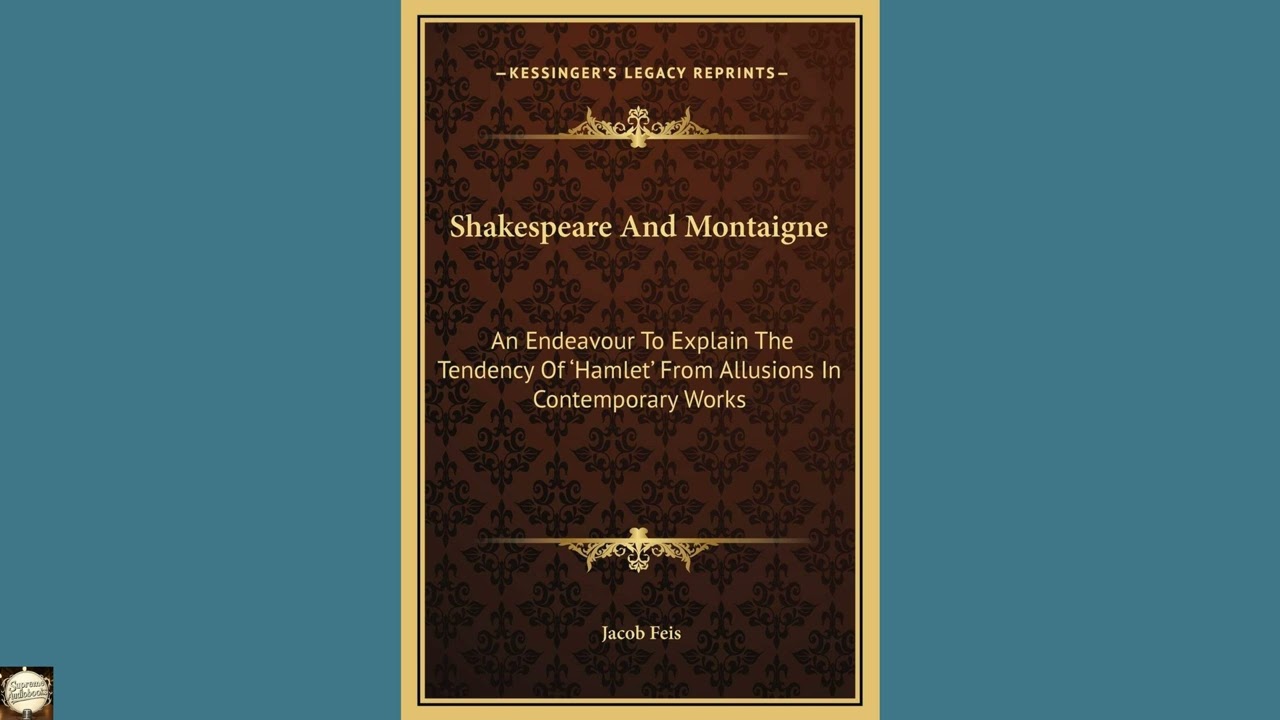
Shakespeare And Montaigne: An Endeavour To Explain The Tendency Of 'Hamlet' From Al
The enigmatic smile of Hamlet, the indecision that plagues his actions, the profound questions he poses about existence – these elements have held audiences spellbound for centuries. Yet, to truly grasp the core of his "tendency," his very inclination of spirit, requires a singular act of intellectual illumination. This critical study, "Shakespeare And Montaigne: An Endeavour To Explain The Tendency Of 'Hamlet' From Al," offers precisely that: an insightful and illuminating perspective that draws a compelling parallel between William Shakespeare's seminal tragedy and the philosophical essays of Michel de Montaigne. It is a work that argues for the profound intellectual kinship between two titans of human thought, proposing that a deeper understanding of Montaigne's skepticism and introspection can unlock the enduring mysteries of the Prince of Denmark. For any listener seeking to move beyond superficial interpretations of Hamlet and engage with the play on a truly philosophical level, this examination provides an essential framework, revealing layers of meaning that resonate with the complexities of modern human experience. This intellectual investigation commences by establishing the philosophical landscape of the late sixteenth and early seventeenth centuries, a period marked by profound shifts in human understanding. The "setting" here is less a geographical location and more a nexus of ideas – the intellectual currents flowing through Renaissance Europe. The central "characters" are, of course, Shakespeare and Montaigne themselves, not as figures in a biographical narrative, but as embodying distinct yet converging modes of thought. This study meticulously constructs a dialogue between them, positing that Montaigne's seminal Essays provided a potent intellectual backdrop, perhaps even a direct influence, on Shakespeare's creation of Hamlet. The central "conflict" isn't external, but rather an internal struggle: the interpretative challenge of reconciling Hamlet's delay, his philosophical brooding, and his seemingly contradictory actions with a coherent understanding of his character. The work asserts that by viewing Hamlet through the lens of Montaigne's radical self-inquiry and his embrace of doubt, his "tendency" – his disposition, his way of approaching the world – becomes significantly clearer. The unfolding argument carefully guides the listener through this intellectual landscape, beginning with an exposition of Montaigne's core philosophical tenets: his radical skepticism, his focus on the self as the primary object of study, and his questioning of absolute truths. From this foundation, the work transitions to a detailed textual analysis of Hamlet, highlighting specific soliloquies, dialogues, and crucial moments where Hamlet's internal struggles mirror Montaigne's philosophical concerns. It illuminates how Hamlet’s famous questioning of “To be or not to be” can be seen as echoing Montaigne’s constant probing into the nature of human existence, the fragility of identity, and the uncertainty of moral choices. The arc of this study moves from establishing the intellectual premise to presenting concrete textual evidence, building a persuasive case for the deep philosophical resonance between the French essayist and the English dramatist. This measured progression ultimately leads towards a more profound appreciation of Hamlet as a figure wrestling with the very philosophical questions that defined his era and continue to challenge humanity. The genesis of this significant critical work, whose specific authorship is not formally recorded, lies within a broader tradition of literary scholarship that seeks to illuminate canonical texts through comparative analysis. It belongs to an intellectual lineage that recognized the power of interdisciplinary thought long before the formalization of academic departments. Scholars and literary enthusiasts across generations have contributed to, and been inspired by, its core argument, shaping how we understand the complex interplay of philosophy and dramatic art. Though its precise origin is obscured by the mists of time, this study stands as a foundational piece in the ongoing dialogue surrounding Shakespeare's most enigmatic character, reflecting a collective endeavor to pierce through the centuries and understand the minds behind the texts. Its lasting impact stems from its courage to forge connections between seemingly disparate intellectual figures, asserting that great minds, even separated by geography and artistic medium, can grapple with similar fundamental human questions. This particular comparative approach, focusing on the philosophical underpinnings of dramatic character, has become a cornerstone of Shakespearean criticism. It represents a significant moment in the development of literary analysis, moving beyond purely textual or historical readings to embrace philosophical and psychological dimensions. The work demonstrates how such a study can transcend its immediate subject matter to offer universal insights into the human condition, making it a critical text of enduring value, recognized for its substantial contribution to our understanding of the Renaissance mind. At its heart, this analysis grapples with themes of existential doubt and introspection. It argues that Hamlet's famous soliloquies – for instance, "How weary, stale, flat, and unprofitable / Seem to me all the uses of this world!" – are not merely expressions of grief, but profound philosophical inquiries into the meaninglessness and uncertainty of life, echoing Montaigne’s consistent questioning of human certitude. Another crucial theme is the nature of human agency versus fate. The study illustrates how Hamlet's struggle with action and inaction, his contemplation of whether to "take arms against a sea of troubles," mirrors Montaigne's reflections on the limitations of human will and the unpredictable currents of fortune. The work also powerfully enacts the theme of intellectual influence, demonstrating how Montaigne's radical self-examination could have permeated the cultural consciousness, providing Shakespeare with a rich vein of philosophical inquiry to infuse into his characters. Finally, the theme of the quest for self-knowledge runs throughout, suggesting that Hamlet’s tormented journey is, at its core, a Montaigne-esque attempt to understand himself and his place in a chaotic world. This study emerged during a period of intense intellectual ferment across Europe. The Renaissance, stretching from the fourteenth to the seventeenth centuries, witnessed a profound rediscovery of classical learning, the rise of humanism, and a burgeoning emphasis on individual reason and experience. The invention of the printing press facilitated the widespread dissemination of new ideas, including Montaigne's Essays, first published in 1580. This cultural shift fostered an environment where the internal life of individuals became a subject of serious philosophical and artistic contemplation, paving the way for figures like Shakespeare to create characters of unprecedented psychological depth. The work speaks to the intellectual curiosity of its time, a desire to understand the complexities of the human mind and its place in the universe, reflecting the very spirit of philosophical inquiry that both Montaigne and Shakespeare so brilliantly captured in their respective mediums. Listening to this critical study as an audiobook offers a unique opportunity to engage deeply with its complex arguments. The several hours of narration provide ample space for the ideas to unfold gradually, allowing the listener to absorb and reflect upon the subtle connections being drawn between Shakespeare and Montaigne. A thoughtful narrator, clear in diction and measured in pacing, becomes an indispensable guide through the philosophical terrain. Pay close attention to how the voice shifts subtly when presenting textual evidence from Hamlet versus when expounding on Montaigne's philosophical positions. The atmospheric delivery transforms what might otherwise be a dense academic text into an accessible and stimulating intellectual dialogue, bringing the brilliance of both the playwright and the essayist, and the critical insights of this work, to life in a way that reading on the page alone cannot always achieve. It is an experience designed for sustained intellectual engagement, inviting you to ponder the profound questions that have defined human thought for centuries.
Enjoyed Shakespeare And Montaigne: An Endeavour To Explain The Tendency Of 'Hamlet' From Al? A few ways to support us
Audible & Amazon links are affiliate; we may earn a small commission at no extra cost.
About this production
Human narration by a volunteer reader from LibriVox.org, the public-domain audiobook project. LibriVox volunteers record literary works whose copyright has expired in the United States, releasing the resulting recordings into the public domain.
Shakespeare And Montaigne: An Endeavour To Explain The Tendency Of 'Hamlet' From Al. The underlying text is in the U.S. public domain. We do not republish any modern copyrighted edition, translation, or commentary.
The 4K cinematic visuals accompanying this audiobook are generated by an AI image model from prompts derived from the source text. No copyrighted photos, paintings, or stock footage are used. AI generation is disclosed on every video on our YouTube channel as required by YouTube's altered/synthetic content policy.
English subtitles are transcribed from the LibriVox recording with OpenAI Whisper. Translations into the 11 other supported languages are produced by Meta's NLLB-200 neural translation model. No human translator's copyrighted translation is used.
Questions about sourcing or rights? See our DMCA & Sourcing policy or contact us.
Enjoyed this audiobook?
If you'd like to own a copy of Shakespeare And Montaigne: An Endeavour To Explain The Tendency Of 'Hamlet' From Al or hear a professionally produced edition, the links below help support free audiobook production at no extra cost to you.
As an Amazon Associate we earn from qualifying purchases. Audible / print links are affiliate.
More by Unknown
Poetical Works of Johnson Parnell Gray and Smollett: With Memoirs Critical Disserta
Cyclopedia of Telephony & Telegraphy Vol. 1 A General Reference Work on Telephony
Manual for Noncommissioned Officers and Privates of Cavalry of the Army of the Unit