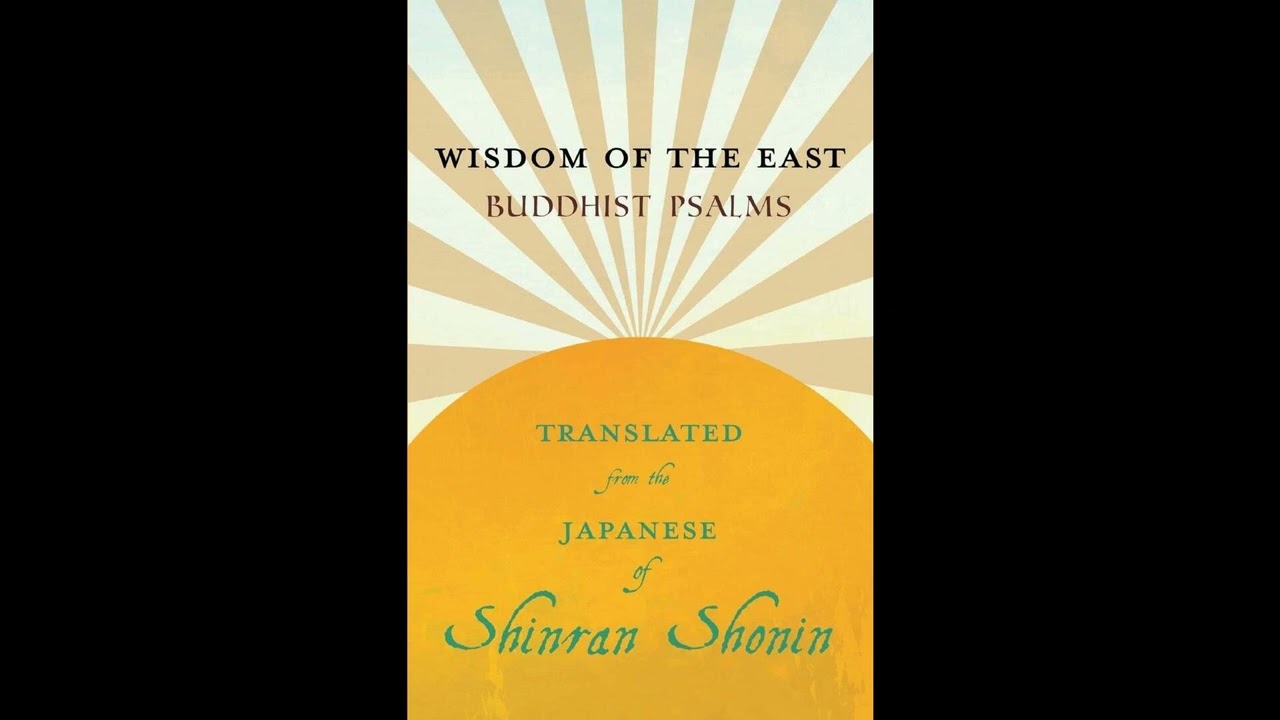
Wisdom of the East - Buddhist Psalms - Translated from the Japanese of Shinran Shoni- Full Audiobook
Step into a profound wellspring of spiritual wisdom with "Wisdom of the East - Buddhist Psalms," a collection that brings to life the enduring teachings of Shinran Shonin. This audiobook offers a singular opportunity to engage directly with the devotional poetry and foundational philosophy of one of Japan's most influential spiritual figures. For listeners today, these psalms are more than historical texts; they present a deeply human response to suffering, a radical vision of universal salvation, and a blueprint for finding solace amidst the chaos of existence. They speak to the heart's yearning for meaning, offering a path of profound faith and liberation that resonates far beyond its original context. This unique collection, a translation of Shinran's poetic expressions, doesn't unfold as a traditional narrative with a single "plot" in the conventional sense. Instead, it traces an intensely personal and yet universally applicable spiritual progression. The "setting" is primarily the human mind and heart grappling with fundamental questions of suffering, merit, and salvation, all against the backdrop of an uncertain world. The central voice, embodying Shinran himself, acts as our guide, a practitioner who has walked the difficult path of spiritual seeking. He is joined by the celestial figure of Amida Buddha, whose boundless compassion forms the very core of the teaching presented here. The overarching "conflict" addressed within these psalms is the perennial human struggle to overcome suffering and attain enlightenment through one's own limited efforts. Shinran vividly portrays the inherent weakness and impurity of ordinary beings, known as bonpu, who are trapped by their karmic burdens and unable to achieve liberation through traditional ascetic practices or self-generated merit. The arc of the psalms moves from this profound recognition of human inadequacy and spiritual despair towards a radiant hope: the realization of salvation through "Other Power." This is the transformative understanding that Amida Buddha, through his Primal Vow, offers a direct and unconditional path to rebirth in the Pure Land, a state from which full enlightenment is guaranteed, simply by placing complete faith in his compassion. The verses celebrate this shift from anxious self-reliance to joyful acceptance of a grace freely given. Though the translator of this specific edition is listed as "Unknown," the true authorial voice belongs to Shinran Shonin (1173–1262), the founder of the Jodo Shinshu, or True Pure Land, school of Buddhism in Japan. Born into the aristocratic Hino family in Kyoto, Shinran’s early life was marked by the political instability and social unrest of the late Heian and early Kamakura periods. At the tender age of nine, he entered the Tendai monastery on Mount Hiei, the leading center of Buddhist study at the time, beginning a rigorous twenty-year monastic training. However, despite his dedicated efforts, Shinran found himself disillusioned with the traditional monastic path, feeling that the complex practices and demanding self-discipline were beyond the reach of ordinary people, and indeed, himself. His spiritual quest led him to Honen, a charismatic monk who advocated for a simpler, more accessible form of Buddhism focused solely on the recitation of the nembutsu—the name of Amida Buddha. This encounter proved transformative for Shinran. Under Honen’s tutelage, he embraced the teaching of salvation through faith in Amida’s Vow, a radical departure from the prevailing emphasis on self-powered practices. This devotion to Amida’s "Other Power" became the bedrock of his teaching. In 1207, Shinran and Honen, along with many of their followers, faced persecution and exile by the government, which saw their popular movement as a threat to traditional Buddhist establishments. During his exile in Echigo province, Shinran defied monastic conventions by marrying and raising a family, demonstrating his belief that a lay life was no impediment to spiritual realization. This act further solidified his vision of a Buddhism accessible to all, irrespective of their social status or ability to adhere to monastic rules. His magnum opus, the Kyogyoshinsho, systematically articulates the doctrines of Jodo Shinshu, but it is through his more direct and personal hymns and psalms that his compassionate message truly shines, making him a pivotal figure in Japanese religious history and a profound spiritual guide for millions. One of the foremost themes present throughout these Buddhist Psalms is the concept of Other-Power (tariki). Shinran’s verses continually emphasize that true liberation from suffering is not achieved through one’s own efforts, wisdom, or accumulation of merit, but solely through the boundless, compassionate Vow of Amida Buddha. We hear, for instance, in the rhythm of the verses, a recognition of human limitation, a lament over the inability of individuals to purify themselves or perfectly adhere to complex precepts. This gives way to a profound sense of relief and gratitude as the speaker acknowledges that Amida’s Vow encompasses all beings, irrespective of their flaws, promising rebirth in the Pure Land. This idea is further reinforced by the theme of Faith (shinjin), which Shinran presents not as a mere intellectual assent, but as a deep, transformative trust in Amida’s Vow. The psalms describe shinjin as a gift from Amida, a moment of profound spiritual certainty that liberates the practitioner from doubt and the anxiety of self-effort. Listeners encounter passages that evoke the joy and liberation that arise when one fully surrenders to this faith, understanding it as the sole cause of rebirth. Another significant theme woven through the collection is the frank acknowledgment of Human Imperfection (bonpu). Shinran does not shy away from portraying the ordinary person as fundamentally flawed, driven by delusive passions, and incapable of escaping the cycle of suffering through their own willpower. The psalms offer a stark but compassionate appraisal of the human condition, detailing the egoism, attachment, and ignorance that define our existence. This honest assessment serves as a crucial prelude to the embrace of Other-Power; it is precisely because humans are so imperfect that Amida’s all-encompassing Vow becomes so essential and so liberating. Finally, the ultimate aspiration of Rebirth in the Pure Land (Jodo) provides the overarching context for these devotional expressions. The psalms frequently paint a picture of this serene realm, not as an end in itself, but as a transitional state where enlightenment is quickly and effortlessly achieved. The anticipation of this rebirth, guaranteed by faith in Amida, imbues the psalms with a sense of hopeful peace, offering solace and direction to those navigating the complexities of their lives. These psalms emerged during the Kamakura period (1185-1333) in Japan, a time of immense social and political upheaval. The previously stable aristocratic Heian era had given way to the rise of the samurai class and continuous civil strife, exemplified by the Genpei War. Natural disasters, famine, and epidemics further contributed to a pervasive sense of impermanence and suffering. Culturally, there was a growing dissatisfaction with the established Buddhist institutions, which were often seen as aloof, corrupt, or overly focused on complex rituals and doctrines accessible only to the elite. The traditional path to enlightenment, requiring monastic withdrawal and arduous practices, seemed increasingly irrelevant to the common people facing daily hardship. It was against this backdrop of societal fragmentation and spiritual longing that new forms of Buddhism, including Shinran’s Jodo Shinshu, gained widespread traction. These emergent schools offered simpler, more direct paths to salvation that resonated with the anxieties and aspirations of ordinary people. Shinran’s teachings, which democratized access to the Pure Land through faith in Amida, provided profound comfort and hope in a world gripped by instability. His decision to marry and live among the populace, sharing the message that lay practitioners could achieve salvation just as readily as monks, was revolutionary and perfectly suited to the tumultuous times, solidifying his place as a spiritual reformer who offered solace and meaning when it was most desperately needed. Listening to "Wisdom of the East - Buddhist Psalms" as an audiobook transforms these ancient texts into an immediate, resonant experience. The spoken word allows the listener to absorb the profound meaning and spiritual depth of Shinran's verses in a way that reading silently might not. With a total run length of several hours, this allows for extended periods of thoughtful contemplation, or for shorter, meditative listening sessions throughout the day. A skilled narrator, with a calm and measured voice, can truly bring out the devotional sincerity and poetic cadence of the psalms, enhancing their capacity to inspire reflection and inner peace. Pay attention to the gentle pacing, which encourages a mindful reception of the philosophical ideas and emotional expressions. The auditory experience fosters an atmosphere of quiet reverence, making these ancient teachings feel remarkably present and personally relevant, a direct conduit to a tradition that has offered comfort and wisdom for centuries.
Enjoyed Wisdom of the East - Buddhist Psalms - Translated from the Japanese of Shinran Shoni- Full Audiobook? A few ways to support us
Audible & Amazon links are affiliate; we may earn a small commission at no extra cost.
About this production
Human narration by a volunteer reader from LibriVox.org, the public-domain audiobook project. LibriVox volunteers record literary works whose copyright has expired in the United States, releasing the resulting recordings into the public domain.
Wisdom of the East - Buddhist Psalms - Translated from the Japanese of Shinran Shoni- Full Audiobook by Shinran. The underlying text is in the U.S. public domain. We do not republish any modern copyrighted edition, translation, or commentary.
The 4K cinematic visuals accompanying this audiobook are generated by an AI image model from prompts derived from the source text. No copyrighted photos, paintings, or stock footage are used. AI generation is disclosed on every video on our YouTube channel as required by YouTube's altered/synthetic content policy.
English subtitles are transcribed from the LibriVox recording with OpenAI Whisper. Translations into the 11 other supported languages are produced by Meta's NLLB-200 neural translation model. No human translator's copyrighted translation is used.
Questions about sourcing or rights? See our DMCA & Sourcing policy or contact us.
View 10 famous quotes from this book →
Enjoyed this audiobook?
If you'd like to own a copy of Wisdom of the East - Buddhist Psalms - Translated from the Japanese of Shinran Shoni- Full Audiobook or hear a professionally produced edition, the links below help support free audiobook production at no extra cost to you.
As an Amazon Associate we earn from qualifying purchases. Audible / print links are affiliate.