Christian Science
Mark Twain’s Christian Science offers more than just a historical critique of a specific religious movement; it presents a brilliant, scathing examination of belief itself, the power of persuasive rhetoric, and the often-unquestioning credulity of the human mind. Penned by one of America's most revered satirists and thinkers, this work transcends its immediate subject to become a profound meditation on reason versus faith, authority, and the seductive appeal of spiritual remedies in times of uncertainty. For listeners today, living in an age frequently grappling with misinformation and the proliferation of belief systems both new and old, Twain’s razor-sharp intellect and unsparing wit feel as vital and relevant as ever, urging a thoughtful skepticism that remains a cornerstone of critical thinking. The book unfurls not as a conventional narrative with characters in the fictional sense, but as a meticulously constructed argument, a literary dissection conducted by Twain himself. His primary focus is on the burgeoning Christian Science movement, its foundational text Science and Health with Key to the Scriptures by Mary Baker Eddy, and Eddy herself. Twain, ever the incisive observer, chronicles the meteoric rise of this faith in late nineteenth and early twentieth-century America, a period marked by both scientific advancement and widespread spiritual searching. He establishes the setting through detailed accounts of the movement's organization, its rapid acquisition of followers, and the financial and social structures that facilitated its growth. The central conflict arises from Twain’s rational, empirically grounded worldview clashing directly with the core tenets of Christian Science—particularly its claims regarding the illusory nature of sickness, suffering, and material reality. He pores over Eddy's writings, scrutinizing her convoluted prose and often contradictory statements, holding them up against the mirror of common sense and scientific understanding. Twain's "arc" in this non-fiction work is one of escalating incredulity and systematic dismantling. He begins with a curious, almost detached observation, attempting to understand the principles behind Christian Science. However, as he delves deeper into Eddy's philosophy and the practical manifestations of the faith, his initial curiosity transforms into a profound skepticism, culminating in a full-blown critique. He details the movement’s emphasis on mental healing, its rejection of conventional medicine, and its tightly controlled organizational hierarchy, all viewed through his uniquely cynical yet often humorous lens. The book becomes a forensic study of how a faith can grow, how its founder can gain immense authority, and how its followers come to accept doctrines that challenge widely held perceptions of reality, without spoiling the nuanced conclusions or specific examples of his most devastating critiques. The author, Samuel Langhorne Clemens, known universally by his pen name Mark Twain, was born in Florida, Missouri, in 1835. His early life was steeped in the experiences of the American frontier and the mighty Mississippi River, where he worked as a steamboat pilot—an experience that profoundly shaped his perspective and provided the inspiration for his famous pseudonym. Twain’s career spanned decades, evolving from a printer’s apprentice and silver miner to a highly respected journalist, lecturer, and eventually, one of America’s most significant literary figures. His life was punctuated by both immense success and profound personal tragedy, including the loss of his wife and two of his daughters, which undeniably sharpened his already keen sense of skepticism and critical observation, particularly regarding matters of faith and human suffering. Twain’s body of work forms a cornerstone of American literature, distinguished by its authentic use of vernacular language, sharp social commentary, and a unique blend of humor and pathos. Beyond Christian Science, his notable works include the foundational American novels The Adventures of Tom Sawyer and Adventures of Huckleberry Finn, the latter often considered a seminal text for its unflinching portrayal of racial prejudice and moral complexity. He also penned Life on the Mississippi, a vivid memoir of his steamboat days, and the satirical A Connecticut Yankee in King Arthur's Court. Twain stood as a towering figure in American Realism, giving voice to the American experience in a way that had rarely been achieved before him, earning him an enduring place as the "father of American literature." Several key themes resonate throughout Christian Science. Foremost is the pervasive theme of skepticism versus uncritical faith. Twain, a lifelong skeptic, rigorously applies his rational faculties to dissect the claims of Christian Science, using logical deconstruction and ironic observation to expose what he perceives as inconsistencies and intellectual evasions. For instance, he meticulously analyzes passages from Science and Health, pointing out its circular reasoning and obscure language, contrasting it sharply with clear, understandable thought. Another significant theme is the power of human credulity and the influence of charismatic leadership. Twain observes how fervent belief, even when based on what he considers flimsy evidence, can command immense devotion and shape collective behavior. He illustrates this by detailing the remarkable growth of the Christian Science movement and the unwavering adherence of its followers to Eddy's pronouncements, despite what he presents as their lack of empirical support. Further themes include the often-blurry line between spiritual healing and quackery, and the commodification of religious experience. Twain expresses deep concern over the practical consequences of rejecting conventional medicine in favor of spiritual healing, highlighting the potential dangers of such a stance. He also critically examines the economic dimensions of Christian Science, from the sale of Eddy's book to the structured financial operations of the church, raising questions about the accumulation of wealth and power within religious organizations. His arguments often return to the fundamental question of truth itself, contrasting the subjective reality promoted by Christian Science—where sickness and matter are illusions—with the undeniable, tangible reality of human suffering and physical existence, frequently employing stark, poignant examples to underscore his point. This particular work emerged during a time of profound transformation in America, from the late nineteenth century into the dawn of the twentieth. The nation was grappling with the rapid pace of industrialization, significant social upheaval, and the aftermath of the Civil War, which collectively fueled a widespread search for meaning and comfort. This period saw a proliferation of new religious movements, spiritualist phenomena, and alternative healing practices, as people looked beyond established institutions for answers to physical and existential ailments. Christian Science, with its promise of health and spiritual enlightenment, resonated deeply with many seeking solace and a sense of control in an increasingly complex world. Twain, already an established voice of reason and critique, found in this burgeoning movement a ripe subject for his sharpest commentary, viewing it as a stark example of unchecked credulity and rhetorical manipulation at a time when scientific progress was simultaneously offering new, evidence-based understandings of the world. Listening to Christian Science as an audiobook offers a unique gateway into the mind of Mark Twain. The spoken word allows his distinctive voice—his wit, his sarcasm, his incredulity, and his occasional bursts of genuine indignation—to truly come alive. A skilled narrator can perfectly capture the nuanced shifts in his tone, from detached analysis to biting satire, making his complex arguments and humorous asides all the more potent and immediate. The several hours of run time are ideal for listeners who appreciate a sustained engagement with profound thought, whether during a commute, on a long walk, or as a dedicated listening session. Pay close attention to the narrator’s pacing, how they deliver Twain’s clever rhetorical devices, and the way the contrasting styles of his direct prose and the convoluted passages he quotes are articulated, allowing the listener to fully absorb the author's compelling, often humorous, and deeply important challenge to unquestioning belief.
Enjoyed Christian Science? A few ways to support us
Audible & Amazon links are affiliate; we may earn a small commission at no extra cost.
About this production
Human narration by a volunteer reader from LibriVox.org, the public-domain audiobook project. LibriVox volunteers record literary works whose copyright has expired in the United States, releasing the resulting recordings into the public domain.
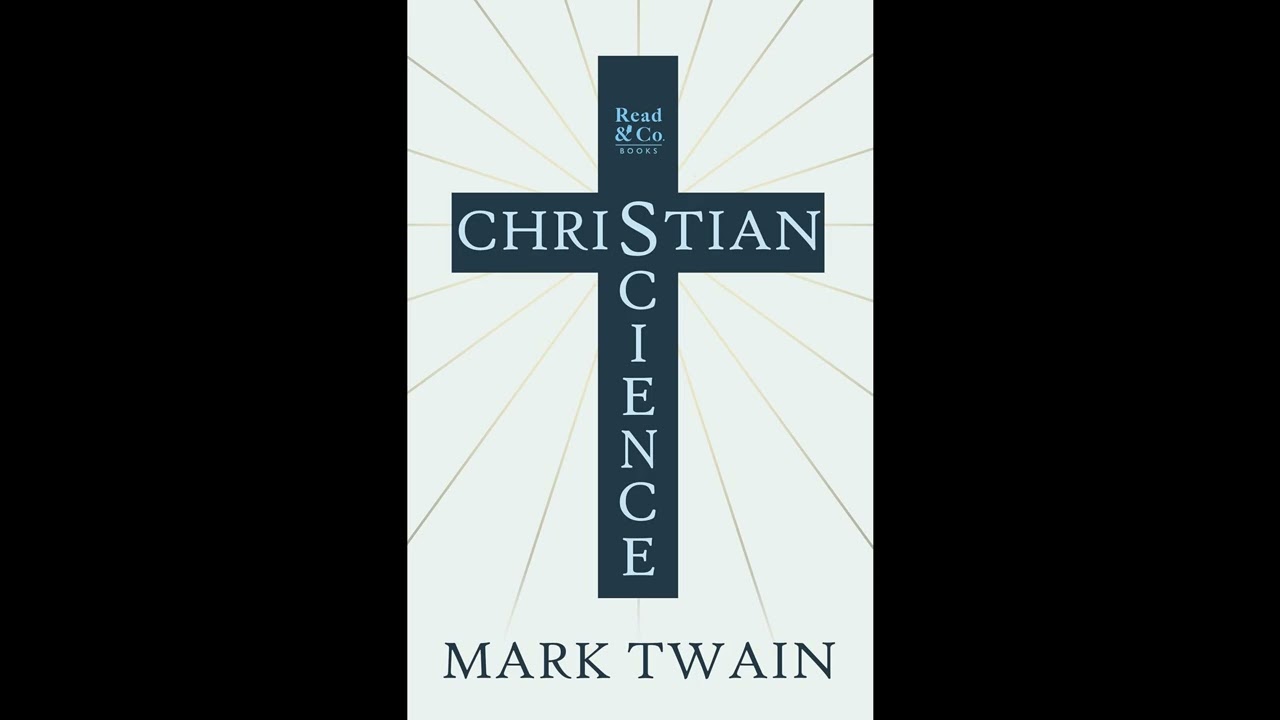
Christian Science by Mark Twain. The underlying text is in the U.S. public domain. We do not republish any modern copyrighted edition, translation, or commentary.
The 4K cinematic visuals accompanying this audiobook are generated by an AI image model from prompts derived from the source text. No copyrighted photos, paintings, or stock footage are used. AI generation is disclosed on every video on our YouTube channel as required by YouTube's altered/synthetic content policy.
English subtitles are transcribed from the LibriVox recording with OpenAI Whisper. Translations into the 11 other supported languages are produced by Meta's NLLB-200 neural translation model. No human translator's copyrighted translation is used.
Questions about sourcing or rights? See our DMCA & Sourcing policy or contact us.
Enjoyed this audiobook?
If you'd like to own a copy of Christian Science or hear a professionally produced edition, the links below help support free audiobook production at no extra cost to you.
As an Amazon Associate we earn from qualifying purchases. Audible / print links are affiliate.