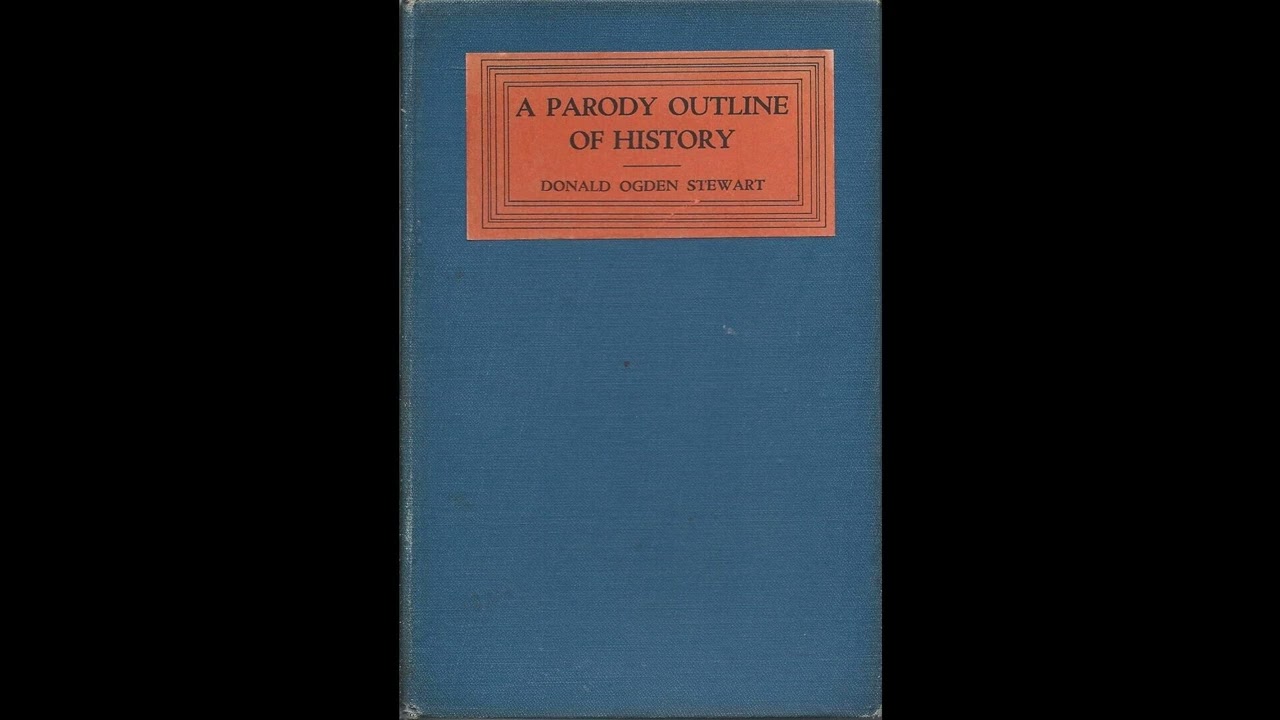
A Parody Outline of History
Imagine history not as a solemn march of great deeds and grand figures, but as a riotous vaudeville show, complete with pratfalls, ludicrous pronouncements, and anachronistic gags. Donald Ogden Stewart’s 1921 classic, A Parody Outline of History, presents precisely such a vision. It is a work of irreverent genius, a side-splitting lampoon of humanity’s persistent attempts to organize, explain, and often glorify its past. In an age where information—and misinformation—floods our senses, and where "outlines" of complex subjects promise easy understanding, Stewart’s comedic genius reminds us to approach all comprehensive narratives with a healthy dose of skepticism and a good laugh. This audiobook offers a chance to experience a foundational piece of American humor, a brilliant satire that skewers academic pomposity and human foibles with equal dexterity, proving that even the most serious subjects can benefit from a dose of absurdity. Stewart’s "outline" begins not with dry dates or archaeological findings, but with the droll, often absurd, pre-history of humanity. Listeners are invited to witness the Stone Age through a decidedly modern lens, where cave dwellers might be found debating prime real estate or struggling with the latest fashion trends in animal skins. He then progresses through the conventional milestones of civilization, from the ancient Egyptians meticulously planning their afterlife (with an eye toward social climbing) to the Greeks debating philosophy in terms of sporting analogies. No figure is too sacred, no era too grand to escape Stewart's anachronistic wit. Moses finds himself grappling with bureaucracy and public relations challenges, while Julius Caesar's campaigns are reimagined as elaborate, somewhat confused corporate takeovers. The narrative structure follows a mock-academic progression, with each "chapter" adopting a slightly different satirical style, from mock-academic essays to invented historical documents or personal diaries. We encounter King Arthur and his knights not as valiant heroes, but as bumbling enthusiasts struggling with medieval social etiquette. The American Revolution becomes a series of comically misunderstood diplomatic blunders and a colonial tea party that spirals into chaos. Stewart’s central conflict, if one can call it that, is the clash between the rigid, often self-important framework of conventional historical writing and the messy, illogical, and fundamentally silly reality of human events. It’s a relentless, joyful assault on the very idea that history can be neatly categorized or distilled into a singular, authoritative account. Listeners will find themselves chuckling as they recognize familiar historical beats, now utterly transformed by the author's mischievous imagination. Donald Ogden Stewart, born in Columbus, Ohio, in 1894, emerged as a leading voice in American humor during the roaring 1920s. After graduating from Yale, he found himself drawn to the burgeoning literary and theatrical scene in New York City. He quickly became a prominent member of the Algonquin Round Table, that legendary group of wits, writers, and critics who gathered daily at the Algonquin Hotel, trading barbs and shaping the comedic landscape of the era. This intellectually stimulating environment honed Stewart’s sharp observational skills and his ability to craft incisive satire. While A Parody Outline of History, published early in his career in 1921, cemented his reputation as a humorist, Stewart’s literary talents extended far beyond satirical prose. He later transitioned into a highly successful career as a Hollywood screenwriter, where his gifts for witty dialogue and engaging character development truly shone. He penned the screenplays for beloved films like "The Philadelphia Story" (for which he won an Academy Award), "Holiday," and "Woman of the Year," leaving an indelible mark on cinematic history. Stewart's place in the literary canon rests not only on his early comedic brilliance but also on his ability to adapt his satirical voice to new mediums, making him a significant figure in both American literature and popular entertainment of the mid-20th century, before his eventual passing in London in 1980. At its core, A Parody Outline of History enacts a profound satire of grand narratives, particularly those that seek to present a definitive, all-encompassing view of human existence. Stewart deftly exposes the inherent biases and oversimplifications that creep into any attempt to distill millennia of human experience into a neat package. For example, he presents the creation story not as a sacred event, but as an argument between two divine beings struggling with project management and the sheer effort of making a world, complete with squabbles over design flaws. This scene underscores the absurdity of trying to package complex origins into simplistic, linear accounts. The book also repeatedly highlights the absurdity of human nature, demonstrating that despite all our supposed progress, fundamental follies and preoccupations remain constant. Whether it's cavemen squabbling over territory, ancient emperors fretting about their legacy, or modern politicians concerned with public opinion, Stewart shows us that human vanity, social maneuvering, and petty rivalries are truly eternal, merely changing their costumes across the ages. A striking feature is Stewart's use of anachronism to critique modernity. He frequently injects 1920s slang, social anxieties, and commercial tropes into ancient settings, revealing the superficiality of contemporary concerns while simultaneously making ancient history feel surprisingly familiar. Consider a moment where Roman senators are reimagined as tired businessmen, more concerned with quarterly reports than matters of empire, or where a prehistoric battle is described with the language of a modern sporting event. These instances not only generate humor but also subtly comment on the often-inflated self-importance of any given era, including Stewart’s own. Ultimately, the work functions as a brilliant demonstration of the subjectivity of history; by presenting such a wildly skewed and opinionated version of events, Stewart implicitly argues that all historical accounts, even the most scholarly, are ultimately interpretations shaped by the perspective of the teller. The book emerged from a fascinating cultural and literary moment in the period following World War I. The conflict had shattered many illusions about progress and human perfectibility, leading to a widespread sense of disillusionment and a questioning of established authorities and traditions. This era, often called the Jazz Age, was ripe for irreverent humor and satirical commentary. Into this cultural landscape came H.G. Wells's monumental "The Outline of History," published in 1920, which aimed to provide a comprehensive, rational, and progressive account of humanity from its origins to the contemporary age. Wells's ambitious project was a massive bestseller and a serious scholarly endeavor. Stewart's "Parody Outline" was a direct, immediate, and utterly hilarious response, a comedic counterpoint that poked fun at the very earnestness and encyclopedic ambition of Wells's work. It tapped into a broader cultural mood that challenged grand pronouncements and embraced a more skeptical, witty outlook on the world. Listening to A Parody Outline of History as an audiobook unlocks a layer of comedic brilliance that is unique to the spoken word. The humor in Stewart’s writing is often found in the subtle inflections, the deadpan delivery of preposterous statements, and the precise timing of a punchline. A skilled narrator can bring out the mock-academic tone of the essays, the exasperated voices of historical figures, and the sheer joy of the author’s anachronistic wit. The "several hours" run length makes this perfect for absorbing a chapter or two at a time during a commute, while tending to household tasks, or simply relaxing with a cup of tea. Pay close attention to the narrator’s pacing, how they use pauses to build anticipation for a joke, and how different voices might be subtly employed to differentiate between Stewart’s authorial voice and the imagined dialogue of historical figures. The auditory experience enhances the conversational, wry atmosphere, transforming history from a dusty subject into a lively, often uproarious, performance.
Enjoyed A Parody Outline of History? A few ways to support us
Audible & Amazon links are affiliate; we may earn a small commission at no extra cost.
About this production
Human narration by a volunteer reader from LibriVox.org, the public-domain audiobook project. LibriVox volunteers record literary works whose copyright has expired in the United States, releasing the resulting recordings into the public domain.
A Parody Outline of History by Donald Ogden Stewart. The underlying text is in the U.S. public domain. We do not republish any modern copyrighted edition, translation, or commentary.
The 4K cinematic visuals accompanying this audiobook are generated by an AI image model from prompts derived from the source text. No copyrighted photos, paintings, or stock footage are used. AI generation is disclosed on every video on our YouTube channel as required by YouTube's altered/synthetic content policy.
English subtitles are transcribed from the LibriVox recording with OpenAI Whisper. Translations into the 11 other supported languages are produced by Meta's NLLB-200 neural translation model. No human translator's copyrighted translation is used.
Questions about sourcing or rights? See our DMCA & Sourcing policy or contact us.
Enjoyed this audiobook?
If you'd like to own a copy of A Parody Outline of History or hear a professionally produced edition, the links below help support free audiobook production at no extra cost to you.
As an Amazon Associate we earn from qualifying purchases. Audible / print links are affiliate.