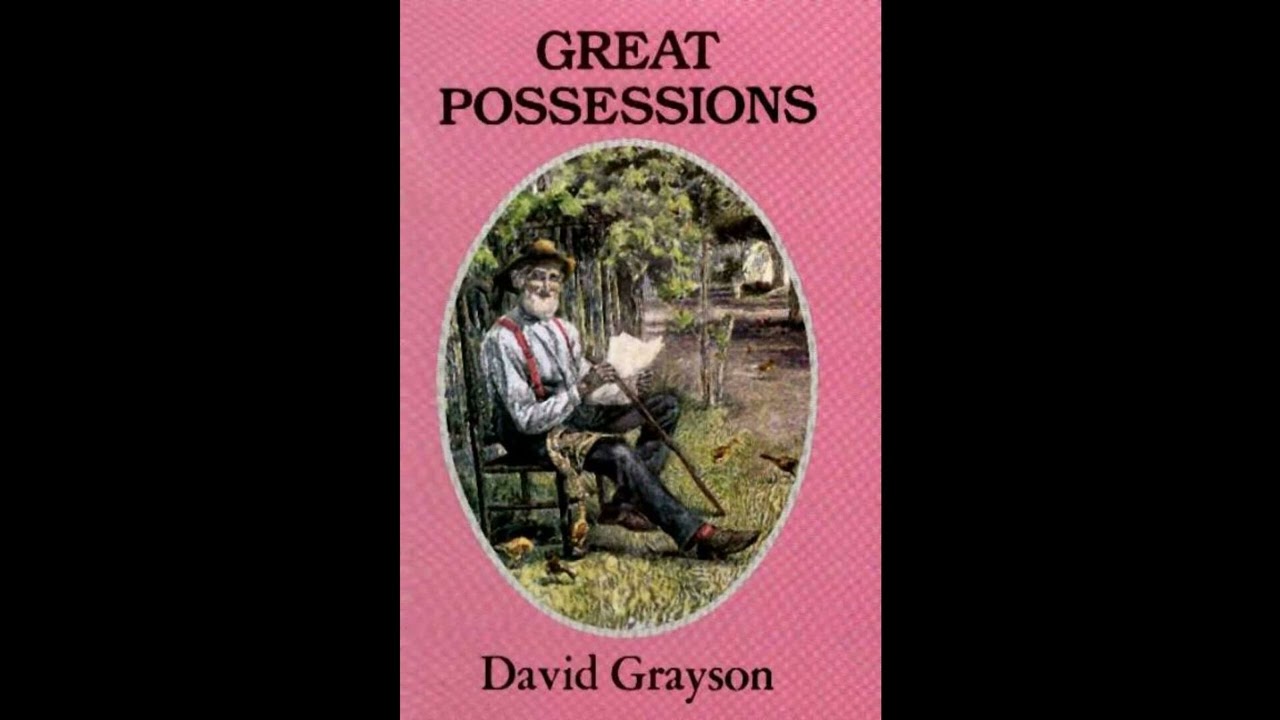
Great Possessions: A New Series of Adventures
In a world that often measures success in speed and accumulation, "Great Possessions: A New Series of Adventures" by David Grayson offers a profound and gentle counter-narrative. This collection of essays, steeped in the quiet wisdom of rural life, invites listeners to reconsider what truly constitutes wealth. It is a quiet rebellion against the clamor of modern ambition, a call to find profound satisfaction not in grand achievements or material gain, but in the sun-drenched fields, the earnest conversation with a neighbor, the simple joy of honest labor, and the ever-present beauty of the natural world. More than a century after its initial appearance, Grayson's insights resonate with a particular clarity today, urging us to pause, observe, and find our own enduring "great possessions" in the often-overlooked moments of ordinary existence. The narrative voice of "Great Possessions" belongs to David Grayson, a reflective and philosophical farmer living a deliberate, humble life in the American countryside. His "adventures" are not grand expeditions to distant lands, but rather a series of observations, encounters, and introspections that unfold within the confines of his farm and its immediate surroundings. We meet his steadfast wife, Harriet, a woman of practical wisdom and quiet strength, and his various neighbors—kind-hearted, hardworking folk who share in the rhythms of the seasons. Grayson's days are filled with the tangible realities of farming: planting seeds, mending fences, harvesting crops, and tending to animals. Yet, beneath these seemingly mundane tasks, a deeper quest is always in motion. Grayson’s central aim is to cultivate a life of profound contentment and meaning, resisting the external pressures to chase fleeting success or material opulence. His "new series of adventures" consists of a heightened awareness, a mindful engagement with his environment, and a genuine curiosity about the human spirit. He finds an almost spiritual resonance in the changing light of an autumn day, the sturdy presence of an oak tree, or the simple act of sharing a meal. Each essay functions as a window into a particular moment or realization, building a cumulative portrait of a man who has chosen to live richly not despite, but because of, his outwardly simple circumstances. His encounters with others, whether a traveling peddler or a fellow farmer, become opportunities for shared humanity and the exchange of enduring truths. The man behind the pen name David Grayson was Ray Stannard Baker (1870-1946), a prominent American journalist and author. Born in Lansing, Michigan, and educated at Michigan State Agricultural College and the University of Michigan Law School, Baker initially pursued a career in investigative journalism. Under his own name, he became a distinguished muckraker, writing for McClure’s Magazine and American Magazine, exposing social and political injustices of his era. His reporting often focused on issues like corporate greed, labor disputes, and racial discrimination, cementing his reputation as a keen observer and a voice for reform. However, Baker harbored a deep personal desire for a simpler, more reflective existence, a yearning that led him to purchase a farm in Amherst, Massachusetts. It was there, seeking respite from the intensity of urban journalism and the complexities of the modern world, that he adopted the pseudonym David Grayson. This allowed him to cultivate a different kind of writing, one focused on the agrarian ideal, the beauty of nature, and the philosophical underpinnings of a contented life. In later years, Baker returned to historical and biographical writing, notably publishing an eight-volume biography of Woodrow Wilson, for which he received the Pulitzer Prize for Biography in 1937. His shift between these two distinct literary personas—the hard-hitting journalist Ray Stannard Baker and the gentle philosopher David Grayson—speaks volumes about the divergent currents of American thought in the early 20th century. At its core, "Great Possessions" enacts a profound philosophy about true wealth, suggesting it lies not in what one owns but in what one deeply experiences and perceives. Grayson continually contrasts the "great possessions" of the spirit—the beauty of a sunset, the warmth of human connection, the peace of honest labor—with the fleeting gains of the material world. For instance, he might describe the simple satisfaction derived from planting a garden, watching the seeds sprout, and harvesting the fruits of his labor, presenting this as a far more enduring and meaningful form of ownership than any amount of accumulated money. The book also powerfully showcases humanity's intrinsic connection to the natural world. Grayson’s detailed, almost reverent observations of his farm animals, the changing seasons, the tilling of the soil, and the growth of crops serve as a constant reminder of our place within a larger ecological order. He often muses on the lessons nature imparts: patience from waiting for seeds to grow, resilience from weathering storms, and renewal from the cyclical return of spring. Through these tangible examples, the narrative underscores how deeply intertwined our well-being is with the health and rhythms of the earth, an idea that holds even greater resonance in our current environmental consciousness. This work emerged during a pivotal time in American history, the early 20th century. It was an era marked by rapid industrialization, the burgeoning growth of cities, and a societal shift towards consumerism and material ambition. The agrarian ideal, once central to American identity, was increasingly threatened by the pressures of modernization. Politically, the Progressive Era was in full swing, grappling with issues of social justice and economic reform. Culturally, there was a growing sense of dislocation and a search for meaning amidst the accelerating pace of life. "Great Possessions" thus served as a poignant reflection and a gentle corrective to the prevailing ethos. It offered a vision of life rooted in simplicity, self-sufficiency, and a deep appreciation for the intrinsic value of natural and human connections, standing in quiet opposition to the anxieties and alienations of industrial society. It provided a literary sanctuary, allowing readers to imagine a different kind of prosperity and a more grounded existence, a balm for souls weary of the era’s relentless push for progress at any cost. Listening to "Great Possessions: A New Series of Adventures" as an audiobook allows its quiet wisdom to unfold with particular grace. The run length, several hours in total, is perfectly suited for extended periods of contemplation—perhaps during a solitary walk, while working in a garden, or on a long drive. A skilled narrator can capture Grayson’s reflective, often wistful, yet always hopeful tone, allowing his intimate voice to truly come alive. The pacing is unhurried, inviting listeners to slow down and absorb the gentle cadence of his prose and the profound simplicity of his observations. Listen for the subtle shifts in atmosphere from a cozy fireside musing to a brisk walk in the fields, and how the dialogue, often with himself or with the natural world, evokes a deep sense of peace and insight. The audio format deepens the feeling of companionship with Grayson, as if he is sharing his thoughtful reflections directly with you.
Enjoyed Great Possessions: A New Series of Adventures? A few ways to support us
Audible & Amazon links are affiliate; we may earn a small commission at no extra cost.
About this production
Human narration by a volunteer reader from LibriVox.org, the public-domain audiobook project. LibriVox volunteers record literary works whose copyright has expired in the United States, releasing the resulting recordings into the public domain.
Great Possessions: A New Series of Adventures by David Grayson. The underlying text is in the U.S. public domain. We do not republish any modern copyrighted edition, translation, or commentary.
The 4K cinematic visuals accompanying this audiobook are generated by an AI image model from prompts derived from the source text. No copyrighted photos, paintings, or stock footage are used. AI generation is disclosed on every video on our YouTube channel as required by YouTube's altered/synthetic content policy.
English subtitles are transcribed from the LibriVox recording with OpenAI Whisper. Translations into the 11 other supported languages are produced by Meta's NLLB-200 neural translation model. No human translator's copyrighted translation is used.
Questions about sourcing or rights? See our DMCA & Sourcing policy or contact us.
Enjoyed this audiobook?
If you'd like to own a copy of Great Possessions: A New Series of Adventures or hear a professionally produced edition, the links below help support free audiobook production at no extra cost to you.
As an Amazon Associate we earn from qualifying purchases. Audible / print links are affiliate.