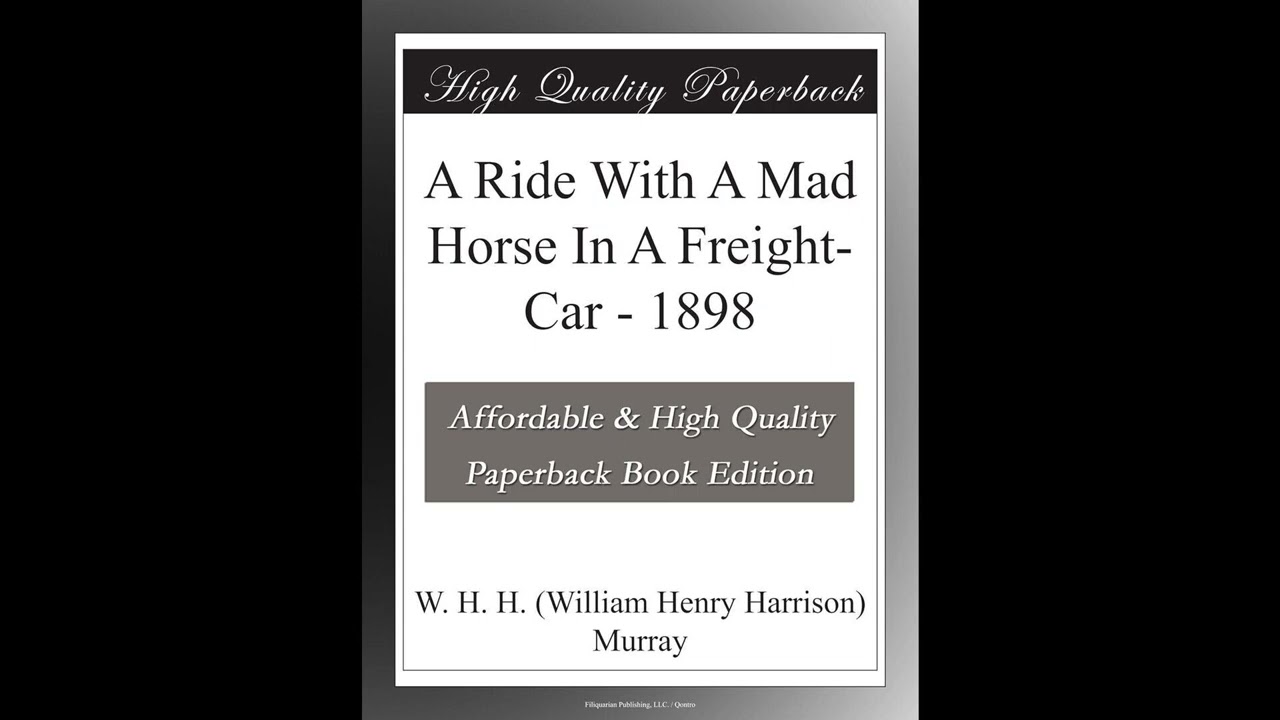
A Ride With A Mad Horse In A Freight-Car
Step into a world where the wilderness, even when contained, refuses to be tamed, and the rush of progress carries unexpected perils. W. H. H. Murray's "A Ride With A Mad Horse In A Freight-Car" presents a story unlike any other, a concentrated dose of visceral suspense that throws a lone individual into a desperate struggle for survival against the raw, untamed force of nature itself. This is more than just an adventure tale; it is a profound meditation on confinement, fear, and the sheer unpredictability of life, themes that resonate just as powerfully in our modern, often chaotic world. It reminds us that even within the structures of civilization, the wild heart can suddenly burst forth, demanding a reckoning. Our story begins in the unlikeliest of arenas: the cramped, wooden confines of a moving freight car. This is not a journey of leisure, nor one taken by choice for our narrator, who finds themselves in an utterly unique and terrifying predicament. Within this rattling boxcar, meant to transport inanimate goods, a creature of immense power and untamed spirit has been imprisoned: a horse, but one possessed by a wildness bordering on madness. Perhaps it is the terror of its capture, the disorientation of its new surroundings, or an inherent ferocity finally unleashed, but this horse is a force of pure, unpredictable chaos. The setting itself, a train hurtling across the landscape, provides a relentless forward momentum, amplifying the claustrophobic dread as the car becomes a miniature, self-contained arena for a life-or-death confrontation. The central conflict quickly emerges as the narrator, an individual thrust into this extraordinary situation, realizes the extent of their peril. They are trapped, alone, with an animal that embodies brute strength and unreasoning panic. Every jolt of the train, every lurch and sway, threatens to provoke the creature further, turning its confined energy into destructive fury. The struggle is not merely physical—it is a battle of wits, courage, and sheer endurance. The narrator must navigate the tight space, anticipate the horse's explosive movements, and find some means, any means, to survive the ride until the journey's end, or perhaps, some unforeseen reprieve. The tension builds with each passing mile, forcing the listener to consider what desperate measures one might take when faced with such an immediate, inescapable threat. The author, William Henry Harrison Murray (1840-1904), was a fascinating figure whose life spanned the transition from America's early republic to its industrial ascendancy. Born in Guilford, Connecticut, Murray was initially known as a prominent Congregationalist clergyman. He held esteemed pulpits, most notably at Boston's Park Street Church, where his eloquent sermons drew large crowds. However, it was his passion for the outdoors that truly captured the public imagination and cemented his legacy, earning him the enduring moniker "Adirondack Murray." In 1869, Murray published "Adventures in the Wilderness; or, Camp-Life in the Adirondacks," a book that revolutionized American leisure. His vivid descriptions of the Adirondack mountains as a pristine, restorative escape from urban life inspired a massive influx of tourists, spawning the phenomenon known as "Murray's Rush." While criticized by some for his occasionally exaggerated claims and for encouraging ill-prepared city dwellers into the wilderness, Murray nonetheless played a pivotal role in popularizing outdoor recreation and indirectly fostering an early appreciation for wilderness preservation. He continued to write, producing further works like "Daylight Land" (1888) and "John Norton's Thanksgiving" (1888), often blending adventure, natural description, and moral instruction, positioning him as an important voice in late 19th-century American letters, bridging transcendentalist nature appreciation with more popular, accessible adventure narratives. One of the prominent themes running through "A Ride With A Mad Horse In A Freight-Car" is the stark confrontation between humanity and nature's raw power. The freight car, a symbol of human engineering and control, becomes an ironic cage where nature, in the form of the "mad horse," reasserts its dominion. The sheer physical presence of the animal—its weight, its unpredictable movements, its capacity for destruction within the confined space—serves as a constant reminder of the elemental forces that civilization can never fully subdue. The story exemplifies how, even when we attempt to contain or transport the wild, its inherent unpredictability and latent power can turn our carefully constructed systems into stages for primal struggle. Another powerful theme is the psychological endurance of an individual under extreme duress. The narrator's internal state, their mounting fear, their desperate calculations, and their attempts to strategize against an irrational foe, are central to the narrative. The very claustrophobia of the freight car intensifies this psychological drama, making the external threat feel overwhelmingly intimate. The story effectively portrays the mind's battle for composure and the instinctual drive to survive when logic and conventional solutions are rendered useless against an immediate, overwhelming physical threat. It’s a compelling look at the limits of human courage and ingenuity in the face of absolute chaos. The period in which W. H. H. Murray was most active, the late 19th century, was a time of immense change in America. Following the Civil War, the nation experienced rapid industrialization, marked by the expansive growth of railroads that crisscrossed the continent. These trains symbolized progress, connectivity, and the taming of vast wild spaces, yet they also held inherent dangers and represented a new, powerful intrusion into the natural world. Culturally, there was a growing fascination with the American wilderness—a romantic ideal of untouched nature juxtaposed against the realities of urban expansion and technological advancement. Works like Murray's emerged from this unique intersection, offering exciting narratives that often placed individuals in dramatic encounters with the untamed, sometimes threatening, natural world, frequently within the context of these very same technological advancements. Such tales provided both thrills and a sense of connection to a disappearing frontier, reflecting the era’s anxieties and aspirations about progress and its costs. Listening to "A Ride With A Mad Horse In A Freight-Car" as an audiobook offers a particularly immersive and immediate experience. The story, unfolding over several hours, benefits immensely from a skilled narrator who can bring the harrowing atmosphere of the freight car to life. Listen for the subtle shifts in pacing, reflecting the narrator's internal struggle and the sudden, explosive bursts of the horse's fury. A good performance will use voice and inflection to convey the creaking wood of the car, the thud of hooves against the floor, and the narrator's gasps of fear or moments of grim determination. The confined setting, the relentless movement of the train, and the visceral sounds of a powerful, distressed animal are all elements that audio can render with striking realism, drawing you into the heart of this extraordinary, pulse-pounding tale.
Enjoyed A Ride With A Mad Horse In A Freight-Car? A few ways to support us
Audible & Amazon links are affiliate; we may earn a small commission at no extra cost.
About this production
Human narration by a volunteer reader from LibriVox.org, the public-domain audiobook project. LibriVox volunteers record literary works whose copyright has expired in the United States, releasing the resulting recordings into the public domain.
A Ride With A Mad Horse In A Freight-Car by W. H. H. (William Henry Harrison) Murray. The underlying text is in the U.S. public domain. We do not republish any modern copyrighted edition, translation, or commentary.
The 4K cinematic visuals accompanying this audiobook are generated by an AI image model from prompts derived from the source text. No copyrighted photos, paintings, or stock footage are used. AI generation is disclosed on every video on our YouTube channel as required by YouTube's altered/synthetic content policy.
English subtitles are transcribed from the LibriVox recording with OpenAI Whisper. Translations into the 11 other supported languages are produced by Meta's NLLB-200 neural translation model. No human translator's copyrighted translation is used.
Questions about sourcing or rights? See our DMCA & Sourcing policy or contact us.
Enjoyed this audiobook?
If you'd like to own a copy of A Ride With A Mad Horse In A Freight-Car or hear a professionally produced edition, the links below help support free audiobook production at no extra cost to you.
As an Amazon Associate we earn from qualifying purchases. Audible / print links are affiliate.
![Jack Of The Pony Express Or, The Young Rider Of The Mountain Trails [Paperback] Fra by Frank V. Webster — free full audiobook](https://img.youtube.com/vi/JmYbgul07Ms/maxresdefault.jpg)