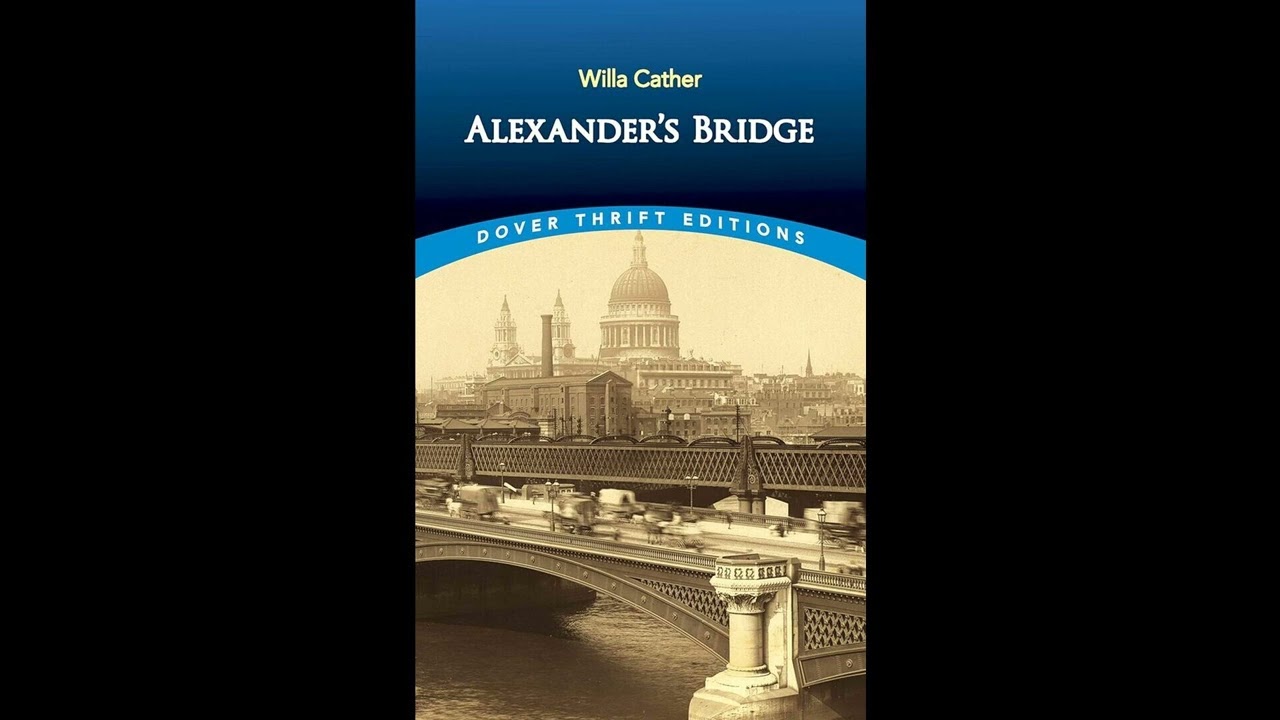
Alexander's Bridge
Bartley Alexander possesses everything a man could desire: a brilliant engineering career, a devoted wife, and an esteemed place in Boston society. He builds grand bridges, connecting worlds. Yet, beneath his perfectly ordered life, another self yearns for expression, a hidden past refusing to stay buried. Willa Cather's Alexander's Bridge, her inaugural novel, invites listeners into this unsettling psychological drama, where outward success clashes with an unyielding inner truth. It's a tale that resonates profoundly today, questioning the very foundations of identity, the compromises we make for achievement, and the enduring pull of past loves. What happens when the bridges we build to separate our lives begin to crumble? Bartley Alexander stands at the pinnacle of professional and personal contentment. An engineer of international renown, he is responsible for monumental feats across the globe, demanding his full intellect. His marriage to Winifred, a woman of grace and sophistication, appears idyllic. Their Boston home reflects their shared values and esteemed position among the city's elite. Bartley navigates this world with assured confidence, his days filled with important decisions and the accolades of his peers, seemingly the epitome of the successful American man with an unimpeded future. However, this carefully constructed existence holds a crucial fracture. A youthful romance, seemingly left behind in London years ago, begins to reassert its claim. Hilda Burgoyne, an actress Bartley knew during his student days, re-enters his life during a business trip abroad. Their reunion ignites dormant feelings, threatening to shatter the meticulously maintained equilibrium of his Boston life. Bartley finds himself increasingly divided, caught between the responsibilities of his present and the passionate freedom associated with Hilda. The narrative observes his growing internal struggle as he attempts to maintain two distinct worlds, each demanding his loyalty and pulling him further from a stable identity. The central tension lies in his desperate effort to keep these spheres separate, while their inevitable collision looms. Willa Cather (1873-1947) remains one of American literature's most enduring voices, whose lyrical prose and profound understanding of character have captivated generations. Born in Virginia, Cather's family relocated to the Nebraska prairie when she was nine, an experience that profoundly shaped her sensibility and provided raw material for many beloved novels. The vast landscapes and struggles of immigrant communities settling the American West became central to her artistic vision. After graduating from the University of Nebraska, Cather pursued a career in journalism and editorial work, moving to Pittsburgh and later New York City. She wrote for magazines and served as managing editor of McClure's Magazine, a prominent publication of its time. Guided by Sarah Orne Jewett, Cather dedicated herself fully to fiction writing in New York. Though Alexander's Bridge was her first novel, she went on to pen a series of acclaimed works, cementing her place in the American literary canon. Novels such as O Pioneers!, My Ántonia, The Song of the Lark, and A Lost Lady are recognized for their evocative portrayals of pioneers, artists, and women striving for self-realization against changing American landscapes. She received the Pulitzer Prize for Fiction in 1923 for One of Ours, about a Nebraska soldier in World War I. Cather's blend of realism and romanticism, her attention to everyday details, and her deep empathy marked her as a singular talent who chronicled the American frontier's transformation and its inhabitants' inner lives. At its heart, Alexander's Bridge examines the theme of a double life and the tension between outward appearance and inner reality. Bartley Alexander consciously performs a role in Boston society, meticulously upholding the image of a successful, upstanding professional and husband. His clandestine relationship, however, represents a fundamental split, a suppressed part of himself he cannot eradicate. This psychological division is complicated by the pull of the past. Hilda Burgoyne is a ghost from Bartley’s youth, embodying a freedom and unburdened self that Boston’s structured world forced him to abandon. Her reappearance compels him to confront the person he once was, challenging the man he has become. Another central idea concerns ambition and its personal cost. Bartley's immense success as an engineer, defining him publicly, requires singular focus and commitment, leaving little room for personal indulgence. His drive to build monumental structures mirrors his drive to build an unassailable public persona. The novel suggests such ambition, while yielding outward triumphs, can hollow out the individual, leaving them vulnerable to denied desires. The metaphorical weight of the bridges Bartley designs serves as a potent image; he constructs links between places, but struggles profoundly to bridge the chasm within his own divided self or between his inhabited worlds. He is a master builder of external connections, yet internally fragmented. Published in 1912, Alexander's Bridge appeared at a pivotal moment in American history and literature. The early twentieth century was a period of rapid industrialization, burgeoning economic power, and growing modernity. America was solidifying its place on the world stage, and figures like Bartley Alexander – self-made men of industry – embodied the nation's progress. Culturally, a shift occurred from rigid Victorian sensibilities towards psychological realism and complex human motivation. Transatlantic travel became more common, enabling the international encounters that drive Bartley's conflict. For Cather, this novel marked her transition from journalism to full-time fiction writer, testing novelistic form before her later, expansive prairie narratives. It serves as a bridge between her early short stories and subsequent works. Listening to Alexander's Bridge as an audiobook offers an intimate experience of Bartley Alexander's internal world. The deliberate pacing allows deep immersion into his psychological state, making his mounting anxieties palpable. A skilled narrator can perfectly capture the nuanced tones of Bartley's public composure versus his private turmoil, giving distinct vocal textures to his interactions with Winifred in Boston and with Hilda in London. The modest length of several hours makes it a compelling listen, ideal for a sustained session or thoughtful segments. Pay attention to how the narration emphasizes quiet moments of introspection, subtle shifts in dialogue, and settings that reflect Bartley’s fractured sense of self. It invites listeners to inhabit his dilemma with immediate, affecting presence.
Enjoyed Alexander's Bridge? A few ways to support us
Audible & Amazon links are affiliate; we may earn a small commission at no extra cost.
About this production
Human narration by a volunteer reader from LibriVox.org, the public-domain audiobook project. LibriVox volunteers record literary works whose copyright has expired in the United States, releasing the resulting recordings into the public domain.
Alexander's Bridge by Willa Cather. The underlying text is in the U.S. public domain. We do not republish any modern copyrighted edition, translation, or commentary.
The 4K cinematic visuals accompanying this audiobook are generated by an AI image model from prompts derived from the source text. No copyrighted photos, paintings, or stock footage are used. AI generation is disclosed on every video on our YouTube channel as required by YouTube's altered/synthetic content policy.
English subtitles are transcribed from the LibriVox recording with OpenAI Whisper. Translations into the 11 other supported languages are produced by Meta's NLLB-200 neural translation model. No human translator's copyrighted translation is used.
Questions about sourcing or rights? See our DMCA & Sourcing policy or contact us.
Enjoyed this audiobook?
If you'd like to own a copy of Alexander's Bridge or hear a professionally produced edition, the links below help support free audiobook production at no extra cost to you.
As an Amazon Associate we earn from qualifying purchases. Audible / print links are affiliate.