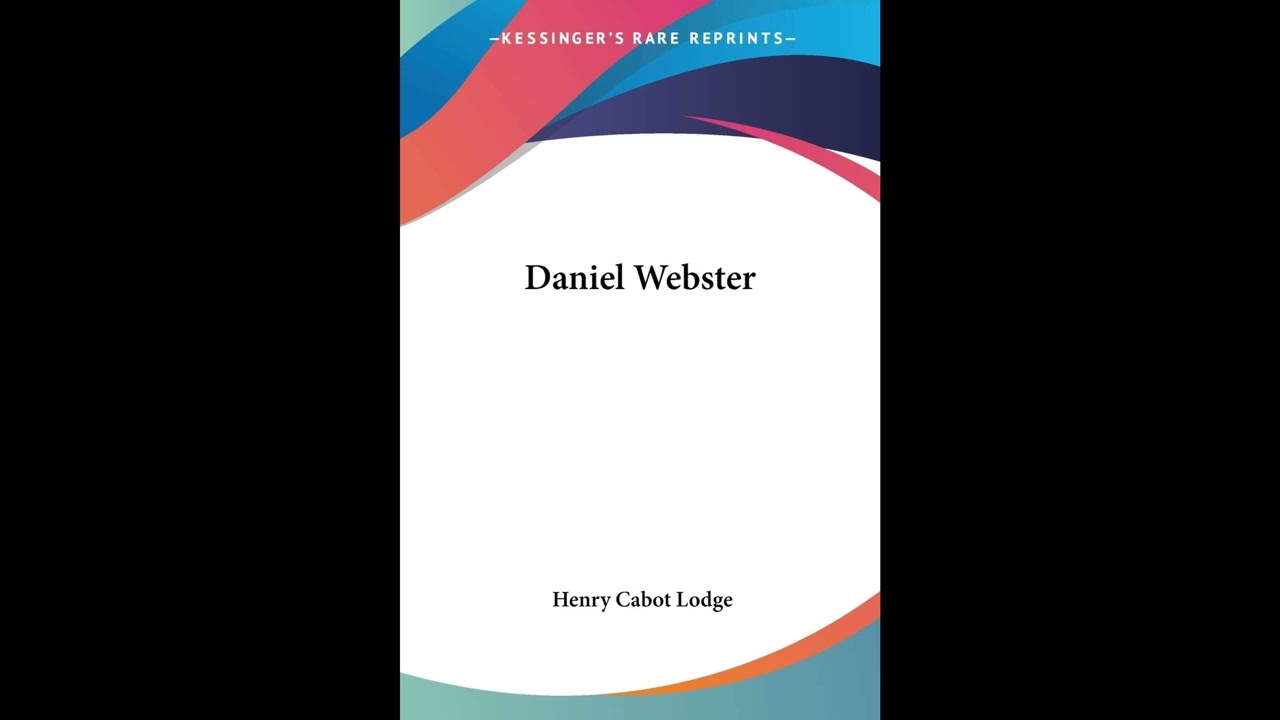
Daniel Webster
Step into the tumultuous early years of the American republic and encounter one of its most towering figures: Daniel Webster. This literary biography, penned by the equally formidable statesman Henry Cabot Lodge, offers far more than a simple chronicle of facts. It is a profound meditation on leadership, national unity, and the very soul of a nascent democracy on the brink of fracture. For listeners today, Webster's struggles to preserve the Union against the relentless pressures of sectionalism over issues like states' rights and slavery resonate with a powerful clarity, reminding us that the foundational questions of American identity are never fully settled. His story is a testament to the enduring power of rhetoric in shaping public opinion and the often painful compromises required to hold a diverse nation together. The narrative transports us to a crucial period in American history, from the early 19th century up to the eve of the Civil War. We begin with Webster's humble birth in rural New Hampshire, tracing his remarkable ascent from a precocious country boy to an unparalleled legal mind and a dominating presence in the nation's capital. His early career as a lawyer quickly established his reputation, notably in landmark Supreme Court cases like Dartmouth College v. Woodward, where his eloquent arguments helped define the scope of federal power and contract law. But it is his transition to national politics, first as a Congressman and then as a Senator from Massachusetts, that truly sets the stage for his most profound contributions and challenges. Webster emerges as a figure of immense intellect and imposing presence, a man whose very voice could command attention. The central conflict of his public life, and thus the core of Lodge's account, revolves around the accelerating tensions between the North and South, particularly over tariffs, the nullification crisis, and, most ominously, the expansion of slavery. Webster, a staunch nationalist, dedicated his considerable talents to forging a unified American identity, often clashing with formidable opponents like John C. Calhoun. The story arc follows his attempts to steer the nation away from disunion, culminating in his role as Secretary of State and his fraught support for the Compromise of 1850. Lodge paints a portrait of a statesman wrestling with both personal ambition and an unwavering belief in the Union, making choices that were often unpopular but, in his view, essential for the nation's survival. Henry Cabot Lodge, the author of this seminal work, was himself a prominent American statesman, historian, and intellectual, born in Boston in 1850 and passing in 1924. A scion of an old New England family, Lodge was educated at Harvard, where he would later teach. His career mirrored Webster's in its dedication to public service; he served for decades in both the U.S. House of Representatives and the Senate, becoming a significant voice in American politics during the late 19th and early 20th centuries. He was a close confidant of President Theodore Roosevelt, sharing a Progressive outlook and a belief in American exceptionalism and power on the world stage. Beyond his political career, Lodge distinguished himself as a historian, producing a number of biographies of key American figures. His writings, which include similar studies of George Washington and Alexander Hamilton, placed him firmly within the tradition of New England Brahmin intellectuals who sought to shape the national historical narrative. His work often reflected his own political philosophy – a strong sense of nationalism and a belief in a robust federal government. This particular biography, written by a statesman about another statesman, offers a unique lens through which to consider the nature of American leadership and the challenges of governing a diverse and rapidly changing nation. This account powerfully enacts several enduring themes, foremost among them the concept of Union and Nationalism. Webster's famous declaration in his "Reply to Hayne" – "Liberty and Union, now and forever, one and inseparable!" – stands as a beacon, illustrating his unwavering commitment to a single, indissoluble nation. This speech is not merely a historical footnote; it is presented as a profound articulation of American identity, vigorously challenging the then-prevalent notion of state sovereignty as superior to federal authority and shaping the patriotic imagination of generations. Lodge shows how Webster consistently framed national unity as the paramount goal. Another significant theme is the Power of Oratory. Lodge devotes considerable attention to Webster's extraordinary rhetorical abilities. Listeners encounter how Webster used his commanding voice and powerful prose to clarify complex legal principles, sway public opinion, and inspire patriotic sentiment. The text vividly describes scenes where Webster's words captivated audiences in the Senate chamber, demonstrating that language itself can be a potent political instrument, capable of shaping the course of national events and defining political ideologies. His speeches were more than arguments; they were monumental performances. Lodge also brings to light the difficult theme of Political Compromise and Principle. Webster's decision to support the Compromise of 1850, particularly the controversial Fugitive Slave Act, became a point of intense scrutiny and criticism. Lodge examines the agonizing choices faced by statesmen attempting to avert civil war, forcing listeners to grapple with the tension between deeply held moral convictions and the perceived necessity of maintaining peace through pragmatic, often ethically troubling, political maneuvers. It’s a stark reminder of the ethical tightrope walked by those in power. When Henry Cabot Lodge penned this biography, America was in a period of intense national self-reflection. The late 19th century, following the trauma of the Civil War, saw a strong renewed interest in understanding the nation's founding and its pivotal moments. Figures like Webster, who had tried to prevent the ultimate conflict, became subjects of renewed study, offering insights into the complex forces that had nearly torn the country apart. It was a time of rapid industrialization, westward expansion, and growing immigration, all of which prompted questions about national identity and the meaning of American citizenship. Lodge, himself a political leader, likely found in Webster's life a compelling narrative of statesmanship and the challenges of upholding national ideals, offering a valuable historical perspective for his own generation grappling with its own set of internal divisions and external aspirations. Listening to Daniel Webster as an audiobook offers an immersive experience, uniquely suited to its subject matter. The run length of several hours allows for an extended engagement with Webster's life and the turbulent era he inhabited, perfect for sustained listening during commutes or focused time at home. A skilled narrator can bring Lodge's elegant prose to life, giving voice to the drama of Senate debates and the profound eloquence of Webster's orations. Hearing these pivotal speeches delivered aloud can convey their original power and resonance in a way that silent reading might not fully capture, allowing the listener to truly experience the atmosphere of mid-19th-century American politics. The nuances of pacing, the emphasis in dialogue, and the overall vocal atmosphere contribute to a deeper appreciation of this significant chapter in American history and the compelling figure at its center.
Enjoyed Daniel Webster? A few ways to support us
Audible & Amazon links are affiliate; we may earn a small commission at no extra cost.
About this production
Human narration by a volunteer reader from LibriVox.org, the public-domain audiobook project. LibriVox volunteers record literary works whose copyright has expired in the United States, releasing the resulting recordings into the public domain.
Daniel Webster by Henry Cabot Lodge. The underlying text is in the U.S. public domain. We do not republish any modern copyrighted edition, translation, or commentary.
The 4K cinematic visuals accompanying this audiobook are generated by an AI image model from prompts derived from the source text. No copyrighted photos, paintings, or stock footage are used. AI generation is disclosed on every video on our YouTube channel as required by YouTube's altered/synthetic content policy.
English subtitles are transcribed from the LibriVox recording with OpenAI Whisper. Translations into the 11 other supported languages are produced by Meta's NLLB-200 neural translation model. No human translator's copyrighted translation is used.
Questions about sourcing or rights? See our DMCA & Sourcing policy or contact us.
Enjoyed this audiobook?
If you'd like to own a copy of Daniel Webster or hear a professionally produced edition, the links below help support free audiobook production at no extra cost to you.
As an Amazon Associate we earn from qualifying purchases. Audible / print links are affiliate.