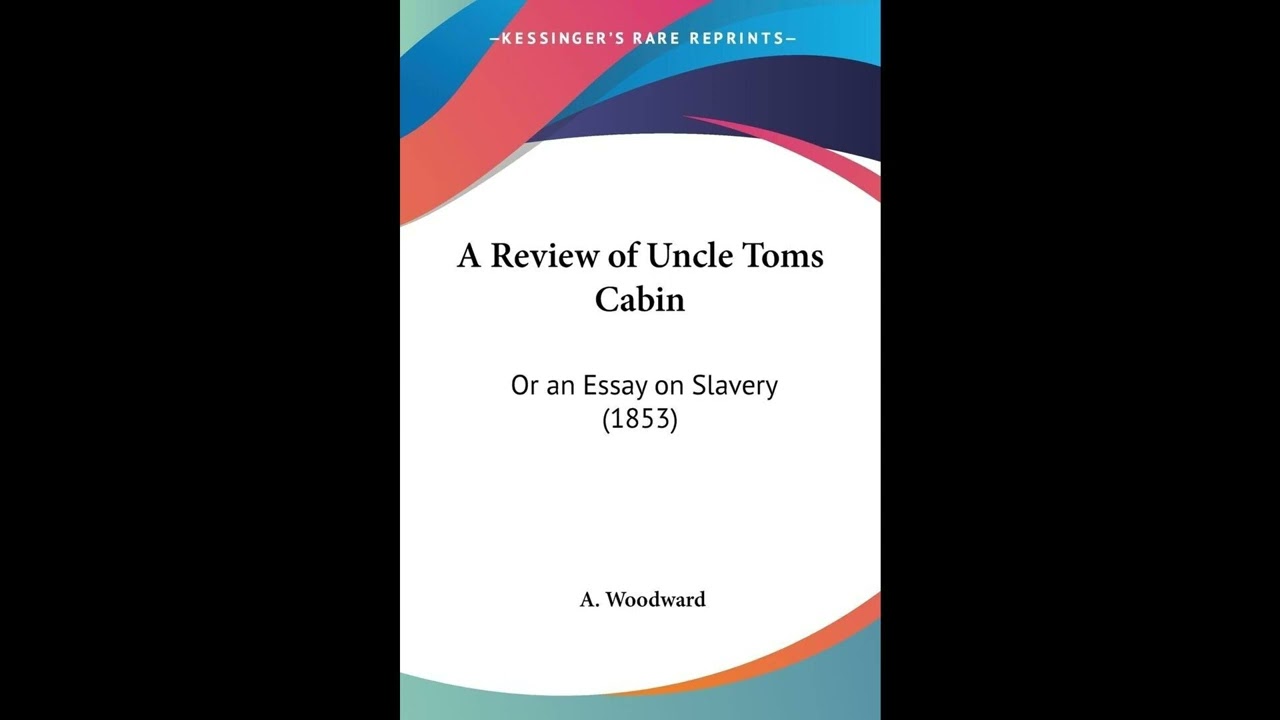
A Review of Uncle Toms Cabin: Or an Essay on Slavery
In the turbulent years leading up to the American Civil War, few literary works ignited the national conscience like Harriet Beecher Stowe's Uncle Tom's Cabin. Its vivid portrayals of enslaved people and their suffering sent shockwaves across the country, galvanizing abolitionists and infuriating those who defended the institution of slavery. Amidst this storm of public opinion emerged A Woodward's A Review of Uncle Tom's Cabin: Or an Essay on Slavery, a forceful counter-argument that sought to dissect Stowe's narrative and challenge its underlying assumptions. This work is not merely a critique; it stands as a direct witness to the intellectual battleground of a divided nation, offering listeners today an essential insight into the complex, often contradictory, arguments that defined the era. It reveals the strategic reasoning, both moral and pragmatic, employed by those who believed Stowe had misrepresented Southern life and the very nature of human bondage, making it an invaluable document for understanding the full spectrum of pre-war American thought. Woodward’s essay unfolds against the backdrop of an America teetering on the brink of disunion, a nation wrestling with the profound moral and economic implications of slavery. The “plot” of this review, if one can call it that, centers on Woodward's meticulous, chapter-by-chapter examination of Stowe's influential novel. From the outset, Woodward establishes an adversarial stance, portraying Uncle Tom's Cabin not as a work of undeniable truth, but as a manipulative piece of fiction designed to inflame passions rather than illuminate realities. The author systematically addresses Stowe's characterizations, taking issue with figures such as the saintly Uncle Tom, the resilient Eliza, and the monstrous Simon Legree. Woodward does not engage with these individuals as literary creations, but rather as representations, arguing that they present a distorted and unfair view of both enslaved people and slaveholders. The central conflict of the review arises from this fundamental disagreement: can a work of fiction accurately and fairly represent a societal institution as vast and varied as slavery? Woodward’s essay progresses by challenging Stowe's anecdotes, questioning the veracity of her reported incidents, and critiquing the emotional appeals she deploys. The author constructs an argument designed to undermine the very foundation of Stowe's moral authority, suggesting that her narrative relies on sensationalism and a lack of firsthand understanding rather than objective truth. This intellectual skirmish reveals the deeply entrenched perspectives of the period, as Woodward endeavors to reframe the debate around slavery, shifting it from Stowe's intensely personal and moralistic perspective to one perhaps more concerned with social order, economic realities, or differing interpretations of religious doctrine. The identity of "A Woodward" remains somewhat cloaked in the mists of history, typical of many authors who entered the heated polemical arena of the mid-nineteenth century. In an age where public discourse often took the form of pamphlets, essays, and reviews published under initials, pseudonyms, or even anonymously, such a choice allowed the arguments to stand on their own merit, or perhaps offered a degree of protection in a fiercely polarized society. What is clear, however, is that A Woodward represents a specific intellectual tradition: one committed to engaging directly with prominent cultural phenomena and attempting to shape public opinion through structured argument. This individual was part of a larger literary movement of critical response, where authors felt compelled to weigh in on the defining issues of their time, often challenging prevailing narratives with alternative perspectives. Woodward's review stands as a testament to the fact that not all voices in the period were united in condemning slavery or praising Stowe's efforts. The author's position suggests an educated individual, conversant with the literary techniques of the day and possessing a clear, articulate style suitable for public debate. The decision to write a comprehensive review, rather than a simple letter to the editor, indicates a serious commitment to influencing the intellectual climate. Such authors often viewed themselves as guardians of truth, or at least as correctives to what they perceived as dangerous popular sentiment, using the power of the written word to challenge widely held beliefs and offer a competing worldview. Among the key themes animating Woodward’s Review is the profound debate between truth and fiction in political discourse. Woodward consistently questions whether Stowe's novel, as a work of imagination, could possibly render an accurate portrait of slavery. For instance, the author might point to the idealized suffering of Uncle Tom, arguing that such a portrayal, while emotionally powerful, simplifies the diverse experiences of enslaved people or misrepresents the typical conditions of slavery. This theme forces listeners to consider the ethical implications of using art to sway public opinion, especially when facts are disputed. Another central theme is rhetoric and persuasion, as Woodward meticulously analyzes Stowe's narrative choices, often implying they are less about objective reporting and more about emotional manipulation. The very structure of the Review is an exercise in counter-rhetoric, attempting to dismantle Stowe’s persuasive techniques with logic and counter-assertions, revealing the deep ideological divisions that were tearing the nation apart. The enduring question of moral relativism versus absolute morality also permeates the text. While Uncle Tom's Cabin presented slavery as an unambiguous evil, Woodward’s critique likely suggests a more nuanced, perhaps even defensive, view of the institution. The essay might implicitly or explicitly argue that slavery, while imperfect, had historical precedents, economic justifications, or even paternalistic elements that Stowe overlooked or intentionally ignored. By dissecting specific scenes, such as Eliza's dramatic escape across the ice or the brutal punishments inflicted by Legree, Woodward aims to show how Stowe exaggerated for effect, thereby misrepresenting the reality of Southern life and the varied ethical frameworks through which people of the time understood human bondage. This Review emerged at a crucial juncture in American history, directly following the sensational publication of Harriet Beecher Stowe's Uncle Tom's Cabin in 1852. The novel's unprecedented popularity propelled the issue of slavery to the absolute forefront of national consciousness, making it impossible to ignore. In the years prior, the Compromise of 1850, particularly the contentious Fugitive Slave Act, had already intensified sectional tensions. Stowe's book, with its powerful emotional appeals against human bondage, further inflamed passions in the North and provoked intense backlash in the South, where it was often denounced as slanderous abolitionist propaganda. Woodward’s work can be seen as part of a significant literary phenomenon of the period: the "anti-Tom" literature. This genre comprised numerous novels, essays, and pamphlets written primarily by Southern authors, or those sympathetic to the South, aiming to refute Stowe's portrayals, defend the institution of slavery, or depict a more benign version of life on plantations. A Review of Uncle Tom's Cabin fits squarely into this context, appearing as a direct, intellectual rebuttal. It materialized not merely as a scholarly exercise, but as a vital contribution to a national debate, reflecting a desperate attempt by one side of a deeply divided nation to control the narrative and influence the course of history as the specter of civil war loomed large. Listening to A Review of Uncle Tom's Cabin: Or an Essay on Slavery as an audiobook provides a unique opportunity to engage directly with the intellectual currents of a bygone era. A skilled narrator can bring clarity and dimension to Woodward’s complex arguments, making the intricate points of contention accessible. The sustained run length, spanning several hours, allows for a truly immersive experience, giving the listener ample time to absorb the structure of the critique, follow the logical progression of Woodward’s points, and consider the weight of each assertion. As the voice recounts the deliberate dissection of Stowe's novel, one can listen for the measured pacing that suggests deep conviction, the subtle vocal shifts that underscore a particular criticism, or the sustained tone that conveys the gravity of the subject matter. It is an experience that transports the listener directly into the heart of a momentous intellectual battle, making the arguments feel as immediate and vital today as they were over a century and a half ago.
Enjoyed A Review of Uncle Toms Cabin: Or an Essay on Slavery? A few ways to support us
Audible & Amazon links are affiliate; we may earn a small commission at no extra cost.
About this production
Human narration by a volunteer reader from LibriVox.org, the public-domain audiobook project. LibriVox volunteers record literary works whose copyright has expired in the United States, releasing the resulting recordings into the public domain.
A Review of Uncle Toms Cabin: Or an Essay on Slavery by A Woodward. The underlying text is in the U.S. public domain. We do not republish any modern copyrighted edition, translation, or commentary.
The 4K cinematic visuals accompanying this audiobook are generated by an AI image model from prompts derived from the source text. No copyrighted photos, paintings, or stock footage are used. AI generation is disclosed on every video on our YouTube channel as required by YouTube's altered/synthetic content policy.
English subtitles are transcribed from the LibriVox recording with OpenAI Whisper. Translations into the 11 other supported languages are produced by Meta's NLLB-200 neural translation model. No human translator's copyrighted translation is used.
Questions about sourcing or rights? See our DMCA & Sourcing policy or contact us.
Enjoyed this audiobook?
If you'd like to own a copy of A Review of Uncle Toms Cabin: Or an Essay on Slavery or hear a professionally produced edition, the links below help support free audiobook production at no extra cost to you.
As an Amazon Associate we earn from qualifying purchases. Audible / print links are affiliate.