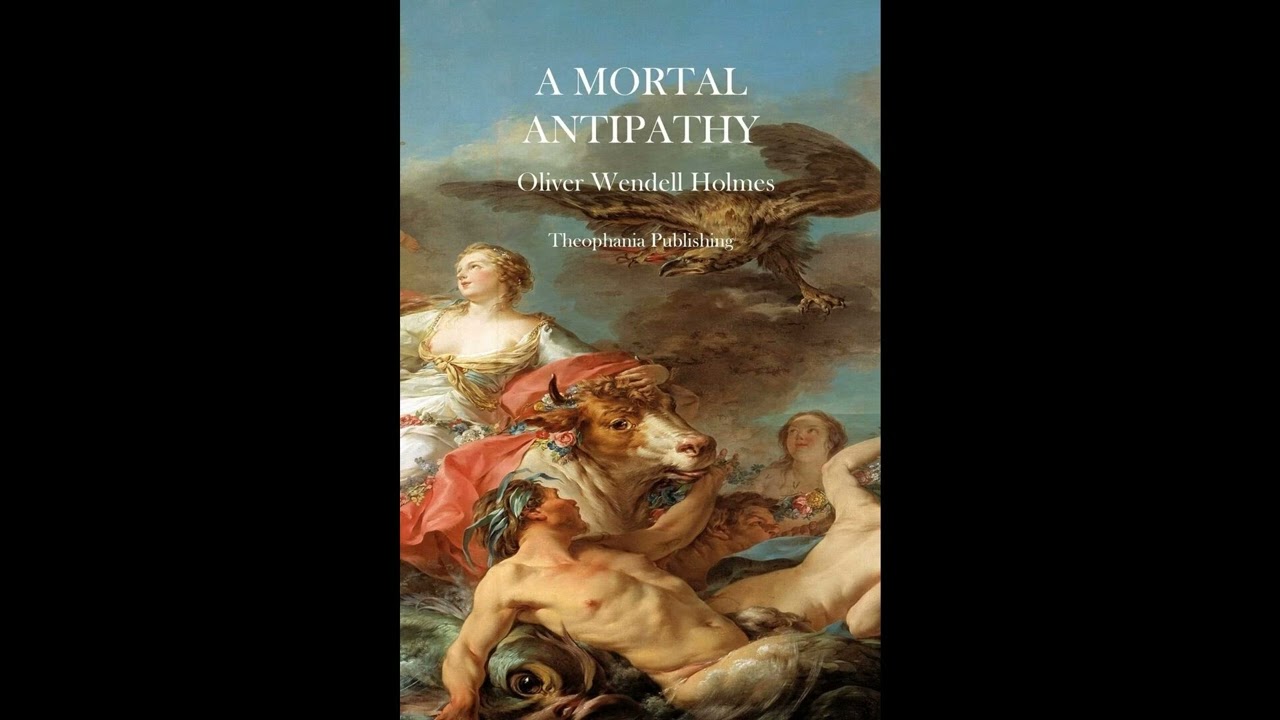
A Mortal Antipathy
In the annals of American literature, few novels dare to center their entire premise on a psychological anomaly as peculiar and pronounced as the one found in Oliver Wendell Holmes’s A Mortal Antipathy. First published in 1885, this often-overlooked work offers a rare window into the 19th-century mind’s grappling with the intricacies of human phobias, social anxieties, and the enduring power of early trauma. What happens when a young, otherwise intelligent and poised woman harbors an inexplicable, violent aversion to the very presence of other young women? How does society respond to such an oddity, and what does it reveal about the hidden mechanisms of our own minds? This is not merely a tale of an unusual affliction, but a thoughtful inquiry into identity, medicine, and the often-unseen forces that shape our deepest fears and affections, making it a compelling listen even today as we continue to probe the complexities of the human psyche. The story introduces us to Euthymia Tower, a woman of striking beauty and intellect, living in a quiet, somewhat secluded existence. From a very young age, Euthymia has suffered from a profound and debilitating "mortal antipathy"—a severe, visceral reaction to the proximity of other young women, particularly those near her own age. This aversion is not born of jealousy or malice, but manifests as a terrifying physical collapse, rendering her unconscious and threatening her very life. Her childhood, marked by this inexplicable condition, has been one of isolation and careful management by devoted guardians and concerned physicians. As she approaches womanhood, the urgency to understand and potentially alleviate her affliction grows, prompting various scientific and social efforts to unravel the mystery. Euthymia’s unusual predicament forms the core conflict of the story. Doctors and scientists are baffled, exploring both physiological and psychological explanations. Society, in its limited understanding, views her with a mixture of pity and morbid curiosity. The narrative follows attempts to integrate Euthymia into social circles, each effort fraught with danger and the potential for a catastrophic episode. We see her navigate a world that is ill-equipped to comprehend her suffering, and the emotional toll her condition takes on her spirit. Love interests emerge, complicating her already delicate existence, and the quiet drama of her attempts to live a normal life unfolds against the backdrop of her constant, silent battle. The story builds as the past, often obscured, begins to shed light on the origins of her antipathy, leading characters on a quest for discovery that promises either liberation or despair. The creator of this fascinating psychological drama was Oliver Wendell Holmes Sr. (1809-1894), a truly remarkable figure who balanced a distinguished career in medicine with an equally celebrated life as a man of letters. Born in Cambridge, Massachusetts, Holmes was educated at Harvard, earning his medical degree in 1836. He went on to become a professor of anatomy first at Dartmouth and then at Harvard Medical School, where he taught for decades. Beyond his scientific pursuits, Holmes was a prominent member of the "Fireside Poets," a group of popular 19th-century American poets from New England whose works were often read aloud by families. Holmes's literary contributions were diverse and impactful. He was a prolific essayist, best known for his "Breakfast-Table" series, which began with The Autocrat of the Breakfast-Table (1858). These works displayed his characteristic wit, keen observational skills, and his ability to blend scientific thought with philosophical musings and everyday life. He also penned other novels like Elsie Venner (1861) and The Guardian Angel (1867), both of which, like A Mortal Antipathy, often explored themes of heredity, environment, and psychological states. Holmes’s unique position as both a physician and a respected writer allowed him to bridge the gap between burgeoning scientific understanding and the unfolding human drama, carving out a distinctive niche for himself in American letters. A Mortal Antipathy enacts several compelling themes, reflecting Holmes's intellectual interests. Central among these is the theme of psychology and the unconscious. Long before the advent of modern psychoanalysis, Holmes was fascinated by the mind's less accessible regions. Euthymia's antipathy is not a conscious choice but an involuntary, deeply rooted reaction, suggesting the powerful influence of hidden mental processes. For instance, the descriptions of her sudden collapses, accompanied by specific physiological symptoms, point to a mind and body reacting to a stimuli beyond conscious control, echoing early ideas about psychosomatic conditions. Another key theme is the impact of early trauma and memory. The narrative strongly hints that Euthymia’s condition might stem from a forgotten or repressed childhood event. The characters’ attempts to unearth this past, through various means, highlight how deeply early experiences can imprint themselves on an individual, shaping their future fears and behaviors in profound, often indirect ways. The novel also grapples with societal response to deviance and the limitations of medical science in its era. Euthymia's condition renders her an outsider, forcing her family and community to constantly adapt to her needs. The various doctors and scientists who examine her represent the cutting edge of 19th-century medical thought, yet their tools and theories often prove insufficient. The book thoughtfully illustrates the blend of genuine concern, scientific curiosity, and sometimes intrusive observation that such an unusual case would elicit. Through Euthymia, Holmes raises questions about compassion, understanding, and the boundaries of what society considers "normal," while simultaneously acknowledging the nascent, often inadequate state of psychological and physiological knowledge during his time. Published in 1885, A Mortal Antipathy emerged during a fascinating period in American history and literature. The post-Civil War era was marked by rapid industrialization, burgeoning scientific advancements, and a growing interest in social and individual psychology. The Gilded Age saw a focus on material progress, but also a quiet undercurrent of intellectual curiosity about the human condition, often tinged with a degree of scientific rationalism. In the literary world, the dominance of Romanticism was slowly giving way to Realism, and Holmes, with his blend of romantic narrative elements and realistic (or proto-scientific) explorations of the mind, stood at an intriguing crossroads. There was a burgeoning fascination with nervous disorders, phobias, and the mind's mysterious workings, fueled by the evolving fields of neurology and psychology. Holmes, as a respected medical professional, was uniquely positioned to contribute to this discourse, weaving medical observations and psychological hypotheses into his fiction. His novels offered a way for the public to engage with complex scientific and social ideas through the accessible format of storytelling. Listening to A Mortal Antipathy as an audiobook offers a unique way to experience this distinctive work. The several hours of narration provide ample time to become immersed in Holmes’s meticulously constructed world. A skilled narrator can truly bring to life the intellectual discussions surrounding Euthymia’s condition, rendering accessible the scientific theories and medical terminology of the period. Listeners will appreciate the measured pace, allowing them to absorb Holmes’s precise prose and thoughtful characterizations. The dialogue, often peppered with Holmes’s characteristic wit and keen observation, gains an added layer of immediacy when performed. The audiobook format lends itself well to the unfolding mystery of Euthymia’s past and the subtle shifts in atmosphere as her story progresses, allowing the psychological tension to build gradually and drawing the listener into the heart of this curious and thought-provoking narrative.
Enjoyed A Mortal Antipathy? A few ways to support us
Audible & Amazon links are affiliate; we may earn a small commission at no extra cost.
About this production
Human narration by a volunteer reader from LibriVox.org, the public-domain audiobook project. LibriVox volunteers record literary works whose copyright has expired in the United States, releasing the resulting recordings into the public domain.
A Mortal Antipathy by Oliver Wendell Holmes. The underlying text is in the U.S. public domain. We do not republish any modern copyrighted edition, translation, or commentary.
The 4K cinematic visuals accompanying this audiobook are generated by an AI image model from prompts derived from the source text. No copyrighted photos, paintings, or stock footage are used. AI generation is disclosed on every video on our YouTube channel as required by YouTube's altered/synthetic content policy.
English subtitles are transcribed from the LibriVox recording with OpenAI Whisper. Translations into the 11 other supported languages are produced by Meta's NLLB-200 neural translation model. No human translator's copyrighted translation is used.
Questions about sourcing or rights? See our DMCA & Sourcing policy or contact us.
Enjoyed this audiobook?
If you'd like to own a copy of A Mortal Antipathy or hear a professionally produced edition, the links below help support free audiobook production at no extra cost to you.
As an Amazon Associate we earn from qualifying purchases. Audible / print links are affiliate.