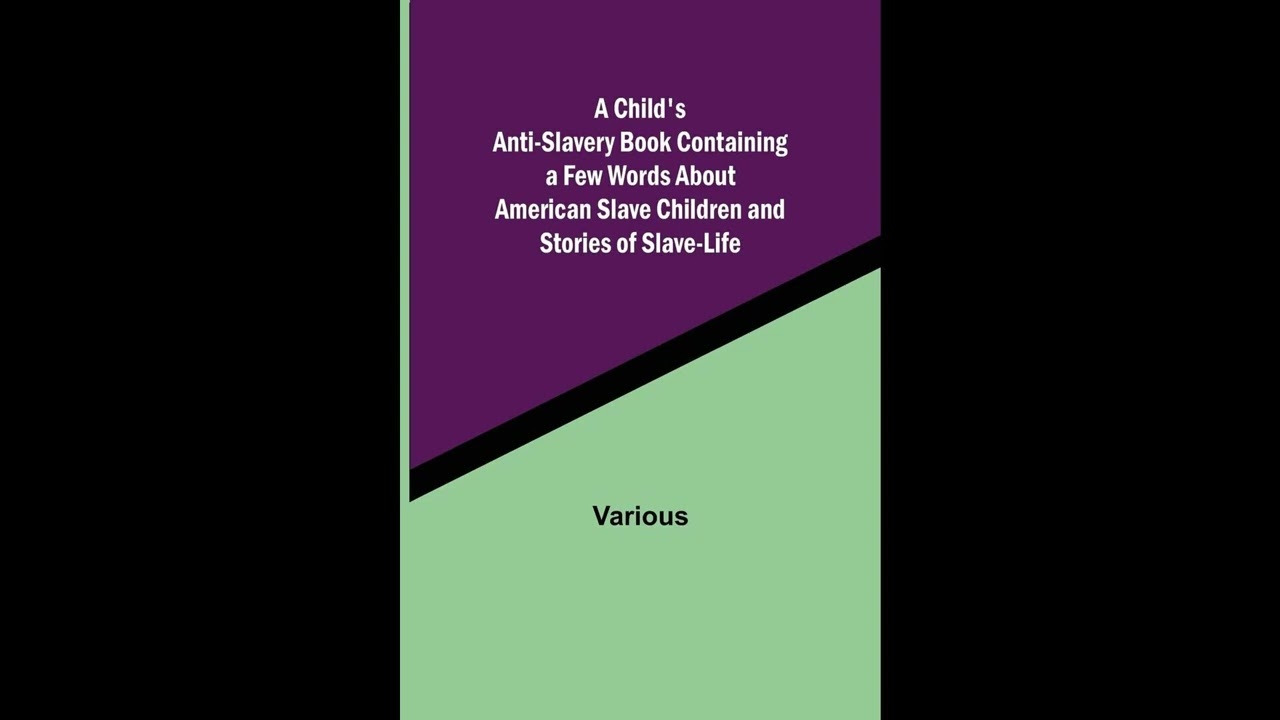
A Child's Anti-Slavery Book Containing a Few Words About American Slave Children and- Full Audiobook
Step into the urgent moral landscape of 19th-century America with A Child's Anti-Slavery Book Containing a Few Words About American Slave Children, a profound and affecting document from an era grappling with its gravest sin. This isn't merely a historical artifact; it remains a potent reminder of how empathy can be deliberately cultivated, how injustice can be dismantled through education, and how literature can become a weapon in the fight for human dignity. For listeners today, it offers an unparalleled opportunity to understand the foundational arguments of the abolitionist movement, not through abstract philosophy, but through the direct and often heartbreaking lens designed to awaken the conscience of a child. It forces us to confront uncomfortable truths about our past, making it an essential listen for anyone seeking to understand the enduring legacies of slavery and the persistent power of moral conviction. This book presents not a single, continuous narrative, but rather a series of carefully crafted vignettes, stories, and instructional lessons, all designed to illuminate the cruel realities of American slavery for a young audience. Set implicitly in the pre-Civil War South, it focuses on the lives of enslaved children, contrasting their grim existence with the presumed freedom and innocence of its young readers. The work introduces various archetypal figures: the young enslaved boy or girl, longing for a parent torn away; the master, whose arbitrary power dictates every aspect of another's life; and the compassionate observer, whose moral outrage drives the narrative's persuasive force. The central conflict lies in the stark contrast between the natural rights and inherent worth of every human being, regardless of race, and the dehumanizing system that denies these fundamental truths. The narrative arc of the book is one of gradual enlightenment and increasing moral urgency. It begins by establishing the basic facts of slavery, often through poignant, fictionalized accounts or perhaps real anecdotes, always rendered in language accessible to a child. Listeners will hear descriptions of the daily hardships endured by enslaved children—their lack of schooling, the arduous labor, the scarcity of food and adequate clothing. The stories emphasize the profound emotional toll of family separation, depicting mothers weeping for children sold away, and children yearning for parents they may never see again. Each segment builds upon the last, deepening the reader's understanding and emotional connection to the plight of the enslaved, culminating in a powerful, undeniable moral condemnation of the entire institution. The author of A Child's Anti-Slavery Book remains unknown, a common circumstance for many polemical or educational texts of its period. Anonymity in abolitionist literature served multiple purposes: it could shield the author from social ostracism, legal repercussions, or even physical danger in a time of intense sectional animosity. For a work designed for children, it might also have been a deliberate choice to elevate the message above any individual personality, allowing the moral truths presented to resonate as universal and unquestionable, rather than as the specific opinion of one person. The absence of a named author allows the "book" itself to become the collective voice of the movement, speaking directly and urgently without the filter of individual identity or reputation. This anonymity places the book squarely within a vital tradition of abolitionist publication that prioritized impact and reach over personal fame. Many anti-slavery pamphlets, articles, and even some powerful narratives of formerly enslaved people were circulated anonymously or under pseudonyms to maximize their influence and protect their creators. This work functions as part of a larger collective effort, reflecting the shared outrage and common persuasive strategies employed by various anti-slavery societies and activists. Its very existence is a testament to the fervent commitment of those who sought to dismantle slavery by educating the next generation, recognizing the profound power of shaping young minds to effect societal change. One of the primary themes running through A Child's Anti-Slavery Book is the inhumanity and moral corruption of slavery. The book enacts this through stark contrasts and emotional appeals. For example, it might describe a young enslaved boy forced to toil in the fields under a scorching sun, his skin raw and his spirit broken, immediately juxtaposing this with the imagined scene of a free child playing joyfully or attending school. Such a comparison is designed to highlight the fundamental injustice of denying basic childhood experiences and human dignity. Another prominent theme is the vulnerability and inherent worth of childhood. The text often presents children as pure and innocent, making their suffering under slavery all the more egregious and offensive to moral sensibilities. It might feature a scene where a child, too young to fully comprehend their fate, is torn from their mother's arms, illustrating the brutal disregard for familial bonds and the profound psychological damage inflicted upon the young. The book also operates heavily on the theme of moral education and the cultivation of empathy. Its very structure and simple, direct language serve as a pedagogical tool, aiming to instill compassion and a sense of justice in its youthful audience. It doesn't just present facts; it invites the reader to imagine themselves in the place of the enslaved child, fostering a deep emotional connection that compels a moral response. Finally, a significant undercurrent is the religious and spiritual imperative for abolition. While not overtly didactic in a purely theological sense, many abolitionist texts, including this one, drew upon shared Christian values to argue that slavery was a sin against God and an affront to humanity. The implicit message is often that freedom is a divine right, and upholding slavery is a transgression against sacred principles. This work emerged during a period of intense moral and political ferment in the United States, likely in the decades leading up to the Civil War. The mid-19th century saw escalating tensions over the expansion of slavery, with debates over issues like the Fugitive Slave Act and the Kansas-Nebraska Act dominating the national discourse. The abolitionist movement, though still a minority, was gaining considerable momentum, utilizing print media—pamphlets, newspapers, and books—as crucial tools for persuasion and activism. Culturally, there was a growing recognition of childhood as a distinct and sacred phase of life, making the exploitation of enslaved children a particularly potent rallying cry for the anti-slavery cause. This book represents a direct response to the need for accessible, emotionally resonant materials to educate the younger generation, countering prevailing pro-slavery sentiments and cultivating a moral opposition that would, eventually, lead to monumental societal change. It was a strategic publication, part of a broader effort to shape public opinion and recruit new adherents to the cause of freedom. Listening to A Child's Anti-Slavery Book as an audiobook offers a uniquely intimate and powerful experience. The several hours of narration allow for a sustained immersion into the perspectives and arguments of the abolitionist movement. A thoughtful narrator’s voice becomes the guiding force, articulating the often-heartbreaking vignettes and impassioned pleas with clarity and appropriate gravity. Listen for the deliberate pacing, designed to allow the emotional weight of each lesson or story to settle, rather than rush through the material. The voice of the narrator, free from visual distractions, becomes the embodiment of the anonymous author's moral purpose—earnest, empathetic, and unwavering in its condemnation of injustice. This auditory experience transforms the text from a historical document into a living, spoken testimony, providing a direct connection to the emotional and intellectual atmosphere of a pivotal moment in American history.
Enjoyed A Child's Anti-Slavery Book Containing a Few Words About American Slave Children and- Full Audiobook? A few ways to support us
Audible & Amazon links are affiliate; we may earn a small commission at no extra cost.
About this production
Human narration by a volunteer reader from LibriVox.org, the public-domain audiobook project. LibriVox volunteers record literary works whose copyright has expired in the United States, releasing the resulting recordings into the public domain.
A Child's Anti-Slavery Book Containing a Few Words About American Slave Children and- Full Audiobook. The underlying text is in the U.S. public domain. We do not republish any modern copyrighted edition, translation, or commentary.
The 4K cinematic visuals accompanying this audiobook are generated by an AI image model from prompts derived from the source text. No copyrighted photos, paintings, or stock footage are used. AI generation is disclosed on every video on our YouTube channel as required by YouTube's altered/synthetic content policy.
English subtitles are transcribed from the LibriVox recording with OpenAI Whisper. Translations into the 11 other supported languages are produced by Meta's NLLB-200 neural translation model. No human translator's copyrighted translation is used.
Questions about sourcing or rights? See our DMCA & Sourcing policy or contact us.
Enjoyed this audiobook?
If you'd like to own a copy of A Child's Anti-Slavery Book Containing a Few Words About American Slave Children and- Full Audiobook or hear a professionally produced edition, the links below help support free audiobook production at no extra cost to you.
As an Amazon Associate we earn from qualifying purchases. Audible / print links are affiliate.
More by Unknown
The Purple Land: Being The Narrative Of One Richard Lamb's Adventures In The Banda
Malayan Literature; Comprising Romantic Tales, Epic Poetry and Royal Chronicles
Old Testament Legends: Being Stories Out of Some of the Less Known Apocryphal Books