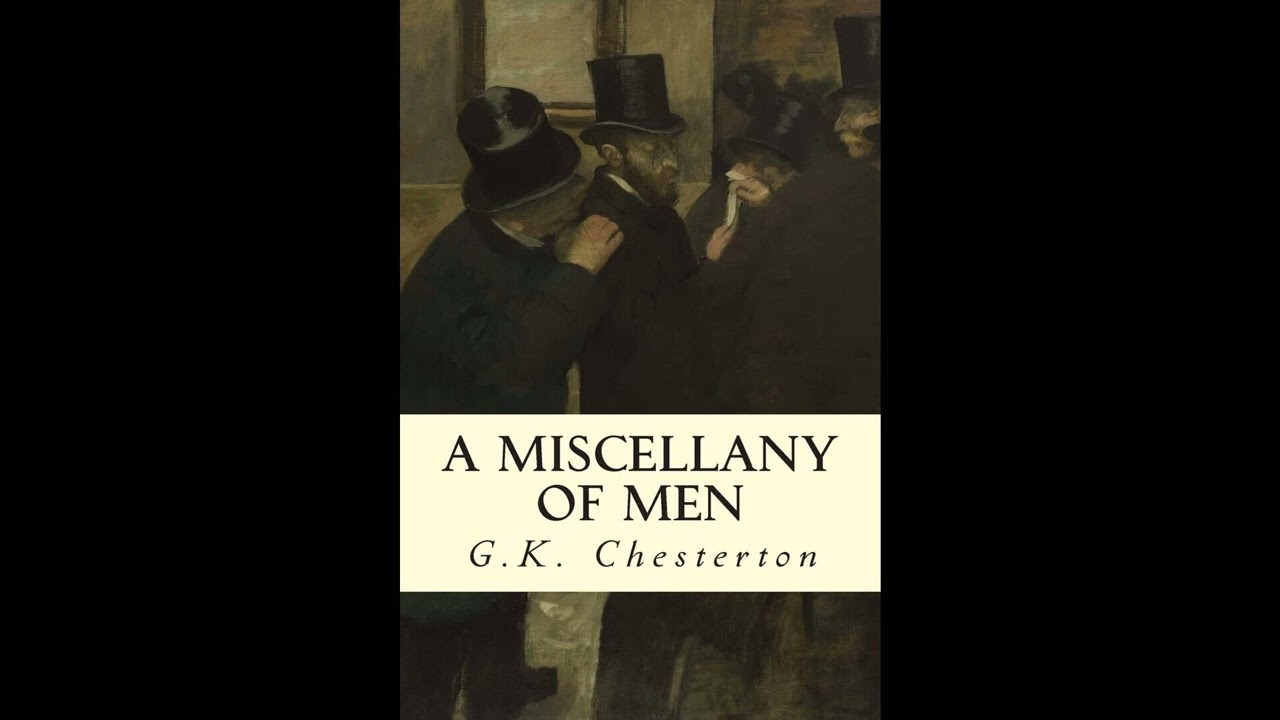
A Miscellany of Men
Step into the mind of a singular thinker, G.K. Chesterton, with "A Miscellany of Men," a vibrant collection of essays that tackles human nature, society, and the enduring questions of existence with unparalleled wit and insight. Far from being a dry academic treatise, this compilation bursts with Chesterton's characteristic paradoxes, keen observations, and robust common sense, offering a refreshing counter-narrative to the prevailing intellectual currents of his day—and ours. Published in 1912, these pieces are not mere historical relics; they confront anxieties and illusions that echo loudly in contemporary life, making them as essential for the modern listener grappling with complexity and confusion as they were for the Edwardian reader facing the dawn of a new, uncertain century. Prepare for an exhilarating intellectual ride that champions the ordinary, questions the fashionable, and consistently finds wonder in the everyday. While "A Miscellany of Men" does not present a single narrative plot in the traditional sense, it unfurls as a grand intellectual conversation, with Chesterton serving as the masterful host, introducing us to a gallery of human archetypes and ideas. Each essay is a carefully constructed argument, a miniature drama where prevailing assumptions are challenged, and overlooked truths are brought to light. The "characters" are not fictional individuals but rather the varied "men" of the title: from the "Architect of Spears," a poetic figure representing the primal urge to create or destroy, to the "Man with the Golden Star," who embodies the subtle complexities of the ordinary citizen. Chesterton does not merely describe these figures; he places them in a lively intellectual arena, examining their motivations, the societal forces that shape them, and the often-unseen contradictions within their roles. The central conflict animating these essays is Chesterton’s profound engagement with—and often playful debunking of—the intellectual fashions of his era. He sets himself against the prevailing tides of scientific materialism, moral relativism, and a certain kind of progressivism that he saw as stripping life of its essential joy and mystery. Through his incisive prose, he constantly redirects attention from abstract theories back to concrete reality, from intellectual arrogance to the wisdom of the common person. The "arc" of this collection is the gradual unveiling of Chesterton’s unique worldview, where paradox becomes a tool for clarity, humor a vehicle for profound truth, and seemingly simple observations blossom into deep philosophical statements, leaving the listener with a renewed appreciation for the often-underestimated sanity of the human spirit. Gilbert Keith Chesterton, born in London in 1874, became one of England's most prolific and recognizable literary figures of the early twentieth century. A towering man of immense physical presence, he matched his stature with an equally immense intellect and a boisterous, often joyful, approach to life and argument. His early career saw him working in publishing, but he soon turned to journalism and writing, quickly establishing himself as a formidable essayist, critic, poet, and novelist. Chesterton was a prominent public intellectual, frequently engaging in lively debates with contemporaries like George Bernard Shaw and H.G. Wells, often taking a contrarian stance against what he perceived as the intellectual fads of his day. His conversion to Catholicism in 1922 marked a significant turning point, deepening the theological and philosophical underpinnings that had always been present in his work. He became a leading voice for Christian apologetics, articulating a worldview that celebrated tradition, wonder, and the inherent goodness of creation. Beyond "A Miscellany of Men," his literary legacy includes the enduring Father Brown detective stories, the theological treatise "Orthodoxy," the fantastical novel "The Man Who Was Thursday," and the historical-philosophical survey "The Everlasting Man." Chesterton's distinctive style—characterized by its reliance on paradox, its robust common sense, and its deep moral conviction—secured his place as a unique and influential voice within the English literary canon until his passing in 1936. The essays within "A Miscellany of Men" deftly illuminate several core themes, inviting listeners to reconsider their own perspectives. One prominent theme is the paradox of common sense. Chesterton consistently shows how widely accepted ideas can mask fundamental absurdities, and conversely, how seemingly outlandish statements can contain profound truth. For example, in an essay like "The Architect of Spears," he might argue that the very act of designing a weapon—something seemingly destructive—reveals an underlying human creativity and intention, twisting our expectations about progress and destruction. He often championed the "man in the street" precisely because he believed ordinary people, unburdened by academic dogma, possessed an intuitive grasp of reality that intellectuals often overlooked. Another powerful theme is the defense of the ordinary and the democratic spirit. Chesterton found profound value in the everyday, in the things and people that are often dismissed as unremarkable. He saw the potential for heroism and deep meaning in the lives of average individuals and in the institutions of ordinary society. He celebrated the idea that a bricklayer or a baker held a dignity and importance that rivaled any king or philosopher. He also expressed a profound skepticism towards uncritical progress and abstract ideologies. He often critiqued what he saw as the detached, dehumanizing aspects of modern industrialism and intellectualism, arguing for a return to simpler, more human-scaled ways of thinking and living. His writings often act as a joyous intellectual wrestling match, demonstrating the pure delight and power in the art of argument and intellectual play, using humor and rhetorical flair to make his often-serious points both accessible and memorable. "A Miscellany of Men" emerged from the vibrant intellectual and cultural ferment of the Edwardian era, just prior to the seismic shock of the First World War. This was a period in Britain marked by rapid industrialization, burgeoning social movements such as women's suffrage, and a rising tide of scientific rationalism and secularism. Thinkers like H.G. Wells and George Bernard Shaw were advocating for utopian social engineering and questioning traditional morality, while evolutionary theory and psychology were challenging long-held beliefs about human nature. Chesterton, with his deep Christian convictions and his championing of tradition and paradox, stood as a robust counterpoint to these prevailing currents. His essays can be seen as a direct response to the intellectual climate that sought to categorize, rationalize, and often diminish the human spirit. He argued against a purely materialistic view of the world and warned against the dangers of intellectual arrogance and the loss of wonder. The book reflects a time of transition, a moment when the certainties of the Victorian age were giving way to the anxieties and new ideas of the twentieth century. Chesterton, far from being a nostalgic traditionalist, offered a radical defense of common sense and spiritual insight, positing that true progress lay not in abandoning fundamental truths but in rediscovering them with fresh eyes. Listening to "A Miscellany of Men" as an audiobook offers a uniquely immersive experience, perfectly suited to Chesterton’s oratorical style. His prose, so rich in rhythm and rhetorical flourish, truly comes alive when read aloud, allowing the listener to fully appreciate the ebb and flow of his arguments and the surprising twists of his paradoxes. A skilled narrator can bring out the inherent humor and the subtle, often ironic, undertones in Chesterton's voice, making his robust intellectual sparring feel like an engaging conversation. The several-hour run length makes it ideal for sustained, focused listening, whether during a long walk, a commute, or an evening spent in quiet contemplation. Pay attention to the narrator’s pacing, which should allow Chesterton's complex ideas and witty observations to properly sink in, transforming a static text into a dynamic performance that captures the very spirit of this extraordinary writer.
Enjoyed A Miscellany of Men? A few ways to support us
Audible & Amazon links are affiliate; we may earn a small commission at no extra cost.
About this production
Human narration by a volunteer reader from LibriVox.org, the public-domain audiobook project. LibriVox volunteers record literary works whose copyright has expired in the United States, releasing the resulting recordings into the public domain.
A Miscellany of Men by G.K. Chesterton. The underlying text is in the U.S. public domain. We do not republish any modern copyrighted edition, translation, or commentary.
The 4K cinematic visuals accompanying this audiobook are generated by an AI image model from prompts derived from the source text. No copyrighted photos, paintings, or stock footage are used. AI generation is disclosed on every video on our YouTube channel as required by YouTube's altered/synthetic content policy.
English subtitles are transcribed from the LibriVox recording with OpenAI Whisper. Translations into the 11 other supported languages are produced by Meta's NLLB-200 neural translation model. No human translator's copyrighted translation is used.
Questions about sourcing or rights? See our DMCA & Sourcing policy or contact us.
Enjoyed this audiobook?
If you'd like to own a copy of A Miscellany of Men or hear a professionally produced edition, the links below help support free audiobook production at no extra cost to you.
As an Amazon Associate we earn from qualifying purchases. Audible / print links are affiliate.