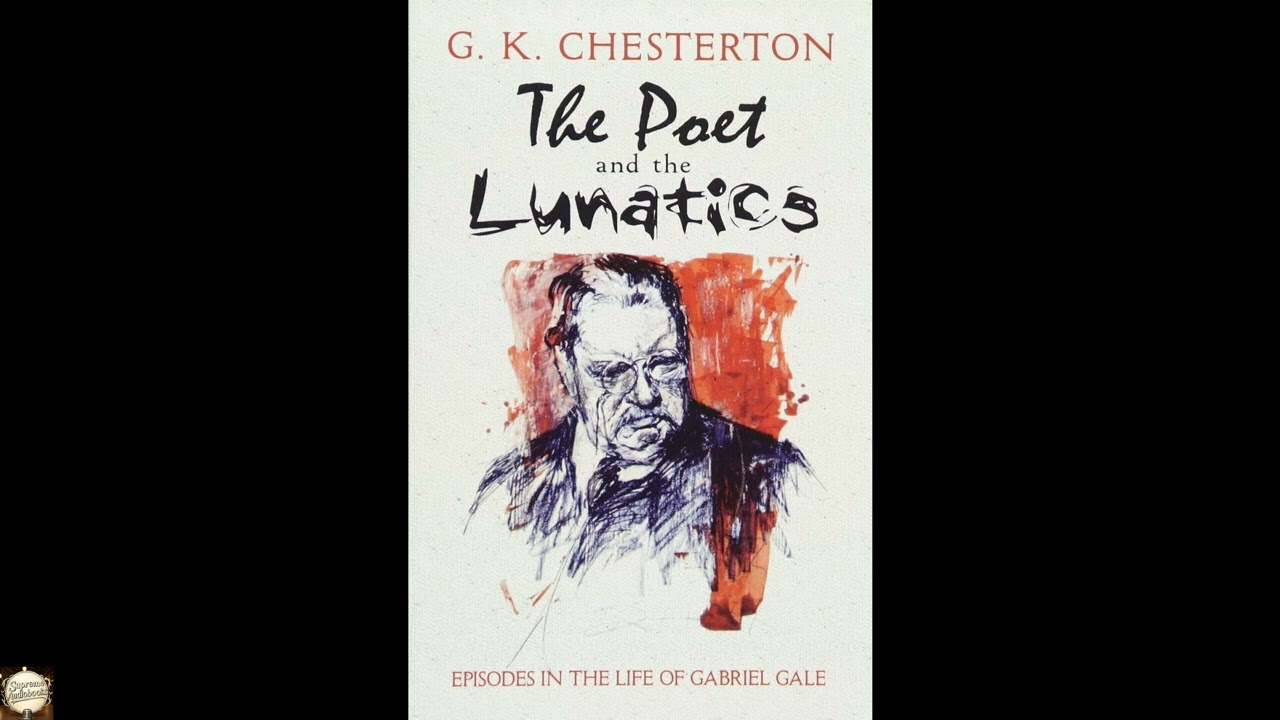
The Poet and the Lunatics
Step into a world where the line between genius and madness blurs, where the most outrageous pronouncements might hold the deepest truth. G. K. Chesterton's The Poet and the Lunatics is not just a collection of mysteries; it is a profound philosophical inquiry wrapped in delightfully eccentric tales, challenging us to question our own assumptions about sanity, reason, and the strange logic that underpins human behavior. At its core, this book asks whether conventional sanity is truly the only path to understanding, or if a certain glorious madness might sometimes illuminate what cold reason obscures. In an age saturated with information and competing narratives, Chesterton's unique brand of inquiry into what truly constitutes rationality remains as piercing and relevant as ever, inviting listeners to see the world—and its mysteries—through an entirely new lens. The story introduces us to Gabriel Gale, an unassuming poet who possesses an extraordinary gift for discerning the patterns in human behavior that others dismiss as mere insanity. He is not a detective in the traditional sense, relying instead on his vast imagination and an uncanny ability to empathize with the peculiar philosophies that motivate people, even those confined to asylums or acting in utterly baffling ways. The narrative unfolds as Gale finds himself entangled in a series of baffling events—accidents that defy explanation, disappearances shrouded in unreason, and seemingly motiveless crimes, many of which involve individuals perceived by society to be "lunatics" or wildly eccentric. From a mysterious death in a seemingly locked room to a bizarre incident involving a man convinced he is a tree, Gale navigates a landscape populated by vivid, often theatrical characters. Each episode presents a new riddle, a new challenge to conventional logic. Gale does not search for clues in the typical fashion of a policeman or a private eye; rather, he seeks to understand the "plot" behind the perceived madness, the peculiar and consistent worldview from which a seemingly irrational act might logically spring. His investigations move through London's intellectual circles and into the secluded, often unsettling environments of country estates and sanatoriums, creating an atmosphere that is both cozy and subtly disquieting. Listeners will find themselves drawn into Gale's unique method, where a poet's intuition proves more potent than a logician's deduction in uncovering the heart of a puzzle. The story's arc centers on this continuous questioning of perception, leading not to a single grand revelation, but to a series of illuminating insights into the human mind's capacity for both reason and astonishing deviation. G. K. Chesterton, the celebrated English writer, was born in London in 1874 and passed away in 1936. A prolific essayist, journalist, poet, novelist, and playwright, he left an indelible mark on English literature and thought. Chesterton was a towering figure in the Edwardian era and beyond, known for his robust wit, his masterful use of paradox, and his unwavering defense of common sense and traditional morality. He became widely recognized for his Father Brown detective stories, featuring a humble Catholic priest who solves crimes through psychological and theological insight rather than conventional deduction—a method not dissimilar to Gabriel Gale's. Beyond his fiction, Chesterton penned influential works of Christian apologetics like Orthodoxy and The Everlasting Man, which articulated his deeply held spiritual convictions. He also wrote social critiques such as The Napoleon of Notting Hill and The Man Who Was Thursday, novels that blended adventure with profound philosophical commentary. His conversion to Catholicism in 1922 marked a significant turning point in his life and work, deepening his engagement with theological themes. Often associated with the Catholic literary revival and the Distributist movement alongside his friend Hilaire Belloc, Chesterton cultivated friendships with many prominent intellectuals of his time, including George Bernard Shaw, with whom he maintained a famous lifelong debate. He remains a unique voice in the English literary canon, celebrated for his clarity of prose, his intellectual honesty, and his joy in the wonders of ordinary existence. The Poet and the Lunatics brilliantly enacts several profound themes. Foremost among them is the nature of sanity and insanity. Chesterton consistently shows how what society labels as madness often possesses an internal, if distorted, logic. For example, Gale encounters a man who insists on wearing several layers of clothes in sweltering heat. While this seems absurd, Gale uncovers a peculiar belief system where the man genuinely feels cold, illustrating that a "lunatic's" actions, though outwardly irrational, stem from a consistent, if detached, personal philosophy. This challenges the listener to consider the subjectivity of sanity. Another central theme is the power of imagination and paradox as tools for understanding truth. Gabriel Gale's poetic method is not about logical deduction but about imaginative empathy—placing himself within the unique worldview of the "madman" or the perpetrator. A situation where a series of "accidents" appear to be entirely random and unconnected baffles everyone but Gale. He uses his poetic mind to imagine a unifying, if eccentric, purpose behind them, seeing the paradox in their apparent randomness and discerning a deeper truth hidden in plain sight. This also connects to the limitations of pure rationalism, as Chesterton suggests that a purely scientific or materialistic lens often blinds one to the imaginative leaps and philosophical underpinnings that explain human behavior, especially its stranger manifestations. The book argues that true understanding often requires a leap of faith, or at least a leap of imagination, beyond the purely logical. This work emerged in the late 1920s, a period marked by profound societal shifts. The aftermath of the First World War left a generation questioning established norms and institutions, fostering a climate of intellectual ferment. New psychological theories, particularly those of Sigmund Freud, were gaining traction, prompting fresh examinations of the subconscious and the nature of mental illness. Alongside these developments, detective fiction was enjoying its "Golden Age," with authors like Agatha Christie and Dorothy L. Sayers captivating readers with intricate puzzles. Chesterton, while participating in this popular genre, consciously subverted its conventions. Rather than merely constructing a complex "whodunit," he infused his mysteries with a deeper philosophical questioning, using the framework of crime and detection to explore larger truths about reality, morality, and the human condition. His engagement with the modern world, while often critical of its more radical trends, was always thoughtful and deeply analytical. The Poet and the Lunatics reflects this historical moment, using the era's fascination with psychology and logical puzzles to deliver a uniquely Chestertonian blend of wit, wisdom, and profound contemplation. Listening to The Poet and the Lunatics as an audiobook offers a particularly immersive experience of Chesterton's distinctive prose. Spanning several hours, it provides an ideal companion for long commutes, contemplative walks, or simply relaxing at home. The pacing of Chesterton's arguments and the intricate dance of his paradoxes truly come alive when delivered by a skilled narrator. Such a performance can underscore the humor in his observations and the subtle gravity of his philosophical insights, allowing the listener to fully absorb the rhythm and music of his language. The nuanced voices of Gabriel Gale and the myriad eccentric characters, from bewildered conventionalists to brilliantly deluded figures, gain an added dimension through expert narration. This auditory presentation allows the listener to settle into the unique atmosphere of Chesterton's England, where every conversation might contain a surprising revelation and the most ordinary scene can suddenly brim with profound, even unsettling, meaning.
Enjoyed The Poet and the Lunatics? A few ways to support us
Audible & Amazon links are affiliate; we may earn a small commission at no extra cost.
About this production
Human narration by a volunteer reader from LibriVox.org, the public-domain audiobook project. LibriVox volunteers record literary works whose copyright has expired in the United States, releasing the resulting recordings into the public domain.
The Poet and the Lunatics by G. K. Chesterton. The underlying text is in the U.S. public domain. We do not republish any modern copyrighted edition, translation, or commentary.
The 4K cinematic visuals accompanying this audiobook are generated by an AI image model from prompts derived from the source text. No copyrighted photos, paintings, or stock footage are used. AI generation is disclosed on every video on our YouTube channel as required by YouTube's altered/synthetic content policy.
English subtitles are transcribed from the LibriVox recording with OpenAI Whisper. Translations into the 11 other supported languages are produced by Meta's NLLB-200 neural translation model. No human translator's copyrighted translation is used.
Questions about sourcing or rights? See our DMCA & Sourcing policy or contact us.
Enjoyed this audiobook?
If you'd like to own a copy of The Poet and the Lunatics or hear a professionally produced edition, the links below help support free audiobook production at no extra cost to you.
As an Amazon Associate we earn from qualifying purchases. Audible / print links are affiliate.