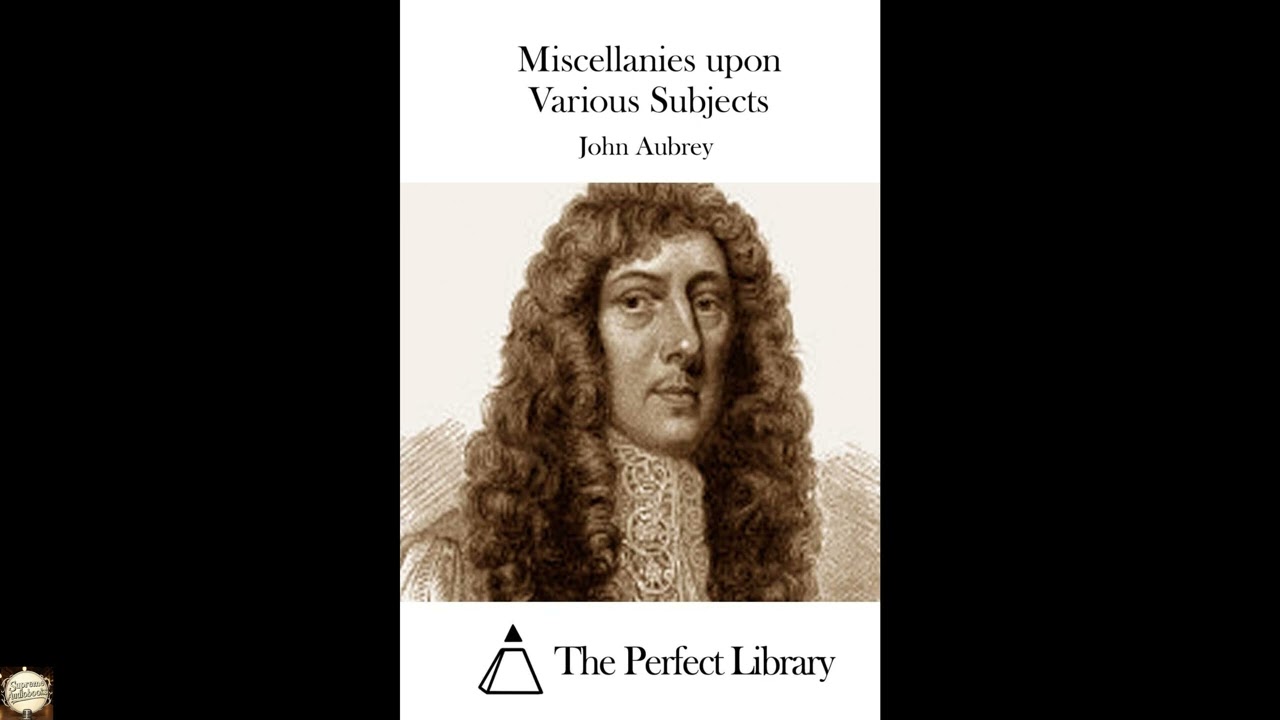
Miscellanies upon Various Subjects (Perfect Library)
Step into the twilight world of 17th-century England, a place where nascent scientific inquiry rubbed shoulders with deeply ingrained folk belief, and the boundaries between the natural and the supernatural were fluid and frequently blurred. John Aubrey's Miscellanies upon Various Subjects (Perfect Library) offers a uniquely intimate and utterly fascinating window into this very era. Far from a dry historical tome, this collection of observations, anecdotes, and curious reports serves as a proto-ethnographic record of human experience, delving into a world populated by omens, apparitions, prophetic dreams, and the strange power of sympathetic magic. It is a work that reminds us how deeply our ancestors grappled with the inexplicable, providing a direct connection to the human desire to find meaning in the mysteries of existence, a desire that resonates even in our hyper-rational present. This is not a story with a singular hero or a grand narrative arc, but rather a mosaic of human experience, a series of vignettes gathered from an age fascinated by wonders and portents. Aubrey acts as a diligent, if sometimes credulous, chronicler, presenting accounts of unexplained phenomena without necessarily vouching for their truth, yet clearly intrigued by their persistence in the collective consciousness. Listeners will find themselves immersed in a setting that stretches from the grand estates of the gentry to the humble cottages of the peasantry, largely across the English countryside that Aubrey knew so well. The "characters" are the myriad individuals whose strange encounters and unusual gifts form the substance of the book: those who claim to possess second sight, who experience vivid premonitions, or who report encounters with spectral figures. The central "conflict" running through these diverse accounts is the human mind's persistent effort to make sense of a world brimming with events that defied simple explanation. It is the clash between burgeoning rationality and ancient, deeply held superstitions. Aubrey meticulously records these instances—often from reputable sources he personally knew—cataloging them under headings like "Apparitions," "Omens," "Impulses," "Prophecies," and "Dreams." The "arc" of the collection builds not through a developing plot, but through the cumulative effect of these varied reports, gradually painting a comprehensive picture of a society that understood the universe not as a purely mechanical system, but as a place where hidden forces and unseen influences still held sway, subtly shaping destinies and revealing glimpses of a world beyond immediate perception. John Aubrey (1626–1697) was a remarkable English antiquary, natural philosopher, and writer, whose personal history mirrors the intellectual ferment of his time. Born in Easton Piers, Wiltshire, to a landed gentry family, Aubrey received his education at Trinity College, Oxford. His life was one of broad intellectual curiosity, though often marred by financial difficulties. He became an early member of the Royal Society, a prestigious group of pioneering scientists who championed empirical observation and systematic inquiry, a testament to his progressive scientific leanings. Yet, alongside his scientific affiliations, Aubrey retained a profound interest in older forms of knowledge, particularly folklore, biography, and local history. He is perhaps best known for his Brief Lives, a collection of lively, often gossipy, biographical sketches of his contemporaries, which offers unparalleled insight into the personalities and intellectual currents of 17th-century England. Aubrey's method involved extensive travel, meticulous note-taking, and a readiness to engage with people from all walks of life, eagerly collecting their stories and observations. His unique blend of rigorous documentation and an open-minded acceptance of the peculiar firmly establishes his place as a singular voice bridging the Renaissance humanists and the early Enlightenment thinkers. Miscellanies keenly demonstrates several enduring themes. One significant thread is the nature of belief and superstition in an age of transition. Aubrey records numerous examples of omens and apparitions, such as the widely believed significance of dogs howling before a death, or detailed accounts of ghostly appearances reported by credible witnesses. These aren't dismissed out of hand but are presented as phenomena worthy of record, reflecting a society where such beliefs were not confined to the uneducated but held sway across social strata. Another theme is the nascent stirrings of empirical observation against a backdrop of traditional folk knowledge. While Aubrey documents phenomena science could not yet explain, his act of categorization itself—listing different types of premonitions or visions—shows an early, if imperfect, attempt to systematically collect data, even if the "data" itself was often supernatural. His description of a "fatall impulse" felt by someone moments before a disaster suggests an attempt to classify subjective experiences, a precursor to psychological study. The book also underscores humanity's enduring fascination with the unknown. The sheer variety of strange occurrences, from vivid dreams that predict future events to the unexplained movements of objects, speaks to a universal human desire to peek behind the curtain of ordinary reality. Aubrey’s work shows how this curiosity manifested in a pre-scientific era. Furthermore, Miscellanies implicitly highlights the power of oral tradition and memory as carriers of knowledge and belief. Many of the anecdotes are explicitly presented as second-hand accounts, stories passed down through families or recounted by friends, emphasizing how information, belief, and local history were preserved and transmitted in a society less reliant on print. For example, stories of local spirits or specific family premonitions often had long lineages within their communities before Aubrey committed them to paper. Aubrey's Miscellanies emerged from a pivotal moment in English history—the latter half of the 17th century. This was the era of the Scientific Revolution, a period that saw the foundation of the Royal Society and the groundbreaking work of figures like Isaac Newton and Robert Boyle, who were establishing new paradigms of empirical investigation and rational thought. Culturally, England was recovering from the upheaval of the Civil War and the Restoration, a time of both intellectual ferment and social reordering. The work directly reflects the tension of this period: a new scientific worldview was taking hold, yet older ways of understanding the world—rooted in folk belief, superstition, and a more spiritual interpretation of nature—still exerted considerable influence. Miscellanies stands as a unique document born from this crossroads, where a scientifically minded individual found himself compelled to record phenomena that defied the very scientific principles he helped to champion, illustrating the slow, complex transition from one epistemic era to another. Listening to Miscellanies upon Various Subjects as an audiobook offers a singular experience. The episodic nature of Aubrey's observations, each often a brief, self-contained account, makes it perfectly suited for listening in segments, whether during a commute or a quiet evening at home. A skilled narrator can bring out the inherent wonder and occasional wry humor in Aubrey's tone, highlighting his blend of scholarly curiosity and open-minded acceptance of the unusual. The pacing can mirror the author’s own approach, presenting each curious report with a clarity that allows the listener to ponder its implications, transporting them directly into a 17th-century parlor or village green where these tales were originally exchanged. It allows the listener to appreciate the atmosphere of intellectual and cultural transition, hearing the echoes of ancient superstitions alongside the nascent voice of scientific inquiry.
Enjoyed Miscellanies upon Various Subjects (Perfect Library)? A few ways to support us
Audible & Amazon links are affiliate; we may earn a small commission at no extra cost.
About this production
Human narration by a volunteer reader from LibriVox.org, the public-domain audiobook project. LibriVox volunteers record literary works whose copyright has expired in the United States, releasing the resulting recordings into the public domain.
Miscellanies upon Various Subjects (Perfect Library) by John Aubrey. The underlying text is in the U.S. public domain. We do not republish any modern copyrighted edition, translation, or commentary.
The 4K cinematic visuals accompanying this audiobook are generated by an AI image model from prompts derived from the source text. No copyrighted photos, paintings, or stock footage are used. AI generation is disclosed on every video on our YouTube channel as required by YouTube's altered/synthetic content policy.
English subtitles are transcribed from the LibriVox recording with OpenAI Whisper. Translations into the 11 other supported languages are produced by Meta's NLLB-200 neural translation model. No human translator's copyrighted translation is used.
Questions about sourcing or rights? See our DMCA & Sourcing policy or contact us.
Enjoyed this audiobook?
If you'd like to own a copy of Miscellanies upon Various Subjects (Perfect Library) or hear a professionally produced edition, the links below help support free audiobook production at no extra cost to you.
As an Amazon Associate we earn from qualifying purchases. Audible / print links are affiliate.