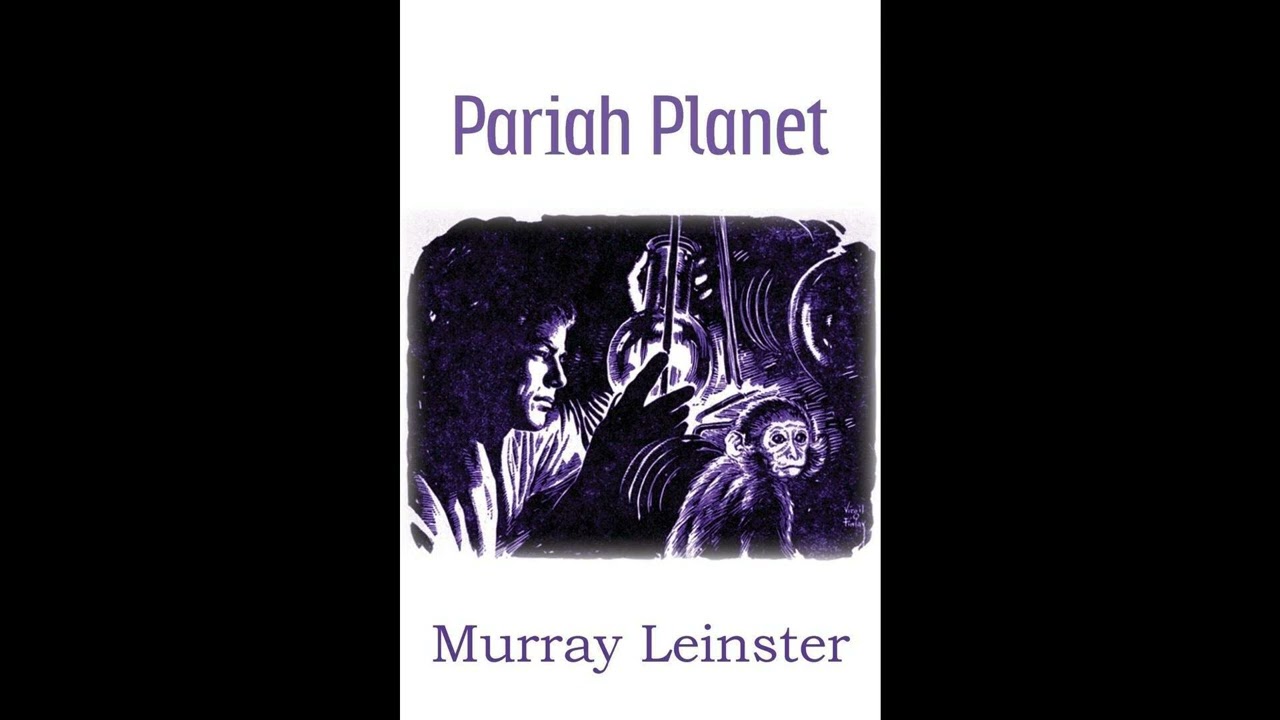
Pariah Planet
Among the foundational works of science fiction, Murray Leinster’s Pariah Planet stands as a compelling and often overlooked narrative that continues to resonate with contemporary audiences. This isn’t merely a tale of starships and alien worlds; it’s a penetrating look at the destructive nature of prejudice, the vital importance of cultural understanding, and the enduring human – or universal – quest for belonging. Written during an era of significant global change and expansion into space, Leinster’s vision of a galactic society grappling with its own biases offers a mirror to our present challenges, making the story as relevant today as when it first appeared. It invites us to consider how we perceive difference and what it truly means to be part of a larger community. The story drops us into a far-flung future where humanity has spread across the cosmos, forming a sprawling galactic federation. Yet, not all worlds are created equal in the eyes of this interstellar society. The planet Kith, isolated and misunderstood, bears the unenviable label of a "pariah planet," its inhabitants regarded with suspicion and disdain by the more "civilized" members of the federation. Into this fraught diplomatic landscape steps Varian, a keen and thoughtful agent from the Bureau of Interplanetary Relations. His mission: to investigate Kith, understand its peculiar customs, and determine if it can ever truly integrate into the larger galactic order. This seemingly straightforward assignment quickly devolves into a complex web of cultural clashes and ancient grudges. Varian finds himself caught between the condescending bureaucracy of the federation, which sees Kith as primitive and dangerous, and the proud, insular people of Kith, who have every reason to distrust outsiders. He grapples with the subtle nuances of Kithian social structures, their unique form of communication, and their deeply ingrained suspicion of those who judge them from afar. As Varian peels back the layers of Kithian society, aided by the intelligent and perceptive Leda, a native of the planet, he begins to question everything he thought he knew. He uncovers not a savage world, but one with its own complex moral code and deep-seated fears, a society that has adapted to its isolation in remarkable ways. The narrative builds tension as a larger, external threat begins to loom over Kith, forcing Varian to not only bridge cultural gaps but also to convince both sides that understanding, not condemnation, is their only path to survival. The author behind Pariah Planet was William Fitzgerald Jenkins (1896-1975), better known by his prolific pen name, Murray Leinster. Born in Norfolk, Virginia, Leinster was a true pioneer in speculative fiction, a writer whose career spanned more than half a century, touching nearly every facet of popular literature. He began writing in his teenage years, publishing his first story in 1916, and would go on to contribute hundreds of stories and dozens of novels across genres from adventure and mystery to westerns and science fiction. His remarkable output and consistent quality established him as a cornerstone of the Golden Age of science fiction. Leinster's contributions to the science fiction canon are particularly noteworthy. He is often credited with conceptualizing core science fiction tropes, such as the parallel universe in his seminal 1934 story "Sidewise in Time," and defining the "first contact" narrative with his celebrated 1945 novella of the same name. He won a Hugo Award in 1956 for "Exploration Team" and continued to produce groundbreaking work throughout his life. A meticulous craftsman, Leinster focused on plausible science and practical problem-solving, even while spinning tales of grand adventure. His work reflects a period of scientific optimism and imaginative possibility, making him a foundational figure whose influence can be traced through generations of science fiction writers. Pariah Planet effectively dramatizes several enduring themes, most notably that of prejudice and xenophobia. The galactic federation's dismissal of Kith, based on superficial differences and long-held biases, serves as a stark warning about the dangers of judging those we don’t understand. Varian's internal struggle to overcome his own preconceived notions, and his eventual advocacy for the Kithians, illustrates the potential for empathy to dismantle prejudice. We see this enacted through his initial, almost clinical observations of Kithian society, which gradually yield to genuine respect as he witnesses their ingenuity and resilience in the face of adversity, proving that "alien" doesn't equate to "inferior." Another central theme is the necessity of cultural understanding and diplomacy. Varian's mission is fundamentally one of bridge-building, an attempt to translate one culture's values to another. The story highlights the painstaking effort required to move beyond surface-level interactions and genuinely comprehend different ways of life. This is not just a challenge for the characters; it's an invitation for the listener to consider how readily we dismiss or misinterpret other cultures, even within our own world. The narrative underscores that true progress in any society, galactic or terrestrial, hinges upon a willingness to engage, learn, and adapt to diverse perspectives. Published in 1961, Pariah Planet emerged during a period of immense global change and technological advancement. The early 1960s were characterized by the intense rivalries of the Cold War, the thrilling — and often terrifying — advancements of the Space Race, and burgeoning civil rights movements across the globe. Yuri Gagarin had just become the first human in space, electrifying the world with possibilities. This climate fostered a fertile ground for science fiction, which frequently used futuristic scenarios to comment on contemporary anxieties and aspirations. Leinster's novel speaks directly to these currents, framing a narrative around questions of belonging, isolation, and the search for peaceful coexistence amidst difference. The concept of a "pariah" planet resonates with the era's discussions about decolonization, international relations, and the dangers of ideological divides. Leinster, with his keen sense of human nature projected onto a cosmic canvas, tapped into the prevailing hopes for interstellar community while simultaneously cautioning against the ingrained biases that could undermine it. The story's focus on an overlooked, marginalized society fighting for its place reflects a deeper cultural dialogue about justice and recognition. Listening to Pariah Planet as an audiobook offers a particularly immersive experience. The narrator's voice becomes the conduit to Leinster's richly imagined future, bringing to life the subtle inflections of bureaucratic agents, the alien cadences of Kithian dialogue, and the internal monologue of Varian as he grapples with his shifting perceptions. The run length, several hours, makes it an ideal companion for a series of commutes, dedicated listening sessions, or even a long afternoon of introspection. Listeners will appreciate the deliberate pacing characteristic of classic science fiction, which allows ample time to absorb the unique atmosphere of Kith and the thoughtful exposition of its customs. The clear, articulate dialogue pushes the narrative forward, making the cultural clashes and Varian's diplomatic efforts feel immediate and compelling, allowing the atmosphere of mystery and the gradual unveiling of Kith's true nature to unfold organically through sound.
Enjoyed Pariah Planet? A few ways to support us
Audible & Amazon links are affiliate; we may earn a small commission at no extra cost.
About this production
Human narration by a volunteer reader from LibriVox.org, the public-domain audiobook project. LibriVox volunteers record literary works whose copyright has expired in the United States, releasing the resulting recordings into the public domain.
Pariah Planet by Murray Leinster. The underlying text is in the U.S. public domain. We do not republish any modern copyrighted edition, translation, or commentary.
The 4K cinematic visuals accompanying this audiobook are generated by an AI image model from prompts derived from the source text. No copyrighted photos, paintings, or stock footage are used. AI generation is disclosed on every video on our YouTube channel as required by YouTube's altered/synthetic content policy.
English subtitles are transcribed from the LibriVox recording with OpenAI Whisper. Translations into the 11 other supported languages are produced by Meta's NLLB-200 neural translation model. No human translator's copyrighted translation is used.
Questions about sourcing or rights? See our DMCA & Sourcing policy or contact us.
Enjoyed this audiobook?
If you'd like to own a copy of Pariah Planet or hear a professionally produced edition, the links below help support free audiobook production at no extra cost to you.
As an Amazon Associate we earn from qualifying purchases. Audible / print links are affiliate.