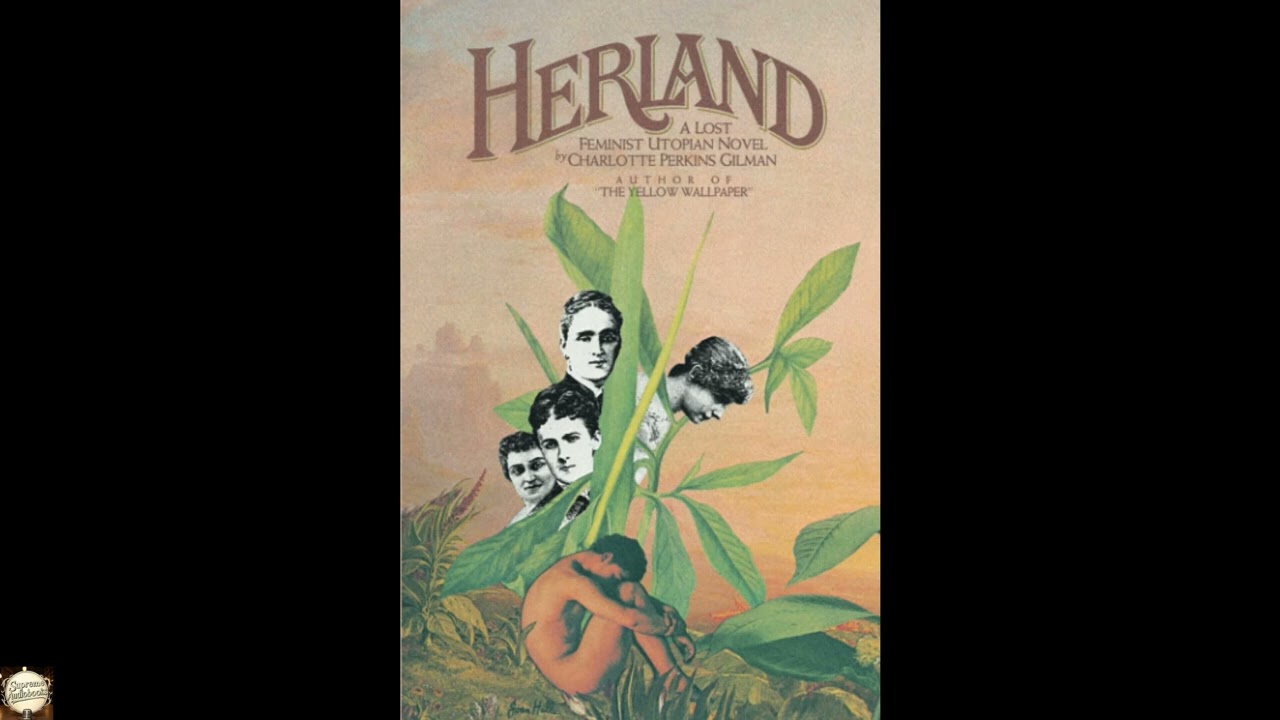
Herland
Imagine a world without men, a society forged entirely by women, where cooperation replaces competition, and the rearing of children becomes the central, revered purpose. Charlotte Perkins Gilman's visionary novel, Herland, invites listeners into just such a realm, a thought experiment that remains as startling and relevant today as it was over a century ago. This isn't just a story about a hidden land; it is a profound interrogation of gender roles, societal norms, and the very foundations of civilization, prompting us to reconsider what we believe about masculinity, femininity, and the potential for a truly egalitarian human existence. It's a book that sparks conversations, challenges assumptions, and holds up a mirror to our own world, asking uncomfortable but necessary questions about power, progress, and parenting. The story begins with three male American adventurers – Vandyck Jennings, a sociologist and our narrator; Terry Nicholson, a wealthy, overtly masculine thrill-seeker; and Jeff Margrave, a romantic idealist and doctor – determined to locate a mythical, isolated country rumored to exist deep within an uncharted jungle. Armed with a biplane and their own ingrained assumptions about "primitive" societies, especially those potentially run by women, they penetrate a formidable mountain range. To their astonishment, they discover not a struggling, backward tribe, but a highly advanced, meticulously cultivated landscape inhabited solely by women who have no knowledge of men. The men's initial reaction ranges from Terry's patronizing desire to "civilize" these women to Jeff's immediate idealization of them. Upon their arrival, the three men are quickly and efficiently subdued by the women of Herland, who exhibit surprising strength and organization. They are treated kindly but firmly, housed comfortably, and carefully studied by their female captors. As the men gradually learn the women's language and are introduced to their culture, they begin to unravel the mysteries of Herland's century-long existence without men. They discover a society rooted in communal child-rearing, an educational system designed for the common good, and an almost sacred veneration of motherhood, where lineage is traced solely through women. The Herlanders, in turn, are equally perplexed by the men's concepts of war, competition, individual ownership, and particularly, the foreign notion of romantic love as the basis for procreation. The cultural exchange becomes a humorous and often enlightening clash of worldviews, as the men's preconceived notions are systematically dismantled by a society that functions with remarkable efficiency, peace, and intelligence, absent any traditional male influence or intervention. Charlotte Perkins Gilman, born in Hartford, Connecticut, in 1860, was a pioneering American writer, lecturer, and social reformer whose life itself was a testament to her forward-thinking ideals. Her own experiences deeply informed her writing, particularly her struggles with postpartum depression after the birth of her daughter, Katharine, which she famously chronicled in her semi-autobiographical short story, "The Yellow Wall-Paper." This harrowing account of a woman's descent into madness while confined to a "rest cure" remains a chilling and powerful critique of Victorian medical practices and the suppression of women's intellectual and creative lives. Gilman, unconventional for her time, divorced her first husband, Charles Walter Stetson, in 1894, a decision that allowed her greater freedom to pursue her intellectual and activist calling. A prominent figure in the women's suffrage movement and an advocate for economic independence for women, Gilman lectured widely and published extensively. Her non-fiction works, such as Women and Economics (1898) and The Home: Its Work and Influence (1903), laid out her theories on how traditional gender roles confined women and impeded societal progress. She argued for collective solutions to domestic labor and childcare, believing that women's economic independence was crucial for their liberation. Herland, first serialized in her own magazine, The Forerunner, in 1915, represents a culmination of her ideas, presenting a fictional blueprint for a truly egalitarian and progressive society, reflecting her unwavering commitment to social justice and gender equality until her death in 1935. Herland enacts several crucial themes, chief among them the radical re-imagining of gender roles and the patriarchy. From the moment the men land, their expectations of women—as delicate, dependent, or even savage—are shattered. Terry, in particular, struggles to assert his dominance, only to find that the Herlander women are physically capable, intellectually astute, and utterly uninterested in his traditional male posturing. Their society runs on principles of cooperation and shared responsibility, demonstrating a potential path beyond the limitations of patriarchal structures. Another central theme is utopianism and social design. Herland presents a meticulously designed society focused on the collective good. Child-rearing is a communal endeavor, with children educated for specific, useful skills rather than individualistic competition. The men witness a society where the absence of warfare, poverty, and crime suggests that many ills traditionally attributed to human nature might, in fact, be products of specific social arrangements. The novel also illuminates the theme of motherhood and its societal value. In Herland, motherhood is not just biological; it is the sacred, guiding principle of their entire culture. Every woman is a "mother" in the broader sense, contributing to the well-being and education of all children. This elevates mothering from a private, domestic duty to a public, revered profession, contrasting sharply with the marginalization of motherhood often seen in patriarchal societies. Furthermore, a subtle but persistent theme of environmental harmony and sustainability emerges. The Herlanders have cultivated their land with great care, practicing sustainable agriculture and living in balance with their natural surroundings, suggesting an alternative to the exploitative relationship with nature often associated with industrial and male-dominated societies. The landscape itself reflects their peaceful, well-ordered existence. The early twentieth century, when Herland was written and published, was a period of immense social and political upheaval. The women's suffrage movement was reaching its peak in Western countries, with women actively campaigning for the right to vote and challenging traditional spheres of influence. The "New Woman" — an independent, educated, and often career-oriented woman — was a growing cultural phenomenon, prompting heated debates about female capabilities and women's roles outside the home. Gilman's novel emerged directly from this ferment, offering a speculative answer to the question: What would society look like if women were truly free to shape it? It was also a time when utopian and dystopian fiction gained traction as a means of social critique, allowing authors to imagine alternative futures or expose the flaws of existing systems, making Herland a vital contribution to this literary conversation. To experience Herland as an audiobook is to gain direct access to its unique voice and intellectual curiosity. The narrator, Vandyck Jennings, is a sociologist, and the audio performance brings to life his gradual shift from initial masculine bias and academic observation to a genuine sense of wonder and re-evaluation. Listeners can savor the conversational, often wry tone, which highlights the humor in the cultural misunderstandings and the profound insights gleaned through dialogue. The run length, several hours long, makes it ideal for a focused afternoon of listening, or for segments during daily commutes or while engaged in routine tasks. Pay attention to the subtle pacing, how the story unfolds the mysteries of Herland piece by piece, allowing you to absorb its revolutionary ideas alongside the bewildered but ultimately enlightened male protagonists, all conveyed through nuanced vocal characterizations that emphasize the distinct personalities of the three men and the calm wisdom of the Herlander women.
Enjoyed Herland? A few ways to support us
Audible & Amazon links are affiliate; we may earn a small commission at no extra cost.
About this production
Human narration by a volunteer reader from LibriVox.org, the public-domain audiobook project. LibriVox volunteers record literary works whose copyright has expired in the United States, releasing the resulting recordings into the public domain.
Herland by Charlotte Perkins Gilman. The underlying text is in the U.S. public domain. We do not republish any modern copyrighted edition, translation, or commentary.
The 4K cinematic visuals accompanying this audiobook are generated by an AI image model from prompts derived from the source text. No copyrighted photos, paintings, or stock footage are used. AI generation is disclosed on every video on our YouTube channel as required by YouTube's altered/synthetic content policy.
English subtitles are transcribed from the LibriVox recording with OpenAI Whisper. Translations into the 11 other supported languages are produced by Meta's NLLB-200 neural translation model. No human translator's copyrighted translation is used.
Questions about sourcing or rights? See our DMCA & Sourcing policy or contact us.
Enjoyed this audiobook?
If you'd like to own a copy of Herland or hear a professionally produced edition, the links below help support free audiobook production at no extra cost to you.
As an Amazon Associate we earn from qualifying purchases. Audible / print links are affiliate.