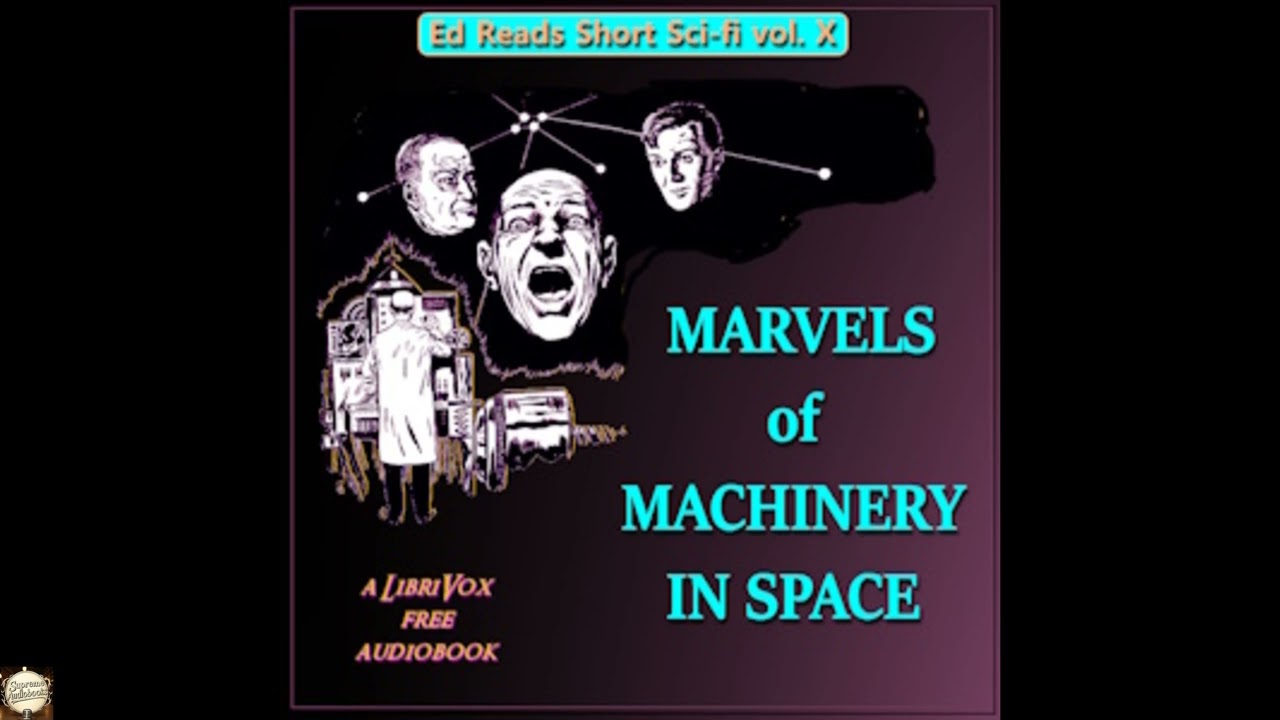
Marvels of Machinery in Space (Ed Reads Short Sci-fi, vol. X)
For those who gaze upon the night sky and feel a pull, a curiosity about what lies beyond our terrestrial sphere, Marvels of Machinery in Space offers a foundational vision. This foundational text, presented as part of the acclaimed "Ed Reads Short Sci-fi" series, is more than just an early work of speculative fiction; it is a meticulously imagined blueprint of humanity's nascent dreams of the cosmos, rendered with a technical precision that sets it apart from its contemporaries. It represents a pivotal moment when the grand adventure of space travel shifted from mythological fancy to engineering hypothesis, challenging its original readers—and now, its listeners—to consider the very real mechanics that might one day carry us to the stars. The story opens in the bustling, smoke-filled industrial heartland of a bygone era, where the formidable Professor Alistair Finch dedicates his life to a singular, seemingly impossible goal: transcending Earth's gravity. A man of formidable intellect and an uncompromising belief in human ingenuity, Finch toils away in his cavernous workshop, surrounded by blueprints, gears, and the nascent hum of his latest creation. His only companion in this obsessive pursuit is his steadfast assistant, young Thomas, whose initial skepticism gradually gives way to awe as Finch's contraption, a gleaming metallic sphere known as The Astrolabe, slowly takes shape. The initial chapters build a palpable sense of anticipation, detailing the mechanical challenges Finch faces—the precise calculations for propulsion, the stress tolerances of strange new alloys, and the sheer audacity of constructing a vehicle capable of leaving Earth. Their maiden flight, a clandestine affair under the cover of night, is a triumph of human will and scientific perseverance. Finch and Thomas ascend, leaving behind the familiar landscapes of Earth to witness its receding blue marble from an unprecedented vantage. Their destination is the Moon, not as a mythical realm, but as a scientific frontier. What they find there is not little green men, but the silence of a desolate, airless world, challenging their assumptions and forcing them to rely solely on the marvels of their own engineering to survive. The core conflict becomes one of adaptation and resourcefulness against an indifferent, hostile environment, testing their machine and their resolve to the very limits. Captain S. P. Meek, the author of this seminal work, remains a fascinating figure in the early annals of speculative literature. Born in the late nineteenth century, Meek’s formative years were spent amidst the burgeoning industrial might of the British Empire, a period that saw revolutionary advancements in engineering and naval technology. It is believed he served with distinction as a marine engineer, working on everything from steamships to early submarine designs. This practical, hands-on experience with complex machinery undoubtedly informed his meticulous descriptions of The Astrolabe, lending an air of authenticity to his most daring fictional creations. While detailed biographical records are scarce, anecdotes suggest he was a man of quiet demeanor but boundless imagination, often seen sketching elaborate mechanical designs in his notebooks during long voyages. Before Marvels of Machinery in Space secured his place, Captain Meek contributed technical articles to various engineering journals under pseudonyms and is rumored to have penned a lesser-known novel, The Subterranean Conveyance, a proto-steampunk adventure set deep beneath the Earth’s crust. His writings positioned him squarely within the tradition of scientific romance, a genre that sought to ground fantastical narratives in the plausible science of the day, standing alongside luminaries who imagined extraordinary voyages and futuristic inventions. Meek's contribution was unique in its dedication to the how – the gears, levers, pressures, and materials – making his fiction feel less like magic and more like an extension of contemporary engineering. At its heart, Marvels of Machinery in Space wrestles with several enduring themes. Primarily, it celebrates human ingenuity and the relentless drive to push the boundaries of what is known. Professor Finch is an embodiment of this spirit, a testament to the power of a single-minded vision against overwhelming odds. We see this acutely in the countless modifications and repairs Finch and Thomas must enact to keep The Astrolabe operational, each a small victory of intellect over adversity. Secondly, the book speaks to the profound sense of awe and isolation that accompanies true exploration. The descriptions of Earth shrinking into a distant orb, or the stark, unchanging lunar landscape, evoke a powerful feeling of both wonder at the universe's scale and the humbling solitude of being utterly detached from one's home world. A third theme concerns the limitations and triumphs of technology. While the machinery is presented as marvelous, it is never infallible. Breakdowns, resource scarcity, and the unforgiving vacuum of space constantly remind the characters—and the listener—that even the most advanced human creations are fragile when confronted with the vastness of the cosmos. Yet, it is precisely through the careful application and understanding of these machines that the protagonists persist. Finally, there's a subtle but palpable theme of the quest for knowledge for its own sake, a pure scientific drive that propels Finch beyond mere adventure or personal gain, emphasizing the intellectual reward of discovery. The period in which Marvels of Machinery in Space likely emerged was one of profound change and fervent optimism about the future. The late nineteenth and early twentieth centuries witnessed an explosion of scientific and industrial advancements: the harnessing of electricity, the invention of the automobile and the airplane, and the ongoing expansion of global communication networks. The world was shrinking, and horizons were expanding. Culturally, there was a widespread belief in progress and the idea that science could solve humanity's problems and unlock untold possibilities. This era, fueled by popular scientific lectures, world's fairs showcasing futuristic technologies, and a general fascination with invention, provided fertile ground for stories that imagined grand machines and impossible voyages. Marvels of Machinery in Space was a direct product of this atmosphere, reflecting both the era's boundless faith in mechanical solutions and a burgeoning public interest in astronomy and the potential for extraterrestrial travel. Listening to Marvels of Machinery in Space as an audiobook offers a unique and intimate way to experience this classic text. The several hours of narration provide ample time to settle into Captain Meek's detailed world, allowing the listener to truly appreciate the author's meticulous descriptions of the inner workings of The Astrolabe and the otherworldly vistas encountered. A clear, measured narration allows the scientific explanations to unfold with clarity, while also building the suspense of each new challenge faced by Professor Finch and young Thomas. One can visualize the turning gears, feel the tremor of the launch, and sense the profound quiet of space through the careful pacing and vocal interpretation. The dialogue, often formal and precise, provides a window into the intellectual rigor of the characters and the period, making it an ideal companion for focused listening or for an extended session that transports one back to the dawn of space-faring dreams.
Enjoyed Marvels of Machinery in Space (Ed Reads Short Sci-fi, vol. X)? A few ways to support us
Audible & Amazon links are affiliate; we may earn a small commission at no extra cost.
About this production
Human narration by a volunteer reader from LibriVox.org, the public-domain audiobook project. LibriVox volunteers record literary works whose copyright has expired in the United States, releasing the resulting recordings into the public domain.
Marvels of Machinery in Space (Ed Reads Short Sci-fi, vol. X) by Captain S. P. Meek. The underlying text is in the U.S. public domain. We do not republish any modern copyrighted edition, translation, or commentary.
The 4K cinematic visuals accompanying this audiobook are generated by an AI image model from prompts derived from the source text. No copyrighted photos, paintings, or stock footage are used. AI generation is disclosed on every video on our YouTube channel as required by YouTube's altered/synthetic content policy.
English subtitles are transcribed from the LibriVox recording with OpenAI Whisper. Translations into the 11 other supported languages are produced by Meta's NLLB-200 neural translation model. No human translator's copyrighted translation is used.
Questions about sourcing or rights? See our DMCA & Sourcing policy or contact us.
Enjoyed this audiobook?
If you'd like to own a copy of Marvels of Machinery in Space (Ed Reads Short Sci-fi, vol. X) or hear a professionally produced edition, the links below help support free audiobook production at no extra cost to you.
As an Amazon Associate we earn from qualifying purchases. Audible / print links are affiliate.