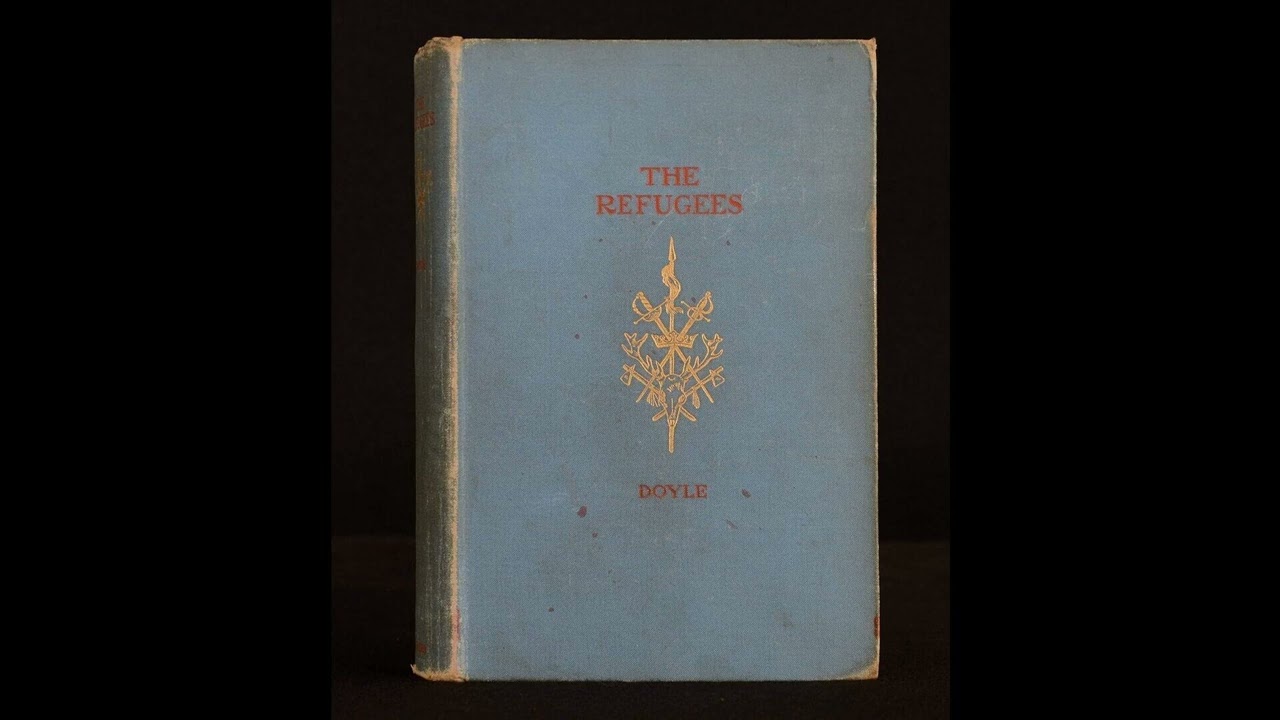
The refugees;: A tale of two continents
Beyond the celebrated detective stories and fantastical adventures, Arthur Conan Doyle, the literary giant, penned a lesser-known but equally compelling historical novel that resonates profoundly with present-day concerns. The Refugees: A Tale of Two Continents plunges listeners into a world where conviction dictates survival, where the promise of a new land offers both peril and profound hope. This is not merely a tale of the past; it is a vivid portrayal of displacement, religious persecution, and the enduring human spirit’s quest for freedom and sanctuary—themes that remain acutely relevant in our interconnected, often turbulent, modern world. It offers a powerful reminder of the courage required to stand for one’s beliefs and the resilience found when facing the unknown, making it a story that speaks directly to the heart of contemporary global challenges. The story begins in the glittering, yet increasingly dangerous, court of King Louis XIV in seventeenth-century France. We are introduced to Amory de Catinat, a young nobleman caught in the escalating persecution of the Huguenots, France’s Protestant minority. Amory, initially serving as a musketeer, finds his loyalties tested and his life threatened as the king’s decree to revoke the Edict of Nantes—a historical edict granting religious tolerance—looms large. He is tutored by the wise and steadfast Captain de la Noue, himself a devout Huguenot, who provides guidance and a moral compass amidst the court’s decadent intrigues and encroaching religious intolerance. When the inevitable crackdown comes, forcing Protestants to renounce their faith or face severe penalties, Amory, along with his mentor and other beleaguered coreligionists, must make the agonizing choice to abandon their homeland and seek refuge elsewhere. Their perilous escape from France marks the first major turn in the narrative, leading them across the treacherous Atlantic to the raw, untamed wilderness of colonial New York. Here, the struggle for survival takes on an entirely new dimension. The sophisticated political machinations of the French court are replaced by the stark realities of the American frontier: the ever-present threat of Native American tribes, the harsh demands of forging a life in an undeveloped land, and the complex relationships between the European settlers and the indigenous peoples, particularly the Mohawk Iroquois. Amory, accustomed to the structured life of a European courtier, must adapt quickly, learning the ways of the woods and navigating the delicate balance of diplomacy and conflict between the French, English, and various Native American nations, all vying for control of the vast North American continent. Sir Arthur Conan Doyle (1859-1930) was a Scottish physician and writer, whose life and career spanned the late Victorian and early Edwardian eras. Born in Edinburgh, he received a Jesuit education at Stonyhurst College before studying medicine at the University of Edinburgh, where he met and was influenced by Dr. Joseph Bell, whose powers of observation later inspired the iconic character of Sherlock Holmes. After a brief stint as a ship's surgeon and a struggling medical practice, Doyle turned to writing, quickly finding success with his historical adventure novels before achieving global fame with the creation of the brilliant consulting detective. While Holmes, first appearing in A Study in Scarlet in 1887, remains his most famous contribution to literature, Doyle’s literary output was remarkably diverse. He produced a series of acclaimed historical novels like Micah Clarke and The White Company, which demonstrated his meticulous research and gift for vivid period detail. He also authored scientific romances such as The Lost World, tales of chivalry, and later in life, became a prominent advocate for spiritualism. His place in the literary canon is secure not only as the progenitor of modern detective fiction but also as a versatile storyteller who brought historical eras and fantastical realms to life with equal skill, demonstrating a remarkable range far beyond Baker Street. The Refugees powerfully enacts several enduring themes, most notably that of religious persecution and the pursuit of freedom of conscience. The desperate flight of Amory and his fellow Huguenots from France, compelled to abandon their homes and heritage rather than renounce their faith, serves as a stark illustration of the devastating consequences of intolerance. A concrete scene demonstrating this is the hushed, clandestine meetings in Parisian attics, where families, including Amory’s, debate the impossible choice between conversion and exile, highlighting the profound personal cost of state-sanctioned religious oppression. The decision to cross an ocean, facing unknown dangers, rather than surrender one’s soul, speaks volumes about the human longing for liberty. Furthermore, the novel compellingly examines the theme of exile and adaptation to a new world. The arrival of the French refugees in the rough-hewn settlements of colonial New York forces them to confront a starkly different way of life. The challenges they face—from learning to navigate the dense forests and forging alliances with unfamiliar Native American tribes to enduring the rudimentary conditions of frontier existence—showcase their remarkable resilience. Amory’s journey, particularly, highlights the transformation from a courtly European to a pragmatic frontiersman, illustrating how individuals reinvent themselves when severed from their past and thrust into an alien environment, learning to survive through resourcefulness and an open mind. To understand The Refugees fully, it helps to place it within its historical and cultural moment. The novel was published in 1893, during the late Victorian era, a period marked by rapid imperial expansion and a keen interest in historical narratives. Conan Doyle, a meticulous researcher, was drawn to the grand sweep of history, and this work, like others of his, was rooted in significant past events. The core historical event underpinning the first part of the story is the 1685 revocation of the Edict of Nantes by King Louis XIV. This act unleashed a wave of persecution against the Huguenots, leading to a massive exodus of French Protestants who sought asylum in various Protestant nations, including England, Holland, and the American colonies. This mass displacement was a major historical trauma, and Doyle’s novel brings its human cost vividly to life. In the second half, the narrative shifts to late 17th-century colonial North America, specifically focusing on the tensions and interactions between the French, English, and the powerful Iroquois Confederacy in what is now upstate New York. This was a time of intense struggle for territorial and economic dominance, often involving complex alliances and devastating conflicts between European powers and Native American nations. Doyle’s depiction of figures like Governor Frontenac and the Mohawk warriors reflects the historical realities of this contested frontier, demonstrating his commitment to blending thrilling adventure with well-researched historical backdrop, characteristic of many popular novels of his time. Listening to The Refugees as an audiobook offers a particularly immersive and enriching experience. The spoken word breathes life into the diverse settings, from the hushed opulence of the French court to the stark, echoing expanse of the American wilderness. A skilled narrator can modulate voices to differentiate between the refined French nobility, the pragmatic English settlers, and the dignified tones of the Native American leaders, adding layers of authenticity and characterization that might be missed in silent reading. The "several hours" runtime makes it perfect for sustained listening, allowing the listener to truly settle into the story's rhythm—the suspense of the escapes, the deliberate pace of frontier life, and the dramatic confrontations. Pay attention to how the narration conveys the shift in atmosphere from the stifling fear in France to the dangerous freedom of the New World, and how the dialogue captures the nuanced social dynamics of both continents.
Enjoyed The refugees;: A tale of two continents? A few ways to support us
Audible & Amazon links are affiliate; we may earn a small commission at no extra cost.
About this production
Human narration by a volunteer reader from LibriVox.org, the public-domain audiobook project. LibriVox volunteers record literary works whose copyright has expired in the United States, releasing the resulting recordings into the public domain.
The refugees;: A tale of two continents by Arthur Conan Doyle. The underlying text is in the U.S. public domain. We do not republish any modern copyrighted edition, translation, or commentary.
The 4K cinematic visuals accompanying this audiobook are generated by an AI image model from prompts derived from the source text. No copyrighted photos, paintings, or stock footage are used. AI generation is disclosed on every video on our YouTube channel as required by YouTube's altered/synthetic content policy.
English subtitles are transcribed from the LibriVox recording with OpenAI Whisper. Translations into the 11 other supported languages are produced by Meta's NLLB-200 neural translation model. No human translator's copyrighted translation is used.
Questions about sourcing or rights? See our DMCA & Sourcing policy or contact us.
Enjoyed this audiobook?
If you'd like to own a copy of The refugees;: A tale of two continents or hear a professionally produced edition, the links below help support free audiobook production at no extra cost to you.
As an Amazon Associate we earn from qualifying purchases. Audible / print links are affiliate.