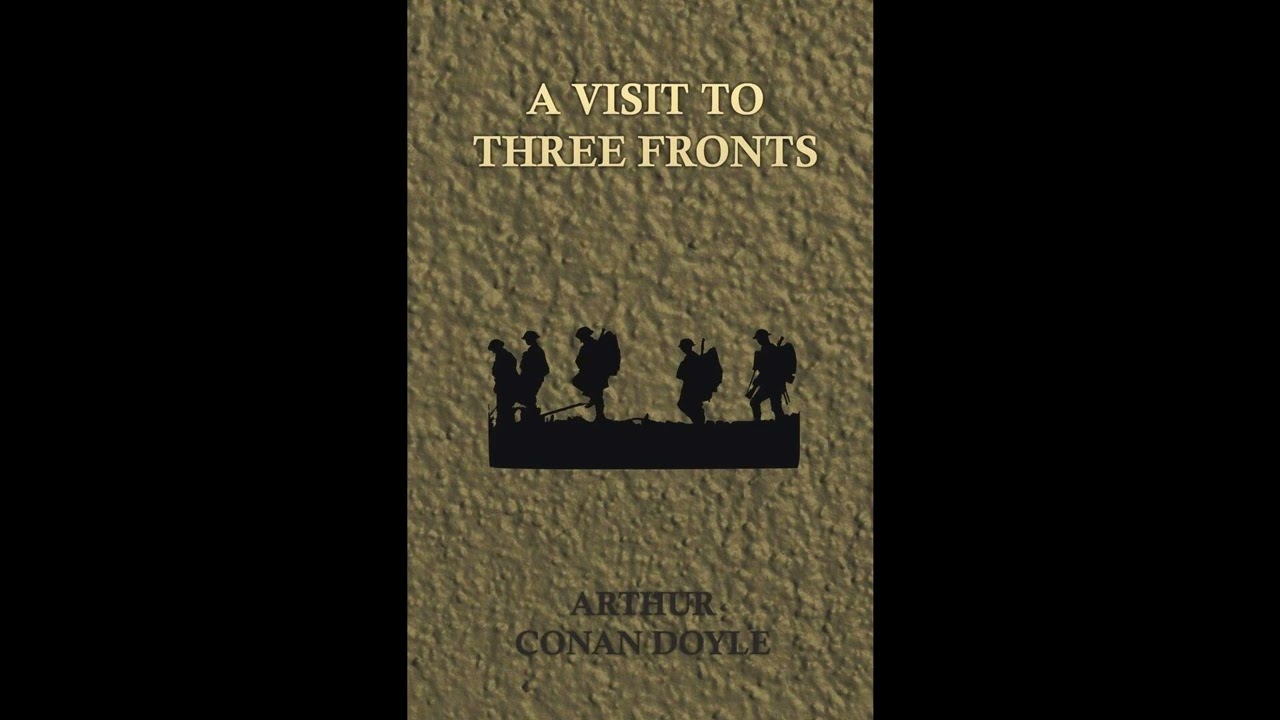
A Visit to Three Fronts
Forget the foggy streets of Victorian London, the baffling cases, and the keen mind of Sherlock Holmes. Picture instead the mud-soaked trenches, the distant thud of artillery, and the grim realities of the Great War. Arthur Conan Doyle, the celebrated author synonymous with the birth of modern detective fiction, steps away from the realm of imagination in "A Visit to Three Fronts" to offer a direct, eyewitness account of the conflict that reshaped the twentieth century. This isn't a thrilling mystery or a swashbuckling adventure; it is a vital historical document, a window into the mind of a prominent public figure grappling with the unprecedented scale of modern warfare, providing a perspective both immediate and profoundly reflective, offering insight into the human spirit under extreme duress that resonates powerfully even today. Doyle’s account opens as he, a civilian of considerable standing, gains extraordinary access to the front lines during the harrowing years of the First World War. He is not a combatant, but an observer granted a unique vantage point, moving through sectors held by Allied forces. His narrative unfolds as a series of candid observations, taking the listener into the heart of the conflict across different battle zones. He meticulously describes the logistical marvels supporting millions of fighting men, the makeshift hospitals teeming with the wounded, and the shattered landscapes bearing witness to industrial-scale destruction. The story arc follows Doyle’s physical and intellectual progression through these war zones. He reports on what he sees and hears, relaying conversations with generals and privates alike, noting the strategies, the morale, and the sheer endurance required from all involved. From the intricate network of trenches on the Western Front, where stalemate and attrition defined the daily struggle, to the formidable mountain positions of the Italian Front, where men battled not only opposing armies but also the cruelties of terrain and climate, Doyle records the specific challenges and unique character of each theater. His observations build a mosaic of wartime existence, focusing on the common soldier—their grim determination, their flashes of humor, and their unwavering sense of duty in circumstances that defy easy comprehension. The narrative captures the atmosphere of anticipation and dread, the moments of calm punctuated by bursts of horrific violence, without revealing the ultimate trajectory of the war itself, preserving the sense of a world caught in an unfolding, uncertain historical moment. Arthur Conan Doyle, born in Edinburgh, Scotland, in 1859, was initially trained as a physician, a profession that would profoundly influence his logical approach to storytelling. After studying at the University of Edinburgh, he practiced medicine, but his true calling soon asserted itself. He began publishing short stories in the 1880s, and his indelible contribution to literature arrived in 1887 with "A Study in Scarlet," which introduced the world to the eccentric, brilliant detective Sherlock Holmes and his steadfast companion, Dr. John Watson. This creation swiftly garnered immense popularity, solidifying Doyle's place as the progenitor of the modern detective story. Beyond the deductive brilliance of Baker Street, Doyle’s literary output was remarkably varied. He penned numerous historical novels, such as "Micah Clarke" and "The White Company," celebrated for their meticulous research and vivid re-creation of past eras. He also wrote science fiction, perhaps most famously the Professor Challenger tales, which began with "The Lost World," transporting readers to a hidden plateau where dinosaurs still roamed. Later in life, after the profound losses incurred during the First World War, including that of his son and brother, Doyle became a prominent advocate for spiritualism, dedicating a significant portion of his later years to lectures and writings on the subject. He was knighted in 1902 for his services to the Crown, particularly his work in a field hospital during the Second Boer War, showcasing his lifelong engagement with public affairs and military history, which would naturally draw him to observe the First World War. One of the central themes woven through "A Visit to Three Fronts" is the stark contrast between traditional notions of heroism and the industrial reality of modern combat. Doyle, an author accustomed to narrating chivalrous deeds and individual valor, finds himself confronted with a war of impersonal machinery and mass casualties. He recounts, for instance, the immense, almost invisible network of logistics that feeds and supplies armies of millions, demonstrating how the true heroism of this conflict often lay in the anonymous efficiency of countless support staff rather than the singular charge of a cavalryman. Another crucial theme is the enduring spirit of humanity amidst overwhelming destruction. Doyle often highlights the resilience and camaraderie of the soldiers, observing how small acts of kindness, shared jokes, or unwavering loyalty within a unit become vital lifelines. He might describe a scene in a dugout, where men, covered in mud and weary from constant shelling, still manage to share a laugh or a word of encouragement, illustrating how even in the most dehumanizing conditions, human connection perseveres. The book also grapples with the concept of truth and perception in wartime. As a writer for the public, Doyle was acutely aware of the need to bolster morale and convey a sense of purpose. Yet, his observations reveal the profound suffering and devastation, forcing him to navigate the delicate balance between reporting grim realities and maintaining a narrative that supported the Allied cause. He often speaks of the quiet determination in the eyes of the troops, framing their stoicism as a testament to their cause, rather than a mere resignation to fate. The inherent absurdity of conflict, too, emerges as a theme, visible in his descriptions of highly advanced technology used for unimaginable destruction, a poignant commentary on human progress and its capacity for self-annihilation. "A Visit to Three Fronts" emerged during a period of unprecedented global upheaval: the First World War itself, fought from 1914 to 1918. This was a conflict of previously unimaginable scale, involving vast conscript armies, new and devastating technologies like chemical warfare and tanks, and an entrenched system of trench warfare that led to immense casualties. Culturally and politically, Europe was gripped by intense nationalism, a pervasive sense of dread, and a constant flow of propaganda designed to maintain public support and vilify the enemy. Literary output of the time often served national interests, either through patriotic appeals or, increasingly, through early attempts to document the raw experiences of soldiers and civilians. Doyle's work fits into this immediate context, offering a perspective shaped by his status as a renowned public intellectual. His access was likely granted with the expectation that he would present an account that was both truthful and supportive of the Allied effort, offering a civilian's authoritative voice to articulate the war's challenges and the steadfastness of those fighting it, at a time when information from the front was heavily controlled and filtered. Listening to "A Visit to Three Fronts" as an audiobook offers a distinct and immersive experience. The length, spanning several hours, makes it an ideal companion for reflective periods—long walks, commutes, or focused listening sessions at home. A skilled narrator brings Doyle's observations to life, giving voice to his carefully chosen words, allowing the listener to absorb the detailed descriptions of the landscapes, the sounds of distant battle, and the nuances of conversations Doyle shares with officers and ordinary soldiers. The pacing of the narration can underscore the author's shifts from clinical observation to moments of profound human insight, from logistics to the psychological toll of war. Through voice and tone, the listener gains a deeper appreciation for the atmosphere Doyle encountered, feeling the weight of the historical moment and the humanity embedded in every scene, transforming a historical account into a deeply personal and resonant auditory experience.
Enjoyed A Visit to Three Fronts? A few ways to support us
Audible & Amazon links are affiliate; we may earn a small commission at no extra cost.
About this production
Human narration by a volunteer reader from LibriVox.org, the public-domain audiobook project. LibriVox volunteers record literary works whose copyright has expired in the United States, releasing the resulting recordings into the public domain.
A Visit to Three Fronts by Arthur Conan Doyle. The underlying text is in the U.S. public domain. We do not republish any modern copyrighted edition, translation, or commentary.
The 4K cinematic visuals accompanying this audiobook are generated by an AI image model from prompts derived from the source text. No copyrighted photos, paintings, or stock footage are used. AI generation is disclosed on every video on our YouTube channel as required by YouTube's altered/synthetic content policy.
English subtitles are transcribed from the LibriVox recording with OpenAI Whisper. Translations into the 11 other supported languages are produced by Meta's NLLB-200 neural translation model. No human translator's copyrighted translation is used.
Questions about sourcing or rights? See our DMCA & Sourcing policy or contact us.
Enjoyed this audiobook?
If you'd like to own a copy of A Visit to Three Fronts or hear a professionally produced edition, the links below help support free audiobook production at no extra cost to you.
As an Amazon Associate we earn from qualifying purchases. Audible / print links are affiliate.