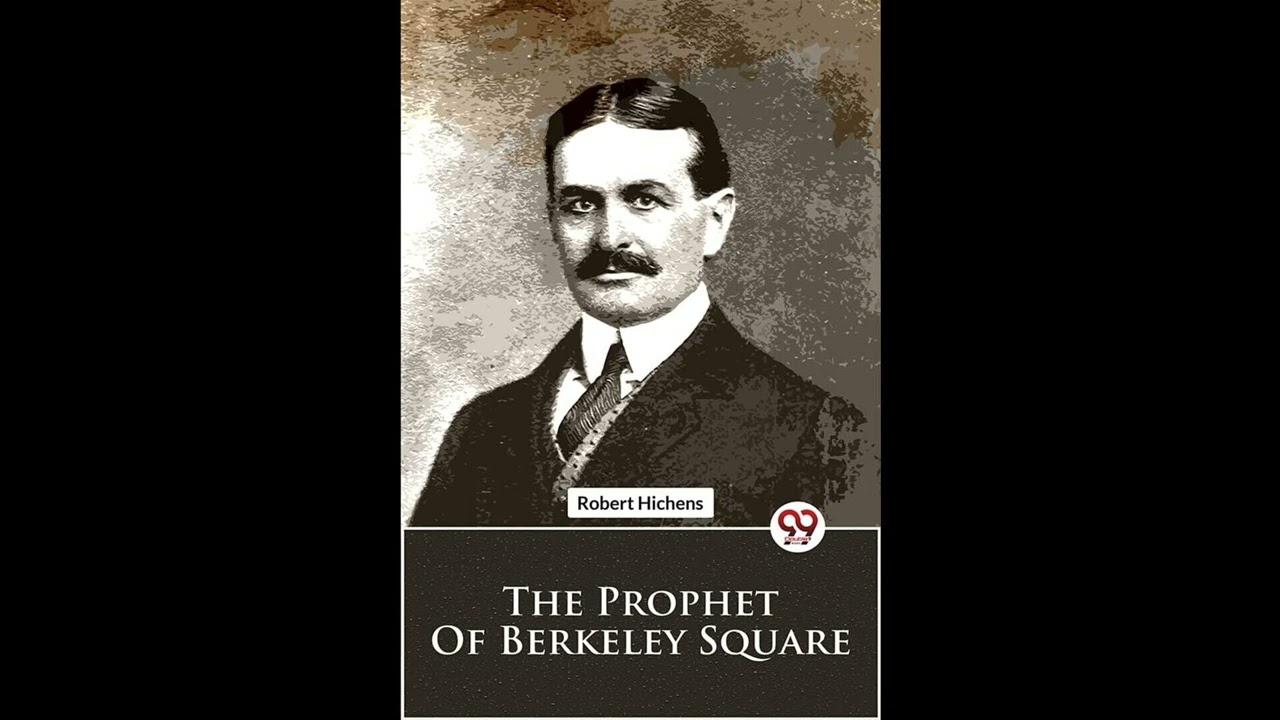
The Prophet Of Berkeley Square Robert Hichens Robert Hichens
Step into the charmingly bewildered world of Edwardian London, where drawing-room decorum clashes with the utterly inexplicable. Robert Hichens' The Prophet of Berkeley Square presents a delightful, subtly unsettling social satire that asks a single, humorous question: what if a perfectly conventional gentleman suddenly found himself cursed – or blessed – with the ability to foresee the most trivial of future events? This audiobook invites you to experience a unique blend of drawing-room comedy, gentle psychological observation, and a touch of the supernatural, all wrapped in the elegant prose of a writer keenly aware of human foibles. It’s a witty observation on how society reacts to anything out of the ordinary, a testament to our enduring fascination with the unseen, and a brilliant send-up of early twentieth-century pretensions that still resonates with comedic force today. Our protagonist is Mr. Hames, a man of settled habits and an altogether unexceptional life, residing in the genteel confines of Berkeley Square. His existence is one of predictable routines, polite society, and a distinct absence of drama. This placid state is shattered, however, when Mr. Hames begins to experience peculiar, unsolicited glimpses into the immediate future. These aren’t grand, world-altering prophecies, but rather inconvenient, often embarrassing premonitions: a servant spilling soup, a hat being blown off by an unexpected gust, or a guest making a particularly dull remark. Initially, he dismisses these flashes, attributing them to an overactive imagination or simple coincidence. As these minor prophetic visions persist and become undeniably accurate, Mr. Hames finds himself in an increasingly awkward predicament. His attempts to subtly avert these predicted mishaps often lead to even greater chaos or draw unwanted attention to his peculiar "gift." His meticulously constructed world of social propriety begins to unravel, as society, ever eager for novelty and prone to both credulity and ridicule, catches wind of his abilities. Friends and acquaintances, some genuinely curious, others openly skeptical, and many simply hoping to exploit his visions for their own trivial gains, descend upon him, transforming his once-peaceful life into a whirlwind of speculation and absurdity. The central conflict thus emerges: how can a man who simply wishes to remain invisible navigate a world determined to make him a spectacle, all while battling the relentless, trivial intrusions of his own prophetic mind? The author behind this clever invention was Robert Hichens, a prolific English novelist, short story writer, and music critic, born in Kent in 1864. The son of a clergyman, Hichens initially pursued a career in music, studying at the Royal College of Music before turning his talents to literature. His early life exposed him to both the earnestness of Victorian society and the burgeoning aesthetic movements that would later inform his satirical voice. He was known for his elegant prose and a talent for creating atmospheric settings, often drawing inspiration from his extensive travels. Hichens' literary breakthrough arrived with The Green Carnation in 1894, a daring satire that playfully lampooned Oscar Wilde and the Aesthetic movement, instantly making him a figure of considerable attention. While The Prophet of Berkeley Square maintains a lighter, more comedic tone, it showcases Hichens' consistent ability to observe and subtly critique societal norms. Throughout his long career, which spanned the late Victorian and Edwardian eras well into the mid-20th century, Hichens published over fifty novels, many of them bestsellers in their time, including The Garden of Allah (1904) and Bella Donna (1909), often set in the exotic locales of North Africa and Egypt where he spent significant portions of his life. He was a master of psychological thrillers, supernatural tales, and social commentaries, bridging the gap between traditional Victorian narrative forms and the more modern sensibilities emerging in the new century. At its core, The Prophet of Berkeley Square enacts several compelling themes, most notably the pervasive nature of social hypocrisy and the absurdity of human ambition. Hichens deftly uses Mr. Hames' trivial prophecies as a mirror, reflecting society's readiness to believe in the outlandish while simultaneously clinging to its rigid conventions. Consider, for instance, the scene where Hames predicts a particularly dull but essential socialite will praise a dreadful painting. His agonizing efforts to prevent this, only for it to happen anyway, underscore how easily people are swayed by superficialities and the comfort of the familiar. Another prominent theme is the unexpected burden of knowledge and foresight. Unlike the epic seers of mythology, Mr. Hames’s gift brings only irritation and social complication, rather than power or respect. His inability to prevent the minor annoyances he foresees highlights the futility of knowing the future when it concerns the inconsequential, emphasizing how even a modest supernatural ability can become a curse rather than a blessing in a mundane world. This gentle satire of precognition also sets up a brilliant contrast between the superficial appearance of society and the strange, inexplicable reality intruding upon it. The period in which The Prophet of Berkeley Square emerged, the early years of the twentieth century, was a fascinating time of transition. Known as the Edwardian era, it was a decade of apparent stability and flourishing wealth in Britain, yet it also hummed with underlying anxieties and nascent social changes that would soon explode with the First World War. Culturally, there was a growing fascination with the occult, spiritualism, and psychic phenomena, exemplified by the popular Society for Psychical Research. Hichens taps into this widespread curiosity about the unknown, but rather than treating it with earnestness, he imbues it with a light touch of mockery, satirizing both the credulity of believers and the rigid dismissiveness of cynics. The novel thus reflects a society grappling with the remnants of Victorian strictness and the dawning of a more modern, yet equally superstitious, age. Listening to The Prophet of Berkeley Square as an audiobook brings Hichens' sharp wit and elegant characterizations vividly to life. A skilled narrator can truly embody the gradual escalation of Mr. Hames's predicament, capturing his initial befuddlement, his growing exasperation, and the comedic timing inherent in his often-failed attempts to intervene with fate. The distinct voices of the various Edwardian social types—the gossips, the social climbers, the well-meaning but meddlesome friends—become palpable, enhancing the social satire. The carefully modulated pacing of the narration allows listeners to fully appreciate the novel’s subtle comedic build-up and the underlying atmosphere of drawing-room absurdity. This story, presented over several hours, offers a delightful and thoughtful escape into a bygone era, allowing the spoken word to illuminate the nuances of Hichens’ observations on human nature and the delightful chaos that ensues when the ordinary meets the extraordinary.
Enjoyed The Prophet Of Berkeley Square Robert Hichens Robert Hichens? A few ways to support us
Audible & Amazon links are affiliate; we may earn a small commission at no extra cost.
About this production
Human narration by a volunteer reader from LibriVox.org, the public-domain audiobook project. LibriVox volunteers record literary works whose copyright has expired in the United States, releasing the resulting recordings into the public domain.
The Prophet Of Berkeley Square Robert Hichens Robert Hichens by Robert Hichens. The underlying text is in the U.S. public domain. We do not republish any modern copyrighted edition, translation, or commentary.
The 4K cinematic visuals accompanying this audiobook are generated by an AI image model from prompts derived from the source text. No copyrighted photos, paintings, or stock footage are used. AI generation is disclosed on every video on our YouTube channel as required by YouTube's altered/synthetic content policy.
English subtitles are transcribed from the LibriVox recording with OpenAI Whisper. Translations into the 11 other supported languages are produced by Meta's NLLB-200 neural translation model. No human translator's copyrighted translation is used.
Questions about sourcing or rights? See our DMCA & Sourcing policy or contact us.
Enjoyed this audiobook?
If you'd like to own a copy of The Prophet Of Berkeley Square Robert Hichens Robert Hichens or hear a professionally produced edition, the links below help support free audiobook production at no extra cost to you.
As an Amazon Associate we earn from qualifying purchases. Audible / print links are affiliate.