Social Pictorial Satire
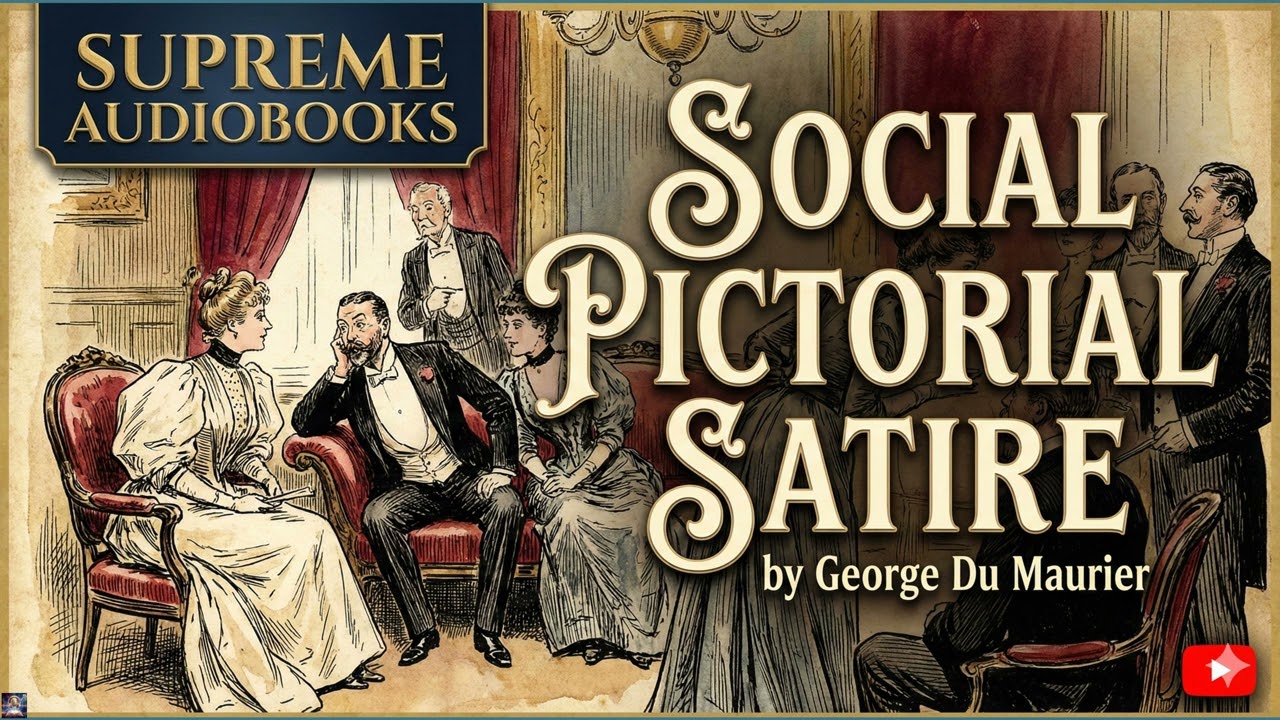
Step into the bustling, witty, and often absurd world of Victorian England with George Du Maurier's "Social Pictorial Satire," a brilliant collection of observations that remain strikingly relevant centuries after their initial publication. Far from a dry historical artifact, this work offers a dazzlingly clear window into the human condition, showcasing the eternal follies of fashion, class aspiration, and social maneuvering that continue to shape our interactions today. Du Maurier, a master of both visual and verbal wit, pulls back the velvet curtains of polite society to reveal the comical truths beneath, inviting us to laugh not only at the Victorians, but perhaps, gently, at ourselves as well. It’s a book for anyone who appreciates keen observation and the enduring humor found in human pretension and desire. While "Social Pictorial Satire" does not present a single linear narrative in the conventional sense, it unfolds as a grand, sweeping panorama of Victorian life, populated by an unforgettable cast of archetypal "characters" and scenarios. The setting is primarily the drawing-rooms, ballrooms, city streets, and seaside resorts of the British middle and upper classes, captured with an artist's eye for detail. Listeners will encounter the earnest but often ridiculous adherents of the Aesthetic movement, prone to dramatically gazing at sunflowers or discussing "utterly utter" beauty. We meet the perpetually flustered hostesses attempting to navigate the labyrinthine rules of social etiquette, and the young bachelors trying to make an impression with their tailored waistcoats and carefully cultivated nonchalance. The central "conflict" isn't one of heroes versus villains, but rather the amusing and sometimes poignant struggle between societal expectations and individual desires, between appearance and reality. Each vignette, each satirical sketch, presents a miniature drama: a disastrous dinner party where social gaffes abound, a young lady attempting to secure a suitable husband through calculated charm, or a family struggling to keep up with the ever-changing tides of fashion. The "story arc" thus becomes the accumulating insight into Victorian mores, charting the progress of a society obsessed with status, propriety, and the subtle art of "keeping up appearances," all through Du Maurier’s discerning and often very funny lens. George Du Maurier, born in Paris in 1834 to an Anglo-French family, possessed a unique perspective that profoundly shaped his contributions to art and literature. Despite early aspirations in chemistry, his true talent lay in drawing, a path he pursued with determination, studying art in Paris and Antwerp. A tragic accident in his late twenties led to the loss of sight in one eye, curtailing his career as a painter, but serendipitously guiding him towards illustration. He moved to London and quickly established himself, becoming a regular contributor to the hugely popular Punch magazine in 1864, where his sophisticated and often biting social cartoons became a weekly fixture for over three decades until his death in 1896. Beyond his prolific work for Punch, Du Maurier also enjoyed significant success as a novelist in his later years. His debut novel, Peter Ibbetson (1891), a fantastical tale of shared dreams, garnered critical praise. However, it was Trilby (1894), a story of an artist's model in Paris who falls under the hypnotic sway of the malevolent Svengali, that propelled him to international superstardom. Trilby became one of the bestselling novels of the era, creating a cultural phenomenon and cementing Du Maurier's place in the literary canon alongside his visual artistry. His bicultural background and deep understanding of both French bohemian life and English high society infused his observations with a rare blend of wit and empathy. Du Maurier's "Social Pictorial Satire" deftly weaves together several enduring themes, none more prominent than the rigid mechanics of social class and aspiration in Victorian England. Listeners will hear countless examples of individuals striving to climb the social ladder, often with comical results, such as the nouveau riche family desperate to imitate aristocratic manners but constantly betraying their origins with an ill-placed word or an overly showy display of wealth. This focus on class underscores the anxieties and aspirations that permeated society, a keen observation demonstrated through the subtle cues of language, dress, and domestic arrangements. Another core theme is the often-absurd nature of fashion and trends. Du Maurier’s observations on the Aesthetic movement are particularly memorable, lampooning its followers' affected poses, exaggerated admiration for beauty, and often superficial appreciation for art. He also keenly observes the defined roles and expectations for women, particularly in courtship and marriage, highlighting both their constrained agency and the subtle power they wielded within polite society. His work consistently points to the gap between outward performance and inner reality, revealing the universal human tendency towards posturing and the gentle hypocrisy required to navigate social conventions. This particular work emerged during the latter half of the nineteenth century, a period of immense change and consolidation for the British Empire. The Victorian era saw a dramatic expansion of the middle class, fueled by industrialization and global trade, leading to new social dynamics and increased disposable income. With this rising affluence came an intense preoccupation with social status, etiquette, and the careful display of respectability. Print culture flourished, and illustrated magazines like Punch became crucial barometers of public opinion and shapers of cultural commentary. Du Maurier's unique position as a leading illustrator for Punch allowed him to comment weekly on the evolving social landscape. His satire was perfectly timed to capture the anxieties and humorous contradictions of a society grappling with rapid change while clinging to strict traditions. He depicted the rise of suburban life, the increasing complexity of urban interactions, and the subtle shifts in gender roles that were beginning to challenge long-held norms. His work, therefore, serves not only as humor but as an invaluable social history, providing direct access to the cultural pulse of a bygone but foundational era. Listening to "Social Pictorial Satire" as an audiobook offers a unique opportunity to immerse oneself in Du Maurier's keen observations. While the original work is visually driven, a skilled narrator can bring his detailed descriptions and witty dialogue to life, transforming what were originally static illustrations and captions into a dynamic aural experience. The narrator's pacing will allow the listener to savor the gentle irony and sharp humor of each individual sketch, giving space for the clever turns of phrase and the nuanced depictions of character and setting to truly resonate. Expect voices that shift subtly to embody the array of Victorian types, from the flustered debutante to the pompous gentleman, creating an atmosphere that is both intimately conversational and grandly theatrical.
Enjoyed Social Pictorial Satire? A few ways to support us
Audible & Amazon links are affiliate; we may earn a small commission at no extra cost.
About this production
Human narration by a volunteer reader from LibriVox.org, the public-domain audiobook project. LibriVox volunteers record literary works whose copyright has expired in the United States, releasing the resulting recordings into the public domain.
Social Pictorial Satire by George Du Maurier. The underlying text is in the U.S. public domain. We do not republish any modern copyrighted edition, translation, or commentary.
The 4K cinematic visuals accompanying this audiobook are generated by an AI image model from prompts derived from the source text. No copyrighted photos, paintings, or stock footage are used. AI generation is disclosed on every video on our YouTube channel as required by YouTube's altered/synthetic content policy.
English subtitles are transcribed from the LibriVox recording with OpenAI Whisper. Translations into the 11 other supported languages are produced by Meta's NLLB-200 neural translation model. No human translator's copyrighted translation is used.
Questions about sourcing or rights? See our DMCA & Sourcing policy or contact us.
Enjoyed this audiobook?
If you'd like to own a copy of Social Pictorial Satire or hear a professionally produced edition, the links below help support free audiobook production at no extra cost to you.
As an Amazon Associate we earn from qualifying purchases. Audible / print links are affiliate.